
Rediscovering Japan
Rediscovering Japan
Travel (JAXA Tsukuba/Sekiyado/Metropolitan Outer Area Underground Discharge Channel Part 3 (Metropolitan Outer Area Underground Discharge Channel)
by tomizuta
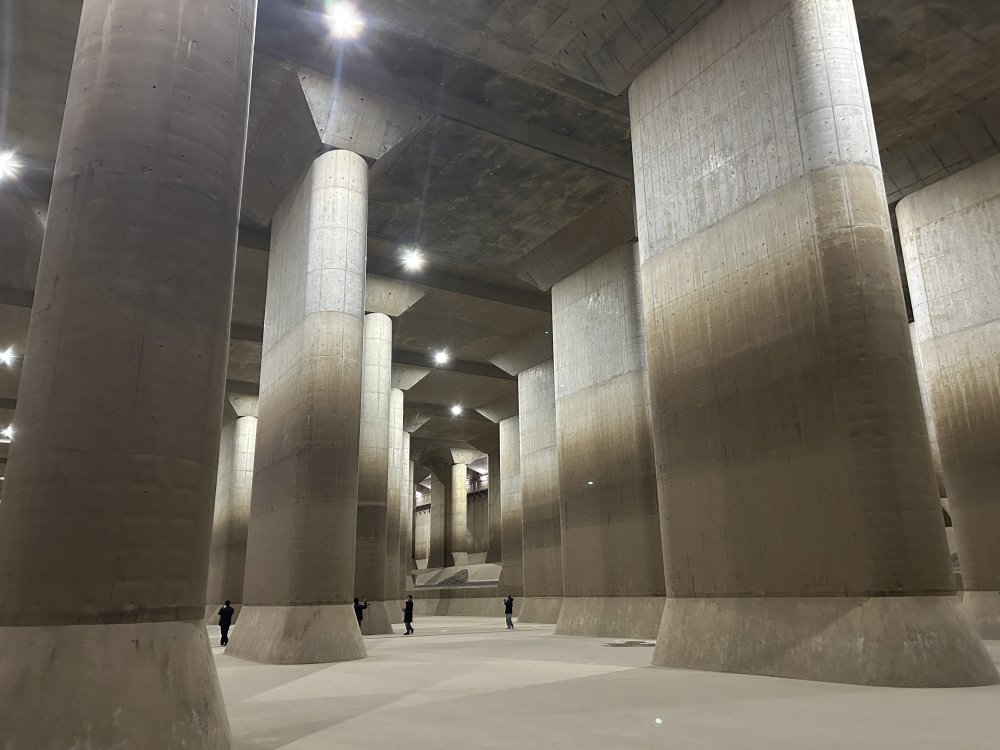
This space, about 20 meters underground and widely known as the “Underground Temple,” is in fact a massive pressure-adjusting water tank. During heavy rainfall, floodwater from several rivers to the west is diverted into a single underground tunnel more than 6 kilometers long and temporarily stored here, before being released via the drainage facilities visible at the far end of the photo.
The Metropolitan Area Outer Underground Discharge Channel is located on elevated ground along the eastern bank of the Edo River, south of Sekiyado (please see Part 2). We arrived at around 1:00 p.m. and first set out to locate the tour reception area. Following the road signs, we parked in the designated lot, but the brown building in front of us was labeled Showa Drainage Pump Station. At first, we were unsure where RyuQkan—the visitor center where tours are registered—was located. Only after noticing a small sign on an automatic sliding door at the entrance did we realize that the reception was inside the same building. Upon entering, the reception desk was immediately to the left. (There are countless photos of the famous “underground temple,” but surprisingly few that show the exterior of RyuQkan itself.)
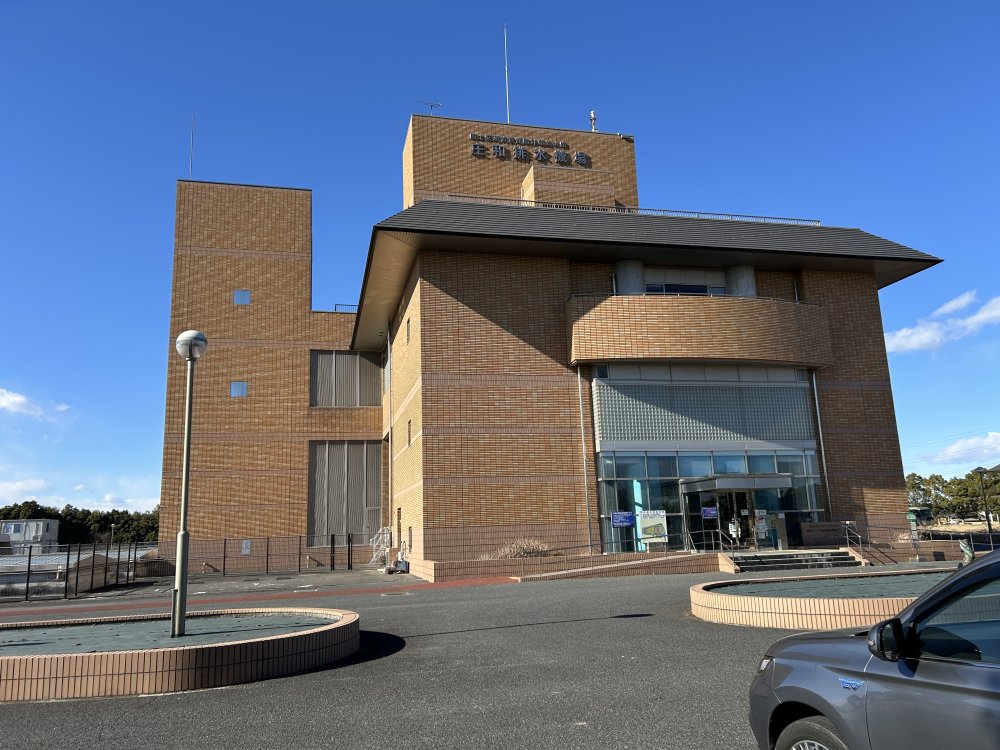
The first building visitors see after entering the Metropolitan Outer Area Underground Discharge Channel site. The prominent sign reads “Metropolitan Outer Area Underground Discharge Channel, Ministry of Land, Infrastructure, Transport and Tourism,” which can briefly make it unclear where RyuQkan is located; a small sign for RyuQkan becomes visible only when approaching the entrance, confirming that this is the correct building for the tour.
At the reception desk, I asked, “I have a reservation for the 3:00 p.m. tour—would it be possible to switch to the 2:00 p.m. tour if there is availability?” The reply was, “There is space, but the content of the tour is different from the 3:00 p.m. course.” The Metropolitan Outer Area Underground Discharge Channel offers several different guided tours, each with its own route, duration, and fee. Some courses require special equipment such as wading boots and involve climbing up and down stairways. As this was my first visit, I had deliberately booked the most straightforward option—the “Underground Temple Course,” which consists of an explanatory panel session in the first-floor lobby followed by a visit to the pressure-adjusting water tank. Given that the alternative course sounded more physically demanding and time-consuming, I decided to keep my original reservation. With time to spare, we went out to find lunch nearby. There is no cafeteria either inside the facility or in its immediate vicinity, so we drove about ten minutes south to a restaurant along National Route 16. While eating, I received a phone call from the facility: “You have a reservation for the 2:00 p.m. tour, but you haven’t arrived, so we’re calling to check.” I had mistakenly thought I had booked the 3:00 p.m. tour, when in fact it was the 2:00 p.m. slot. After explaining the situation, I asked whether it might be possible to change to the 3:00 p.m. tour. The staff replied, “That course takes nearly two hours, includes a visit to the vertical shaft, and the fee is higher—would that be acceptable?” Having come all this way, it seemed pointless to turn back, so I asked them to switch us to the 3:00 p.m. course.
| Underground Temple Course | Most popular course (just under 1 hour): Explanation using display panels in the first-floor lobby, followed by a visit to the pressure-adjusting water tank. Participation fee: ¥1,000 per person. |
| Shaft Course | In addition to the Underground Temple, this course includes walking along the catwalk (maintenance walkway) of Shaft No. 1 and descending partway down the staircase inside the shaft. This is the course I joined. Duration 110 minutes. Participation fee: ¥1,000 per person. |
| Pump Course | A course focused on the pumps—the heart of the Metropolitan Outer Area Underground Discharge Channel. Visitors tour the Underground Temple (pressure-adjusting water tank) and the pump room, with explanations of the pumps’ functions and roles, including the mechanical sections of the special gas turbines. Duration 100 minutes. Participation fee: ¥2,500 per person. |
| Impeller Course | A course featuring a close-up visit—using special equipment—to the massive impeller located at the far end of the pressure-adjusting water tank. From Shaft No. 1 through the pressure-adjusting water tank to the drainage pump impeller, this course allows visitors to experience the full flow of water through the system. Duration 110 minutes. Participation fee: ¥4,000 per person. |
| Adventure Course | An expanded course that includes Shaft No. 3, the pump room, and the impeller at the far end of the pressure-adjusting water tank. Participants wear hip waders (waterproof boots) and helmets equipped with headlamps. Duration: 2 hours Fee: ¥15,000 per person. |
| Disaster Preparedness Course | A course that teaches disaster preparedness through interactive games. Duration: 2 hours Fee: ¥4,000 per person |
| Light Up Course | A course that adds a special lighting program to the Underground Temple, allowing visitors to experience the power of nature, understand the flood-control role of the Metropolitan Outer Area Underground Discharge Channel, and appreciate the importance of disaster preparedness. Fee: ¥4,000 per person |
After returning to RyuQkan, I completed the check-in procedures for the 3:00 p.m. tour. According to the Japanese-language description on the official website, this course “includes not only the Underground Temple but also a walk along the catwalk (maintenance walkway) of Shaft No. 1, followed by a partial descent down the staircase inside the shaft. It is a course that allows visitors to fully experience the scale and impact of a structure reaching a depth of 70 meters. Participants wear safety harnesses and helmets as required.” Unfortunately, no English descriptions are provided for the individual tour courses. The tour began with an explanatory session in the exhibition room on the second floor of RyuQkan.
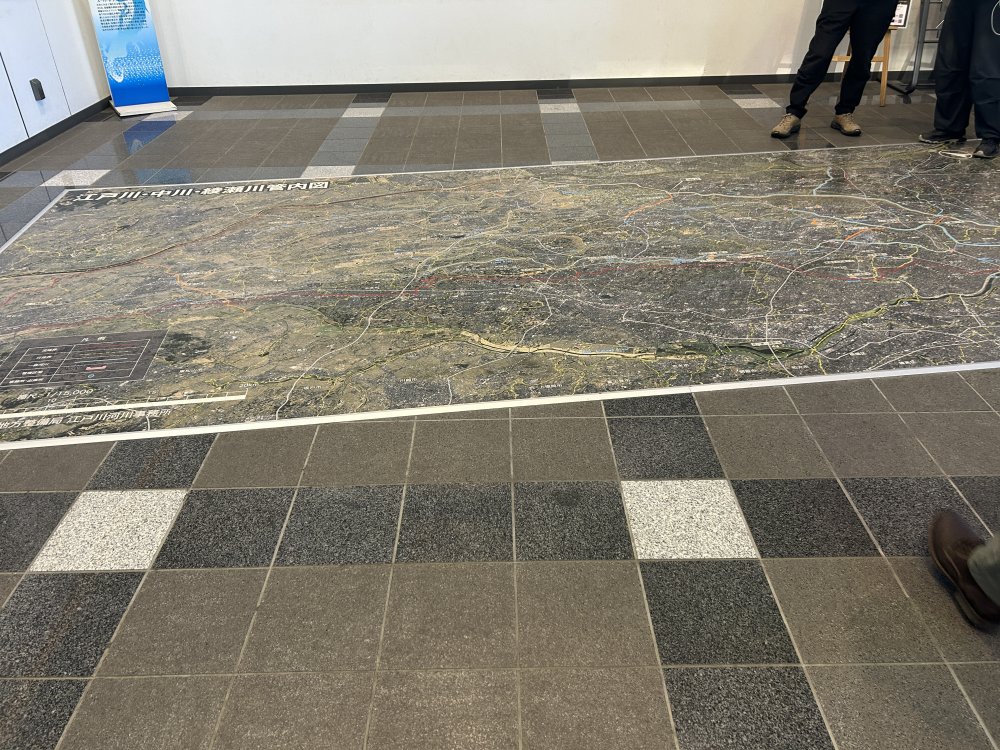
The staff explanation in the second-floor exhibition room was especially helpful, particularly the presentation using the large map laid out beneath our feet. It makes clear how, in the area served by the discharge channel, many rivers that were separated from the Tone and Arakawa river systems run side by side at very narrow intervals.
The Metropolitan Outer Area Underground Discharge Channel is one of the largest underground flood-control systems in the world. It diverts floodwater from medium and small rivers such as the Kuramatsugawa and the Ootoshi–Furutonegawa underground, channeling it through a single tunnel measuring 6.3 kilometers in total length and running 50 meters below ground, before releasing it into the Edogawa River. Construction began in March 1993, bringing together some of Japan’s most advanced civil engineering technologies, and after roughly 13 years of work, water was finally able to flow from the Ootoshi–Furutonegawa to the Edogawa in June 2006. The total construction cost was ¥230 billion. Using the large floor map beneath our feet and scale models of facilities such as the pressure-adjusting water tank, the staff provided a clear explanation of how the entire system works. Although the briefing was conducted in Japanese, a small number of foreign visitors were also taking part. While the official website of the Metropolitan Outer Area Underground Discharge Channel is available only in Japanese, the Edogawa River Office of the Ministry of Land, Infrastructure, Transport and Tourism—the agency that manages the facility—offers an official guide app for the Metropolitan Area Outer Underground Discharge Channel (click here to visit their website). In addition to an overall introduction, the app provides explanations of individual facilities and locations in English and several other languages. It effectively covers almost everything explained in Japanese during the tour, and the foreign participants were likely following along using this app.
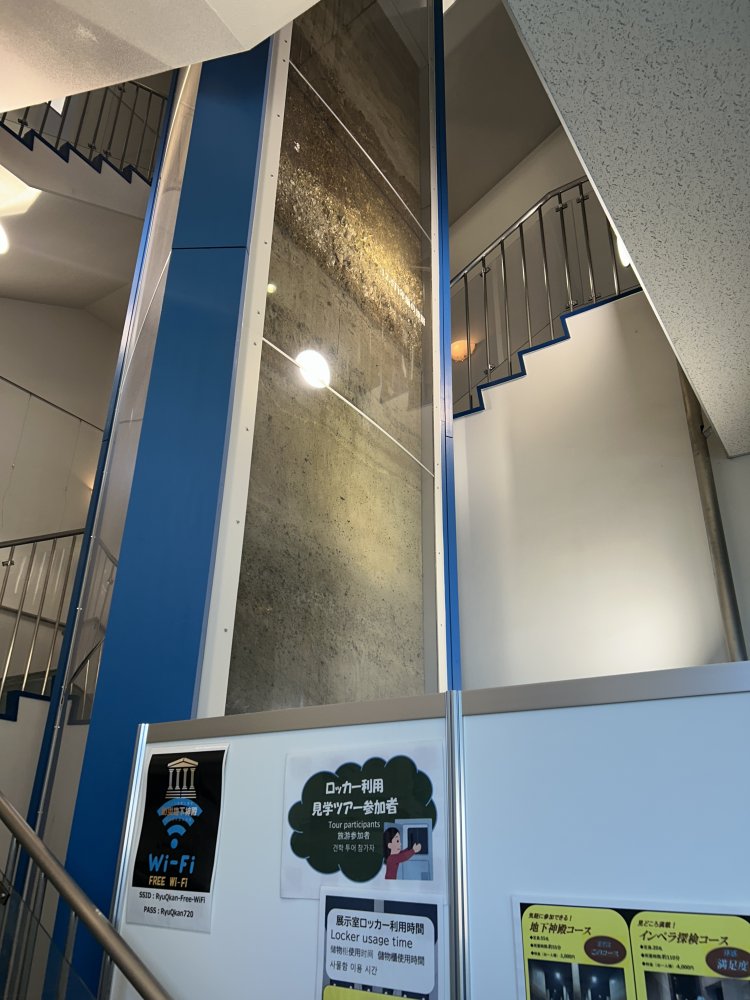
Beside the staircase leading from the first-floor entrance to the second-floor exhibition room stands the “Strata Tower,” which displays a cross-section of geological layers excavated during the construction of the pressure-adjusting water tank. The presence of marine shells in the strata reveals that this area lay beneath the sea more than 6,000 years ago, making it a valuable exhibit. Partially hidden behind the stairs, it is easy to miss. Other exhibits in the second-floor gallery are shown on the Edogawa River Office website; while explanations are in Japanese only, the facility models, pump models, and control room displays are self-explanatory from the photographs.
After the explanation in the exhibition room, we left RyuQkan and headed outside toward the entrance to the pressure-adjusting water tank. Along the way, a soccer field appears on the right; we were told that it occupies the same surface area as the ceiling of the underground tank below. The entrance to the tank is located at the edge of this field.
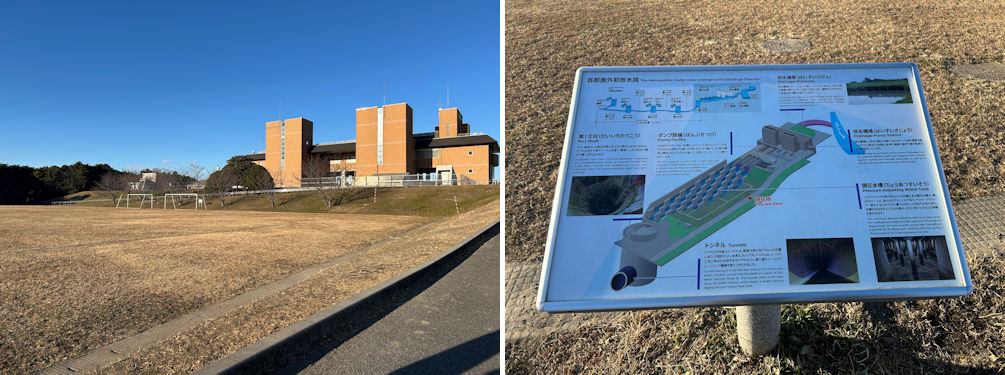
On the way to the pressure-adjusting water tank, a soccer field appears on the right (left). Along the path, near the edge of the field, stands an information board for the pressure-adjusting water tank (right). With explanations in both Japanese and English, it is worth taking a moment to read before descending underground.
From the entrance, it is a descent of about 100 steps—roughly 20 meters—to the floor of the pressure-adjusting water tank. Once at the bottom, the staff provide an initial explanation, followed by around ten minutes of free time for walking around and taking photographs. This massive water tank serves two main purposes: reducing the momentum of incoming floodwater and regulating backflow. During river flooding, water diverted from multiple rivers is carried through the underground tunnel and flows into the tank via Shaft No. 1. When the water level inside the pressure-adjusting water tank reaches the designated predetermined height, pumps at the drainage station are activated, lifting the water and discharging it into the Edogawa River, and are operated to maintain water level at the designated maximum height.
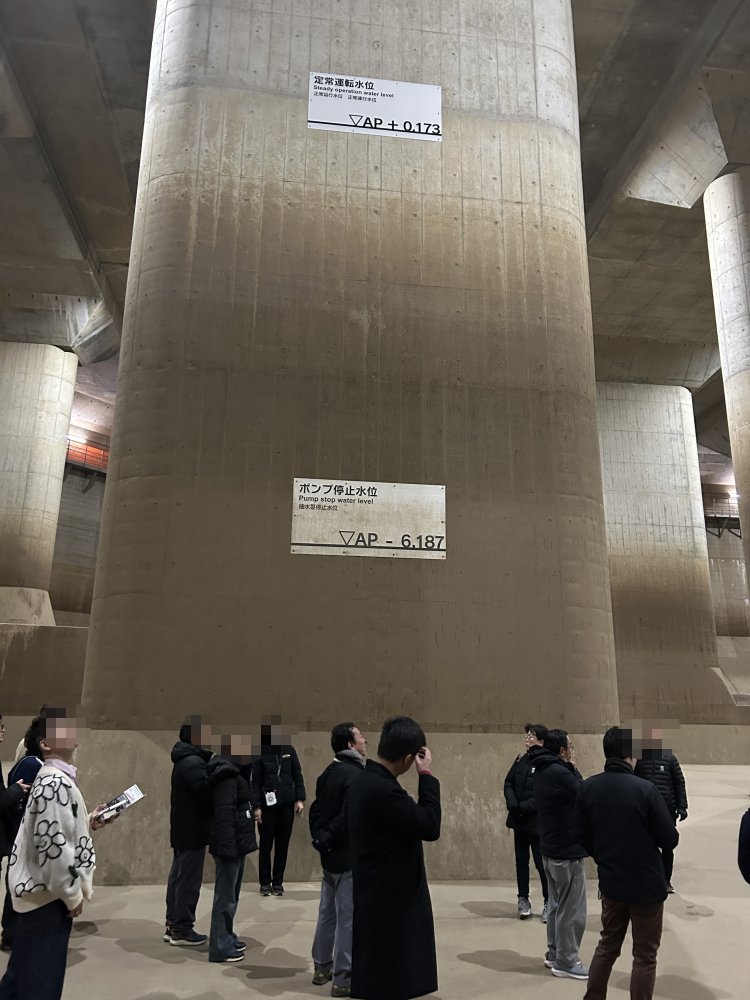
Listening to the guides explanation of the impressive pillar with signs indicating the minimum and maximum water level during pump operation.
The sight of the 59 massive pillars supporting the ceiling is truly impressive, and it is easy to see why the space is likened to an underground temple. What was particularly striking was learning that the primary role of these columns is not so much to support the ceiling itself, but to prevent the pressure-adjusting water tank from being pushed upward by groundwater pressure. Visitors are allowed to explore only the area around the stairway by which they descend, but even within this limited zone it is possible to grasp the overall scale of the space. Shaft No. 1 can be seen only from the side here, so the underground tunnel through which the water flows is not visible.
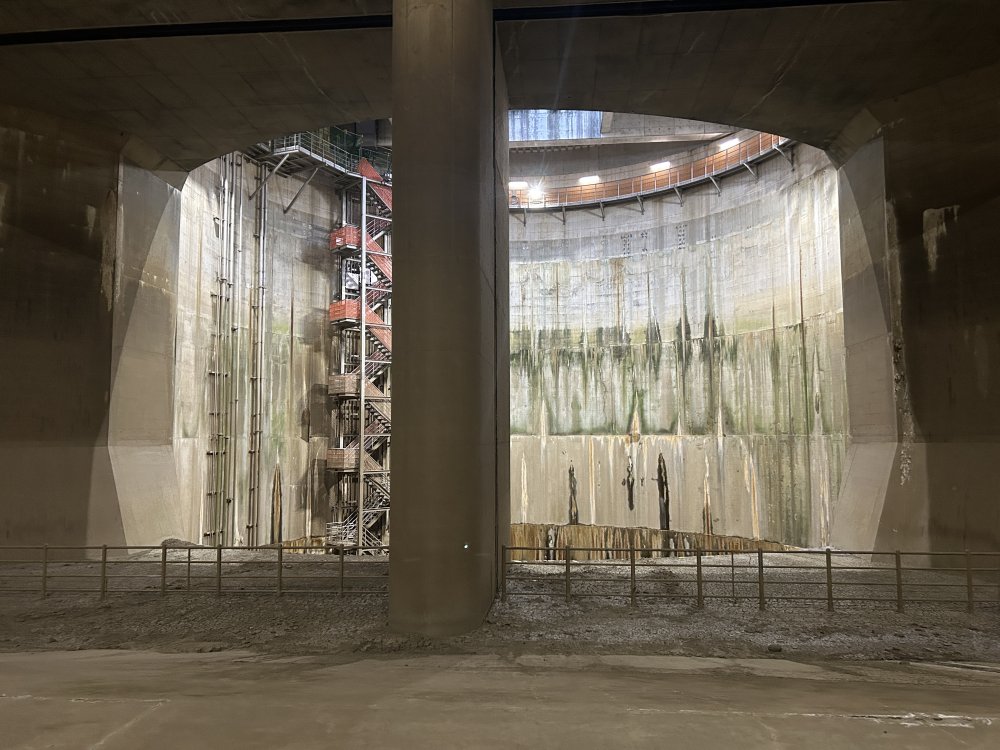
Shaft No.1 as seen from the pressure-adjusting water tank side
We then climbed back up the same 100-step staircase to return to ground level. This was the most physically demanding part of the tour. There was little time to catch our breath, however, as the tour moved on almost immediately. The entrance to Shaft No. 1 is located just across from RyuQkan at the drainage pump station, only a short distance away, but before heading there we were asked to stop at a nearby spot. One corner of the area is covered, and we were told that this is where heavy machinery is lowered down to the floor of the pressure-adjusting water tank. Several times a year, equipment is brought down through this opening to remove sediment that accumulates inside the tank.
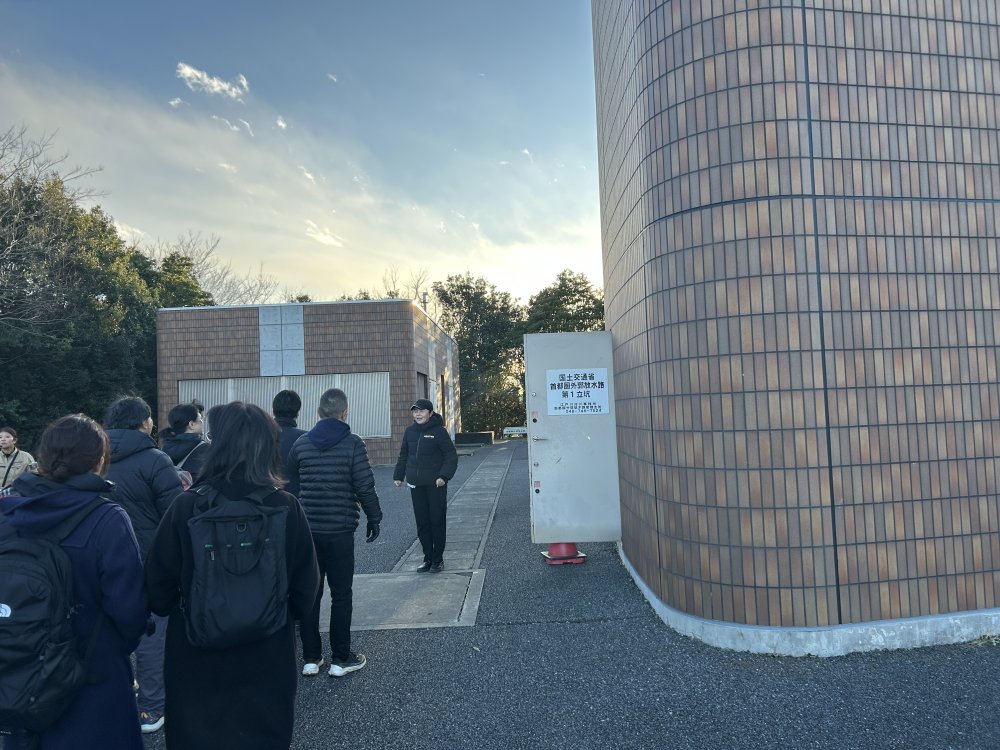
The entrance to Shaft No. 1 is located just across from RyuQkan at the drainage pump station, only a short distance away.
Upon entering Shaft No. 1, we were instructed, as announced in advance, to put on helmets and safety harnesses. Once equipped, we descended the staircase inside the shaft to a point higher than the floor of the pressure-adjusting water tank we had just visited. At the designated turning point—marked as the photo spot—we were able to look out over the opening to the pressure-adjusting water tank below. The primary role of Shaft No. 1 is to guide water from the underground tunnel into the pressure-adjusting water tank when water levels rise.
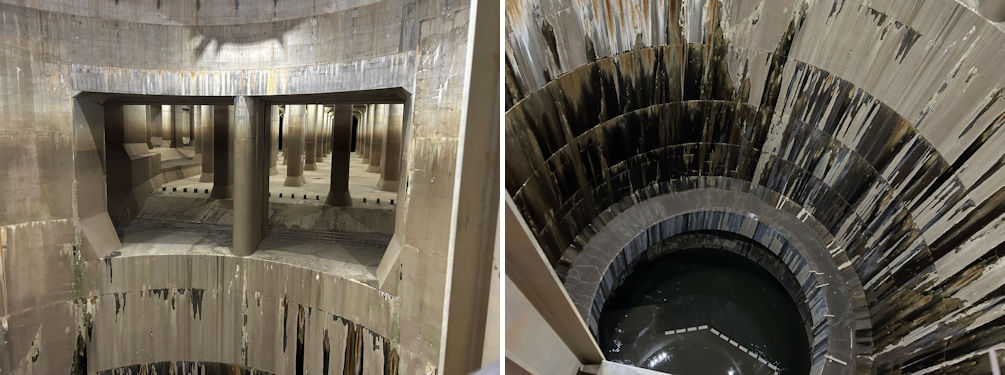
(Left) View of the regulating reservoir we visited earlier, seen from about 10 meters down the No. 1 vertical shaft. (Right) Looking down toward the bottom of the No. 1 vertical shaft from the same point.
After finishing our photography, we climbed back up and made a final circuit along the catwalk installed around the upper level of the shaft. To prevent falls, we clipped our safety harnesses onto a rail running along the shaft wall. With this system in place, it was reassuringly safe to lean out and look down toward the bottom of the shaft. Although the tour lasted just under two hours, it was not as physically demanding as the warnings might suggest—though slippery footwear should certainly be avoided. We visited in winter, and both the pressure-adjusting water tank and the shaft were noticeably milder than the outside air. We were told, however, that in summer the temperature inside matches the outdoor temperature, so visitors should keep that in mind. Combined with the earlier visit to the Sekiyado Museum, this proved to be a valuable and informative experience, deepening our understanding of rivers and flood control in the Kanto region.
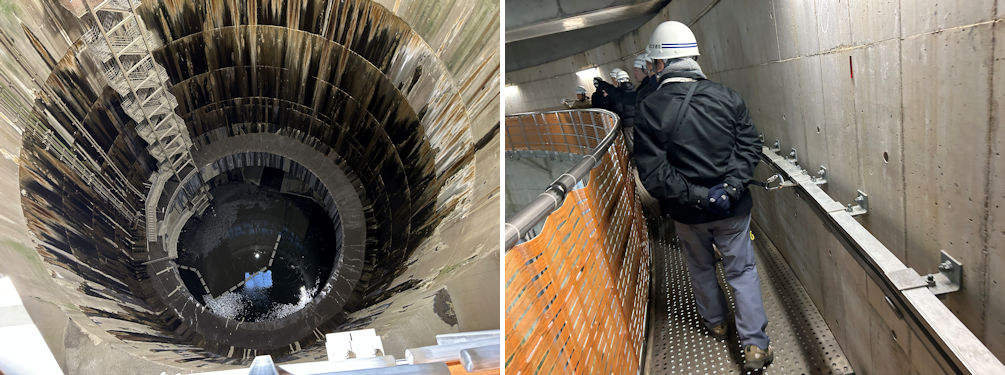
(Left) Photo looking down toward the bottom of the No. 1 vertical shaft from the catwalk. Secured by a harness clipped to the rail along the wall, visitors can lean out slightly to peer down—but when the guide adds, “Please be careful not to drop your phone or other items,” it still takes a bit of courage.. (right) Notice the harness clipped to the rail.