
Rediscovering Japan
Rediscovering Japan
Travel (Sekiyado Castle Museum (Noda City, Chiba)
by tomizuta
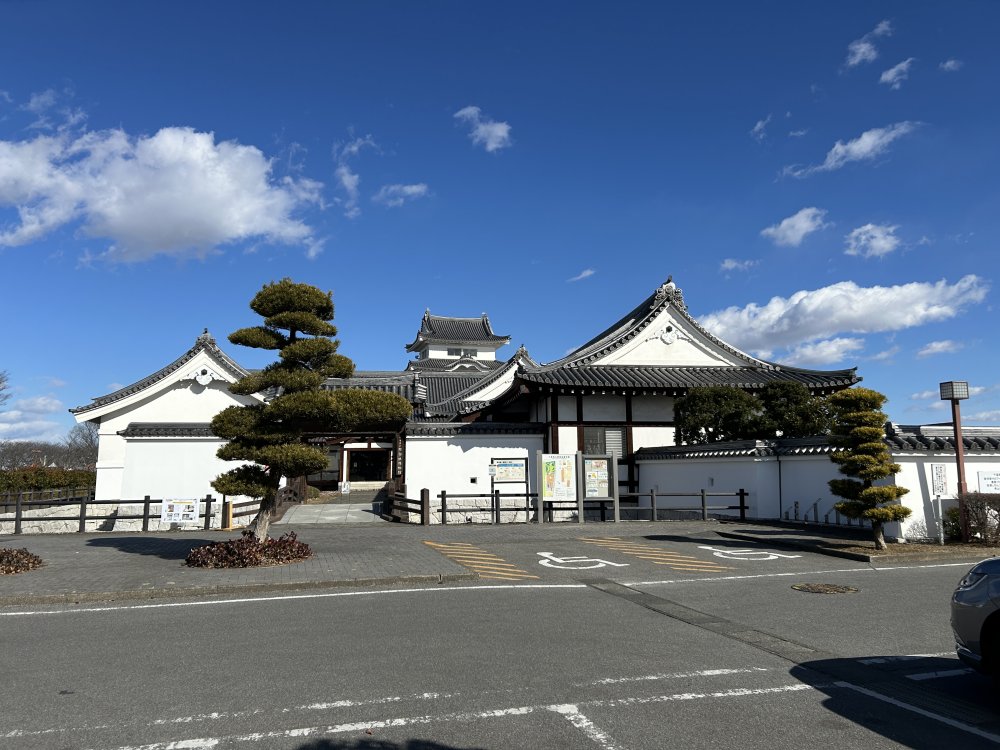
The Chiba Prefectural Sekiyado Castle Museum, which opened in 1995. The castle keep is a reconstruction based on historical records and stands on elevated ground along the Tone River embankment, slightly north of the original site of Sekiyado Castle.
On the morning after our visit to the JAXA Tsukuba Space Center, we set out for Kasukabe, home to the Metropolitan Outer Area Underground Discharge Channel, the main objective of this trip. Although Tsukuba lies in Ibaraki Prefecture and Kasukabe in Saitama Prefecture, we felt we had time to spare before our 3:00 p.m. reservation, and decided to make a stop in Sekiyado along the way. This turned out to be an unexpectedly rewarding detour, particularly in relation to understanding the context of the discharge channel itself. Sekiyado belongs neither to Saitama nor to Ibaraki, but forms part of Noda City in Chiba Prefecture, at the prefecture’s northwesternmost edge. What first piqued my interest in Sekiyado was a familiar connection: Kiyosumi Gardens in Tokyo’s Sumida Ward—often visited when guiding overseas guests—was originally the lower residence garden of the Sekiyado Domain. Yet Sekiyado itself remained a place I knew little about. Historically, the Sekiyado Domain occupied a strategic military position. Because of its importance for flood control and river transport, it was governed by feudal lord s (daimyos) closely connected to the Tokugawa shogunate, with the Kuze family serving as lords of the domain until the final years of the Edo period.
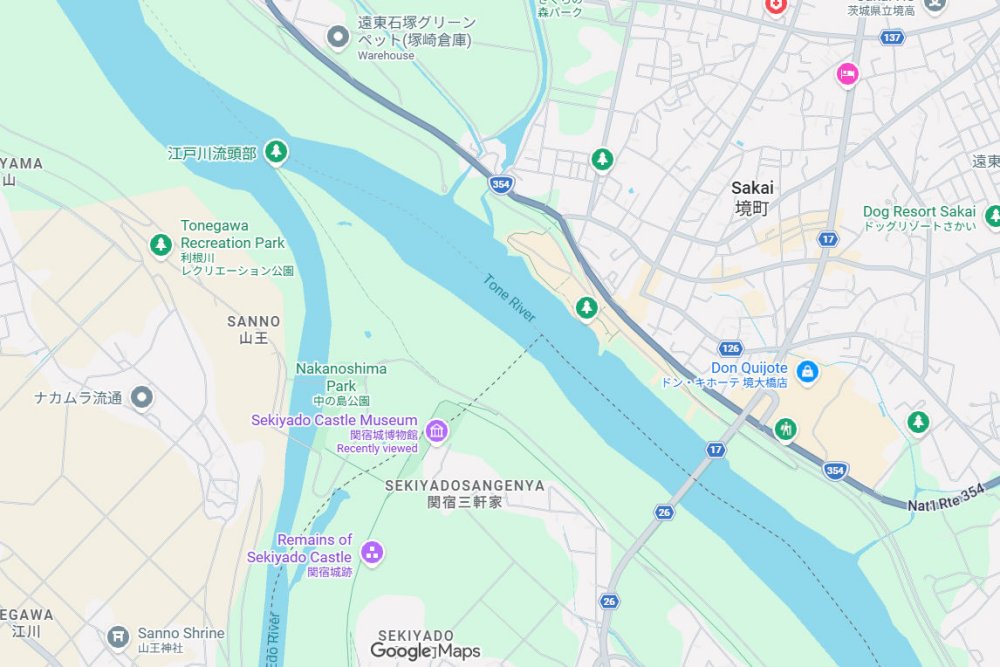
The location of Sekiyado is shown on the Google Map above. Sekiyado lies at the junction of the Tone River, which flows east into the Sea of Japan, and the Edo River, which flows south into Tokyo Bay. The present courses of these two major rivers were artificially altered in the early Edo period. North of the Tone River is Ibaraki Prefecture, south is Chiba Prefecture, and west of the Edo River is Saitama Prefecture; Sekiyado is located at the northernmost tip of Chiba Prefecture.
The place we visited was the Chiba Prefectural Sekiyado Castle Museum, which opened in 1995. The castle keep is a reconstruction based on historical records and stands on elevated ground along the Tone River embankment, slightly north of the original site of Sekiyado Castle. Inside the museum, the first floor is devoted to river-related exhibits, while the second floor focuses on the Sekiyado Domain and the Kuze family. We toured the exhibits in that order.
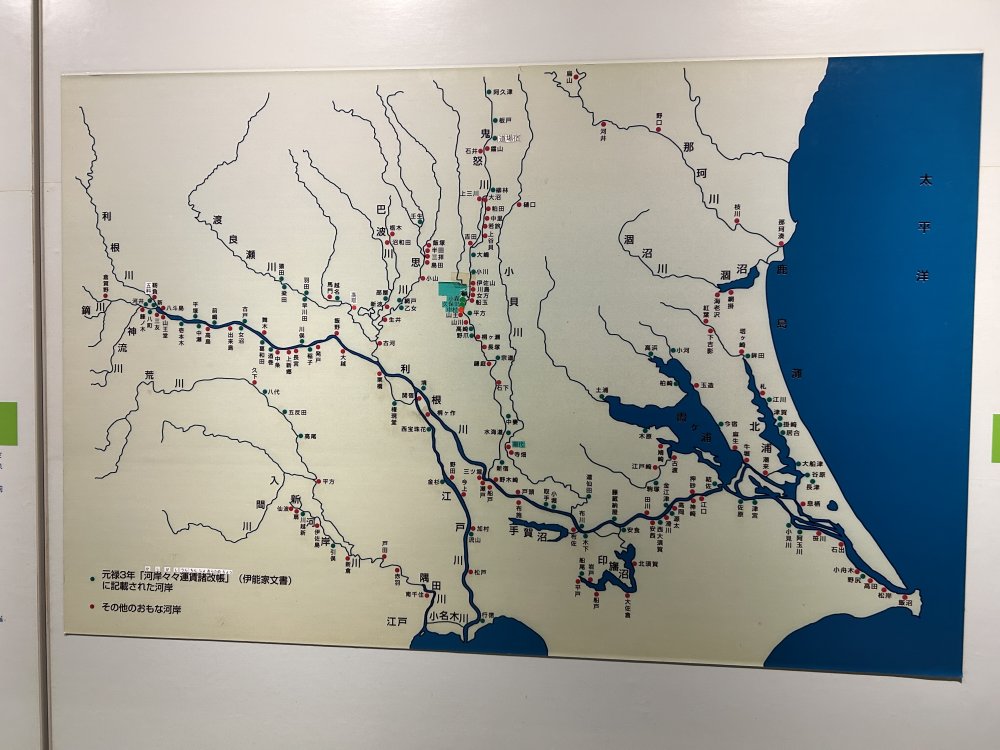
A list of officially sanctioned river ports in the Kanto region at the time of the Tokugawa shogunate’s survey of water transport fees in 1690. It shows that the present-day courses of the Arakawa, Edo, and Tone rivers had already been established by that year. River transport formed the backbone of logistics in the Edo period, and river ports along these waterways prospered accordingly.
In the section on rivers, visitors can learn about the history of flood control and waterborne transport on the Tone River and its tributaries. Of particular note is the fact that, prior to the Edo period, the Tone River flowed from Gunma Prefecture through Sekiyado and emptied into Tokyo Bay. During the Edo period, however, its course was redirected eastward to flow into the Pacific Ocean, resulting in its present route running eastward north of Tokyo and forming the boundary between Ibaraki and Chiba prefectures. Visitors also learn that the branch of the Edo River from the Tone River at Sekiyado—now forming the boundary between Tokyo and Chiba—was created by an artificial waterway in the early 17th century. In addition, the exhibition highlights how water transport along the Tone River and its tributaries played a central role in supplying Edo with goods such as rice, miso, and soy sauce, and how towns along these rivers prospered as port settlements.
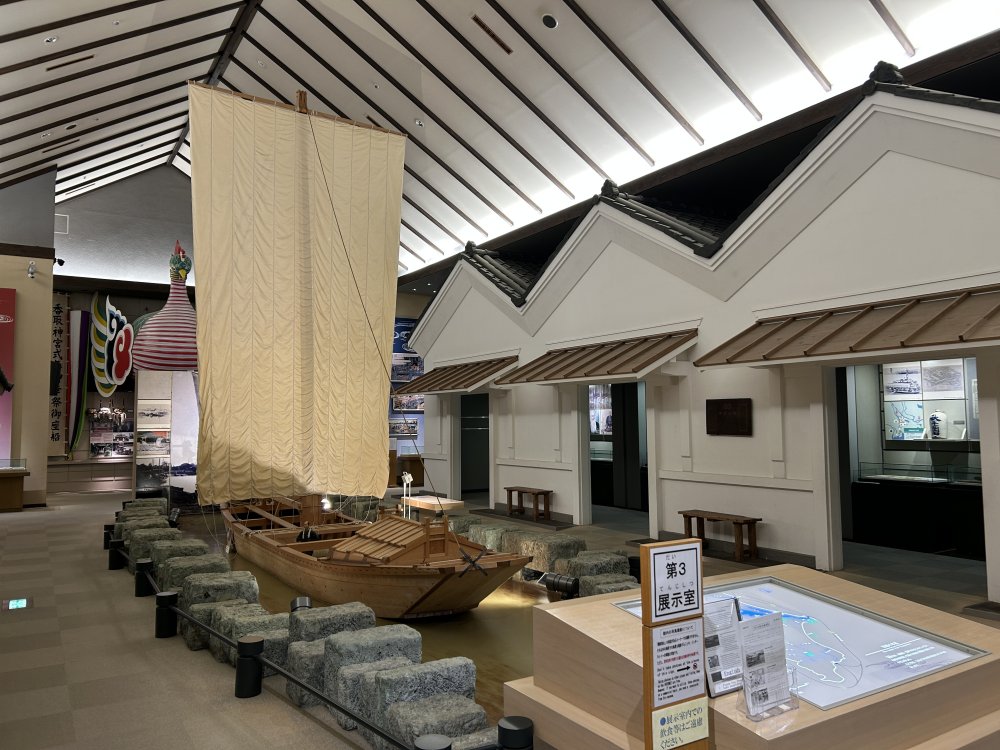
One of the first-floor exhibition rooms. A large-scale model of a takase-bune, the shallow-draft cargo boat that played a central role in transport on the Tone River, is displayed at the center. There are also a reconstructed river port wholesaler and a soy sauce storehouse.
In addition, because rivers flowing into Tokyo Bay—such as the Ayase, Naka, and Edo rivers (see note)—converge and run increasingly close together across the low-lying plains of southern Saitama Prefecture, the area has repeatedly suffered from flood damage. As a result, flood control remains a critical issue for the region even today. The Metropolitan Area Outer Underground Discharge Channel was constructed as a flood-control facility to address this challenge: during periods of heavy rainfall, it diverts water from multiple tributaries into an underground tunnel system and releases it into the Edo River to the east, where the riverbed is deeper. This facility is located on the eastern bank of the Edo River, approximately 10 kilometers south of Sekiyado.
(Note) The Tokyo–Saitama–Chiba region contains three major river systems: the Tama, Arakawa, and Tone river systems. Of these, the Arakawa, which originates in the Chichibu Mountains, originally joined the Tone River and flowed into Tokyo Bay. However, in the early Edo period, in parallel with the eastward redirection of the Tone River (including the creation of Edogawa flowing into Tokyo Bay), the course of the Arakawa was diverted further to the southeast. As a result, it no longer merged with the Tone River and instead assumed its present course, flowing directly into Tokyo Bay. At the same time, the Ayase and Naka rivers, which had previously been tributaries of the Arakawa, were separated from the Arakawa river system.
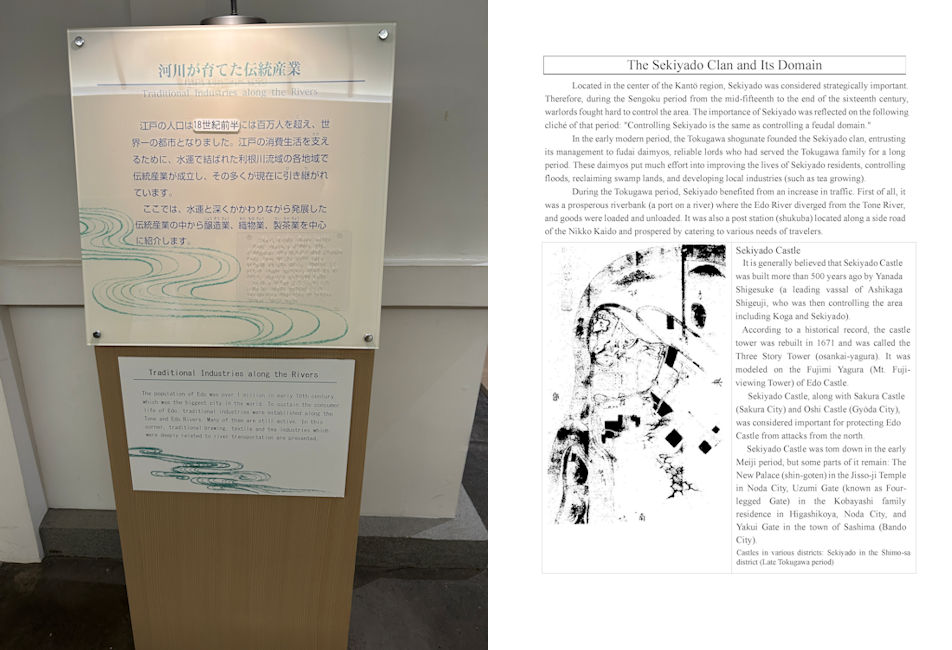
(Left) Exhibition panels are presented in both Japanese and English. (Right) Among the Japanese-language leaflets available in the gallery, one was provided in English.
Although the exhibitions are primarily in Japanese, printed materials provided in each gallery are available in English. By reading these handouts while viewing the displays, visitors can gain a sufficient understanding of the exhibition content. Satisfied with what I had learned from the museum visit, I left Sekiyado and headed for my final destination, the Metropolitan Area Outer Underground Discharge Channel.
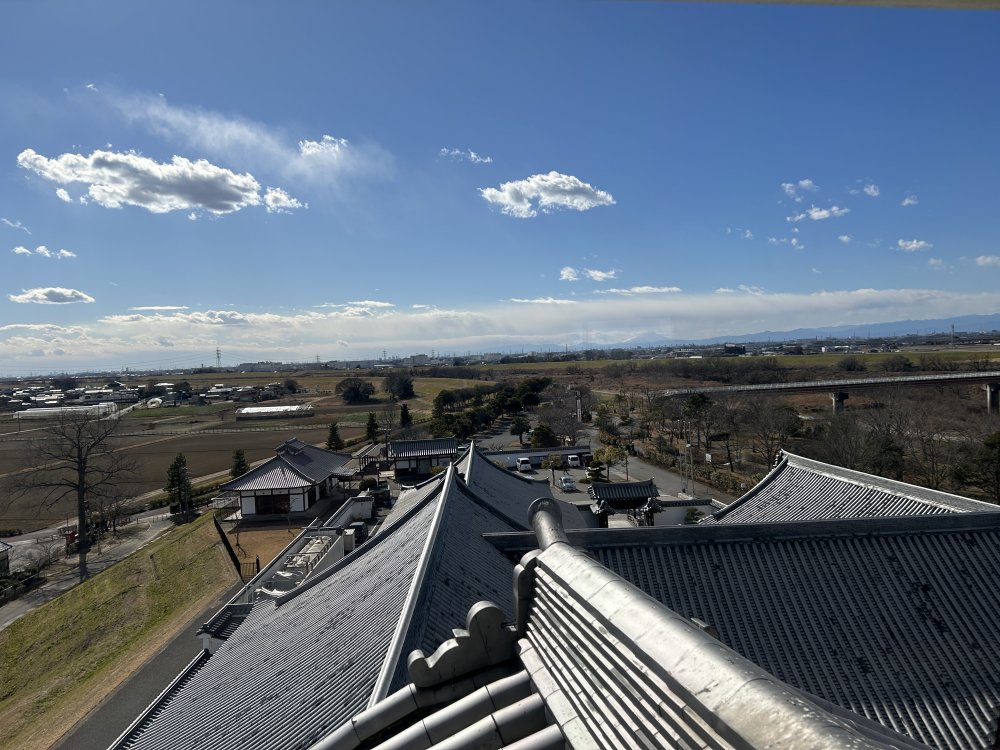
The fourth floor of the museum serves as an observation deck offering panoramic 360-degree views. This photo looks north toward Mount Tsukuba.
continue to Part 3 (Metropolitan Area Outer Underground Discharge Channel)
back to top page