
Rediscovering Japan
Rediscovering Japan
Travel (Ichijodani/Echizen Ono/Katsuyama (Fukui) Part 3 (Ichijodani)
by tomizuta
continue to Ichijodani/Echizen Ono/Katsuyama (Fukui) Part 4
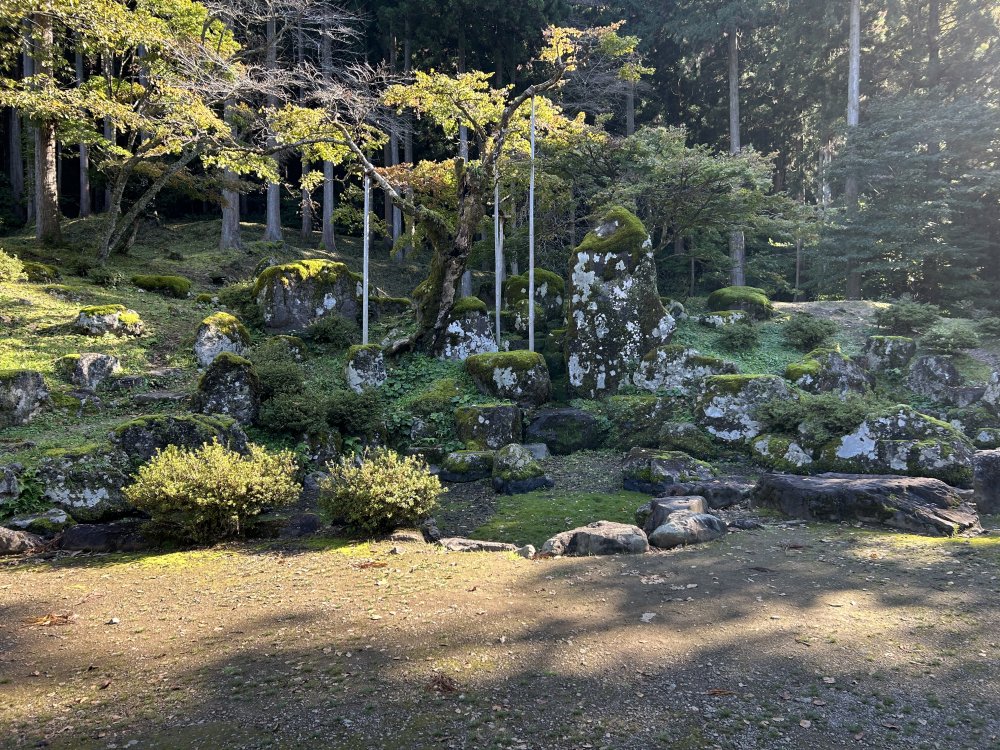
The grand garden ruins of the largest garden in the Ichijodani Asakura Family Site. The garden consists of two levels, this one being the lower level garden. Note the tall upright stone in the middle, depicting the background cliffs of a waterfall.
From the restored townscape, I headed across the river to the site of the
Asakura Residence. Except in times of war, when the mountaintop castle
was used, the residence served as the place where the Asakura clan leaders
carried out their daily administrative duties and lived in Ichijodani.
When Ichijodani was burned down by the forces of Nobunaga Oda, the last
clan leader, Yoshikage Asakura, fled to Echizen Ono at the urging of his
cousin Kageakira Asakura, only to be betrayed by him and driven to take
his own life. At the entrance to the residence site stands a karamon (Chinese-style
gate), although it is not original. After the fall of the Asakura clan,
a temple named Shoun-in was built on the former residence grounds, taking
its name from Yoshikage Asakura’s Buddhist posthumous title, 松雲院殿太球宗光大居士(Shoun-inden
Taikyu Shuko Daikoji). The karamon is said to have been donated to console
Yoshikage Asakura’s soul. (Some sources state that it was donated by Hideyoshi
Toyotomi, but this does not appear in any official documents issued by
Fukui Prefecture, and the basis for the claim is unclear.) Our guide explained
that the crest on the front and the crest on the back of the gate differ.
The crest on the front is that of the Asakura clan. As for the crest on
the back, one theory—an extension of the view that Hideyoshi Toyotomi donated
the gate—associates it with the Toyotomi family. However, I agree with
the theory that it is the ura-mon (secondary crest) used by Yoshikage Asakura,
as the gate seems far too modest in appearance to have been a donation
from Hideyoshi Toyotomi.
If you are interested in Karamon, check (click) the following:
Koishikawa Korakuen (Tokyo)
NishiHongwanji (Kyoto)
Kenchoji (Kamakura)
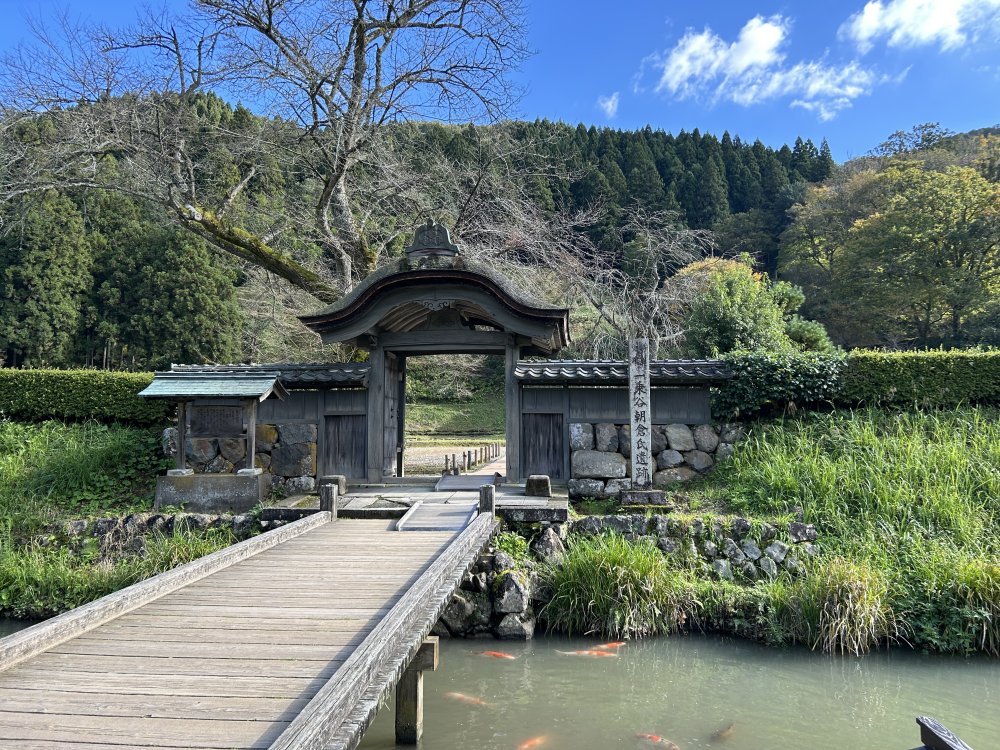
The karamon gate at the entrance to the Asakura Yakata, the former home of the Asakura clan leaders. As you can see, it is far too modest to have been a donation from Hideyoshi Toyotomi. A cherry blossom tree stands beside the gate. Our guide showed us a photograph of the gate when the cherry blossoms were in full bloom. “I took this myself—don’t you think it’s good?” she said.
Passing through the karamon gate, the ruins of the Asakura Residence—the place where the clan head lived and carried out his daily duties—spread out before you. The section at the rear right of the compound has been reconstructed at full scale inside the site museum. For that reason, I recommend visiting the museum first to get a clear sense of what the original buildings looked like before seeing the actual ruins. The guide first led us to the right-hand rear of the grounds, toward the foot of the mountain. Here lies the grave of Yoshikage Asakura. Although Yoshikage took his own life in Echizen Ono and a grave dating from the early Edo period stands there as well, this one was established by local villagers shortly after the fall of the Asakura clan.
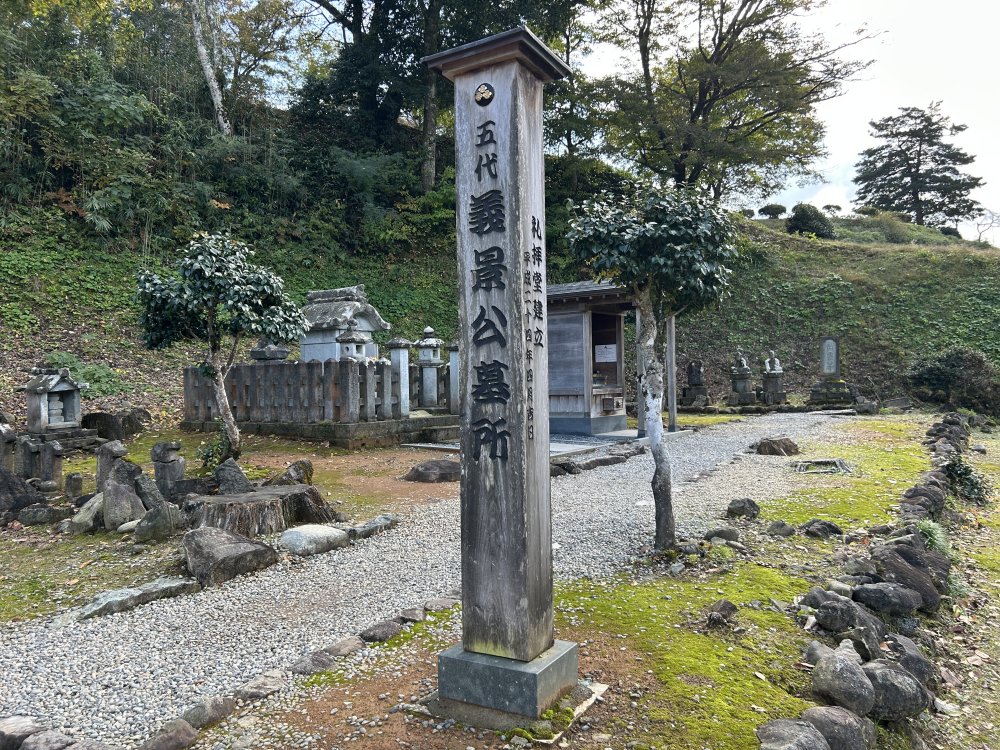
This graveyard of Yoshikage Asakura was established by local villagers shortly after the fall of the Asakura clan.
As we continued along the foot of the mountain beyond the burial site, we reached the first of the gardens that had been one of the main purposes of our visit: the Asakura Yakata Garden. When one hears the word “garden,” it is easy to imagine a large daimyo garden like Koishikawa Korakuen, but this one is a compact, stone-structured garden set against the mountainside. From the guest reception room located at the rear edge of the residence—right where the building meets the slope—this garden could be enjoyed together with the flowerbeds inside the compound, and the reception room itself appears to project out over the garden. In addition, this garden connects to an inner courtyard enclosed by buildings, where an elevated mound bordered with stones has been found, which is believed to have been a flowerbed. The layout allowed guests to appreciate a unified garden space that blended the exterior and the interior, showing the extent to which the Asakura Family sought to demonstrate their sophistication through this garden design. What surprised me most in learning about Ichijodani was the extent to which it flourished culturally. One of the reasons behind this was the background of the Asakura Family. Having risen to the rank of Sengoku warlords through a classic case of gekokujo (lower-ranking persons overthrowing their superiors), they needed to justify their authority despite their origins. To do so, they had to embody the most sophisticated culture of their time. This led them to actively welcome many cultural figures fleeing the devastated capital of Kyoto and to cultivate a level of culture that could rival Kyoto itself—while also ensuring that their achievements became widely known. Numerous outstanding gardens were created, and they took full advantage of maritime transport on the Sea of Japan to import goods from China and the continent. Excavations have uncovered many first-rate items obtained through trade, including fine Chinese ceramics and even Venetian glass.
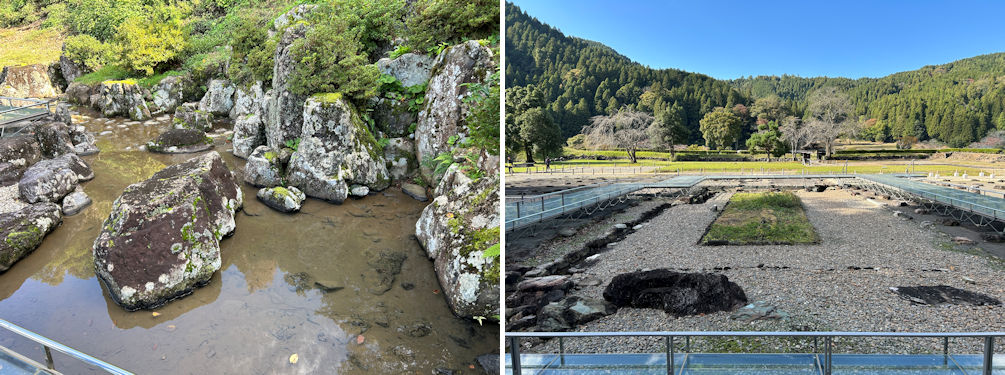
The stone-structured exterior garden set against the mountainside (left). I turned around to face the excavated site of the Asakura Yakata. The platforms show the square building area. In the open air courtyard in the middle, you can see the elevated flower bed as well as the rock and water garden extending into the courtyard (right).
From the first garden, a path runs along the mountainside, and following it upward for a short distance brings you to a higher terrace: the Yudonoato Garden. Its name comes from an old Edo-period illustration, and it is not known what sort of building once stood here. According to the information board on-site, “the garden’s stonework, which makes prominent use of tall, upright stones, conveys the grand and forceful character befitting a Sengoku-period warlord’s garden. Although the pond is now dry, a water channel was found along the mountainside, indicating that it once held water during the Sengoku era.” Among the four gardens of Ichijodani designated as Special Places of Scenic Beauty, the Yudonoato Garden is distinctive for its extensive use of upright stones, and it is thought to be the oldest of the four. In Japanese gardens, stones are an element of paramount importance alongside water: they create sandy shores and rocky coastlines representing the sea, form waterfalls fed by water drawn from the mountains, symbolize Buddhist belief or Shenxian thought (ancient Chinese folk belief in the existence of mountain wizards), or embody wishes for auspicious events or long life. This garden includes a waterfall stone arrangement—stones set to create the scenic effect of water falling like a natural waterfall within the garden, while also showcasing the sculptural beauty of the stonework. It is also said to contain (though imperceptible to an amateur like me) a triad of Buddhist stones—usually expressed with a tall central stone representing the Buddha flanked by two lower stones—and stones thought to express prayers for longevity. It is said that when the late artist Taro Okamoto visited the site, he was so moved by the garden that he spent a long time contemplating it.
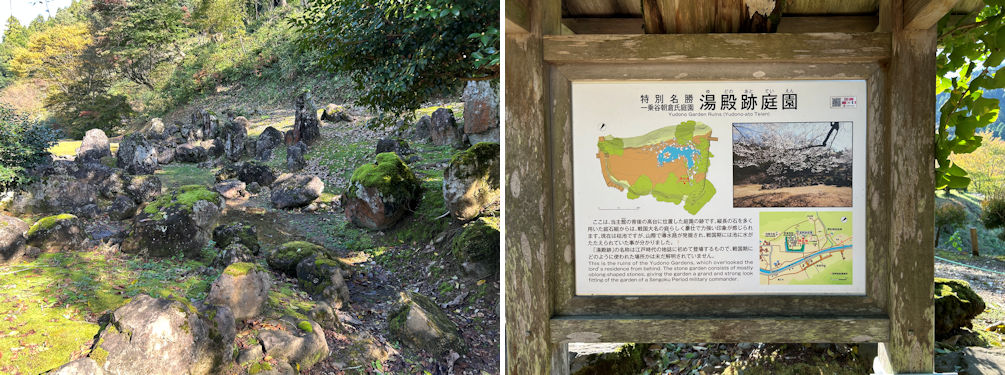
Picture of the remains of the excavated garden (left). Note the tall upright stone in the center, which must have been placed at the side of the waterfall arrangement. Looking at the layout map and explanation provided on the information board (right), it must have been a very large rock and water garden.
Continuing south along the ridge, we soon came to an adjacent flat terrace: the site of the Naka no Goten residence. According to the information board, this is thought to have been the residence of the mother of Yoshikage Asakura, the clan’s last lord. The map on the board shows that the main building and daily living quarters once stood directly ahead. Beside them to the side lay the garden. Although a few English labels such as garden and trench appear, translations for the buildings themselves are absent. Amusingly, Naka no Goten is rendered in English simply as “The inside of the palace remains.” Across the entire Ichijodani site, English explanations do exist, but they are extremely limited and in need of substantial improvement. Although more than a dozen garden remains have been identified in the Ichijodani ruins, only four are currently designated as Special Places of Scenic Beauty.
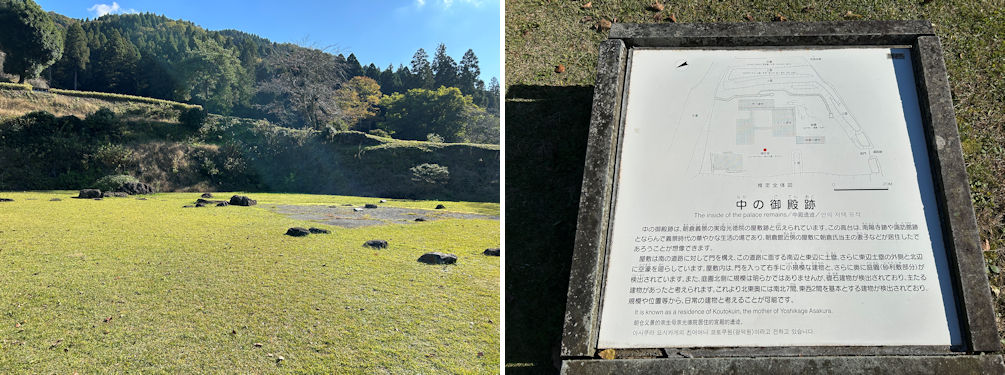
We soon came to an adjacent flat terrace (left) According to the information board (right), this is thought to have been the residence of the mother of Yoshikage Asakura, the clan’s last lord.
Continuing on, there was not much at the Naka no Goten site that required extended viewing, so our guide quickly led us east to the adjoining Suwa Residence ruins. The English explanation on the information board here was noticeably better: “The Suwa Residence was the residence of Koshosho, the wife of the 5th Daimyo of the Asakura Domain, Yoshikage. The Suwa Residence Gardens form the largest scale garden in Ichijodani. It is constructed into two levels, above and below, with the lower garden featuring a waterfall stone arrangement, using a large rock that stands 4m 13cm tall.” This massive stone is known as a taki-fuku-ishi (the auxiliary waterfall stone). Josiah Conder, the British architect active in Japan from the Meiji through Taisho periods, describes it in Landscape Gardening in Japan, the earliest English-language treatise on Japanese gardens: “cascade-supporting stone: An alternative name for the ‘guardian stone.’ ‘Guardian stone’ is a large rock of the ‘statue stone’ shape, backed with earth, and forming the principal part of the rocky cliff over which the water falls. This is the most important of all garden stones, and in some form or other, is always introduced as the central feature of the near distance.” Despite its impressive scale, the Suwa Goten garden shares a similar composition with the Asakura Residence garden, and is believed to have been created at the same time—during the major renovations undertaken in 1567, when the Asakura clan lavishly entertained Ashikaga Yoshiaki, who would become the last shogun the following year. In the Edo period, the site is thought to have served as the Asakura family’s cemetery, where religious observances were held.
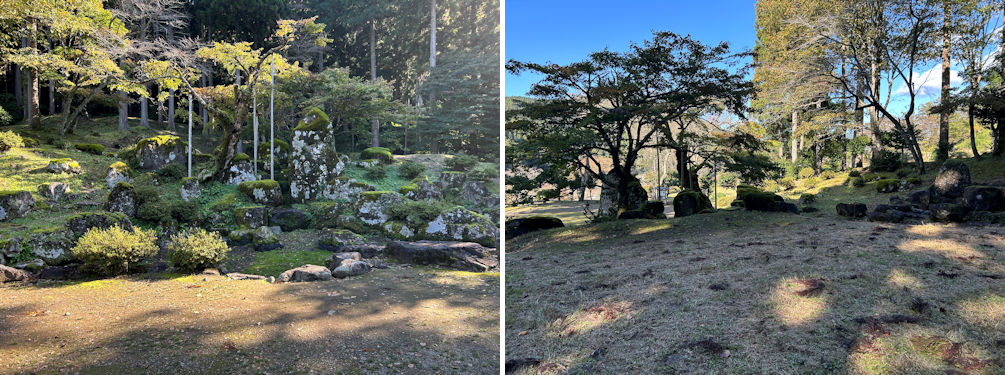
The Suwa Residence Gardens Ruins form the largest scale garden in Ichijodani, and is constructed into two levels. The lower level garden with a waterfall stone arrangement, using a large rock that stands 4m 13cm tall (left), and the upper level garden (right).
We had originally booked a guided tour that was scheduled to end here, returning us to the starting point of the reconstructed townscape. However, since we also wanted to see the fourth garden, we thanked our guide at this point and went on our own. The fourth garden is the site of the Nanyoji Temple garden. It lies further up the mountainside beyond the Yudono garden we had already visited. Because it sits deeper in the hills, it is presumably excluded from the standard tour route. There had been recent bear sightings in the area, so we climbed the mountain path with a touch of apprehension—only to regain some confidence when we caught sight of a foreign couple walking ahead of us. Before long, we reached the garden. The information board on one corner of the spacious grounds states: “Nanyoji Temple was the nunnery temple the daughters of the Asakura clan entered, said to be a gorgeous and luxurious temple during the Sengoku period. In 1568, a cherry blossom viewing party with poetry recitation was held under the weeping cherry tree in front of the garden to entertain the visiting Yoshiaki Ashikaga, who would rise to become the Muromachi Shogun later the same year.” Like the other three gardens, this one is characterized by a highly three-dimensional stone composition. In particular, the large auxiliary waterfall stone set on the right side mirrors the arrangement found in both the Asakura Residence garden and the Suwa Residence garden.
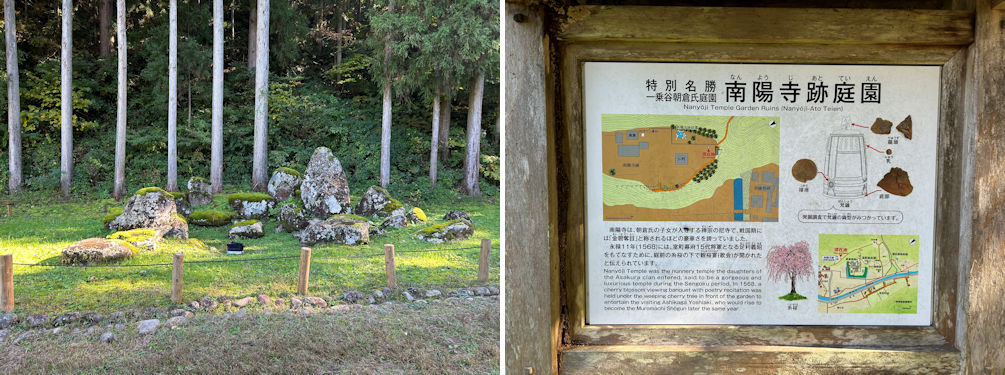
Like the other three gardens, the Nanyoji Temple garden is characterized by its highly three-dimensional stone composition. In particular, the large auxiliary waterfall stone set on the right side mirrors the arrangement found in both the Asakura Residence garden and the Suwa Residence garden (left) The information board of the garden ruins (right).
Having now visited all four gardens, we returned to the parking area by the Restored Town Area, where our journey had begun. Before leaving, we decided—at our guide’s recommendation—to go and see the Shimo-kido ruins, the ruins of the gate that guarded the northern end of the castle town. Although there is a signboard, there is no parking space. After walking about two minutes from the main road, I came to the remains of the gate: enormous stones, each weighing more than ten tons, stacked to form a formidable defensive structure. The way the road forces a left turn at the end and then a right turn to enter the township clearly reflects the strategic design of the gate and powerfully conveys that the entire Ichijodani valley functioned as a single, integrated fortress. With this final stop, we concluded what had been an extremely rich and enlightening journey. We left Ichijodani and returned to Echizen Ono (continued to Part 4).
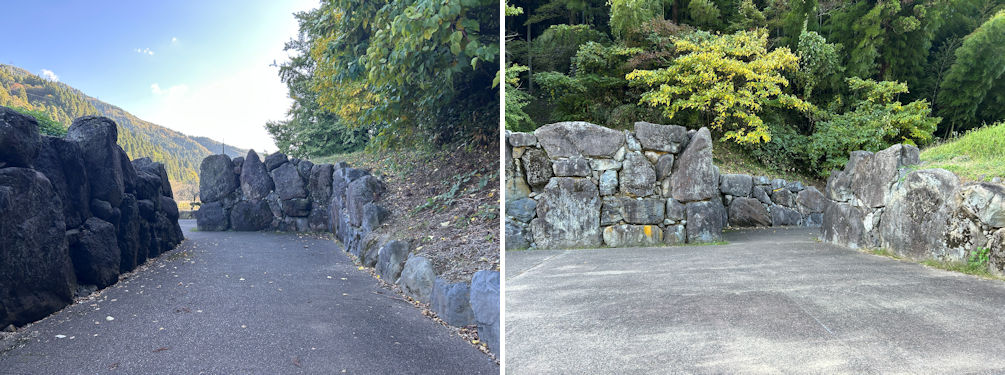
A huge stone structure appeared in front. This was the entrance to the castle town from the north, Shimo-kido (right). Visitors were forced by the stone structure to turn left at the end of the approach, and the make a right turn to enter the township. Once you turn left at the end of the approach you reach a large area which must have aerved as a checking point (right).