
Rediscovering Japan
Rediscovering Japan
Travel (Ichijodani/Echizen Ono/Katsuyama (Fukui) Part 2 (Ichijodani)
by tomizuta
continue to Ichijodani/Echizen Ono/Katsuyama (Fukui) Part 3
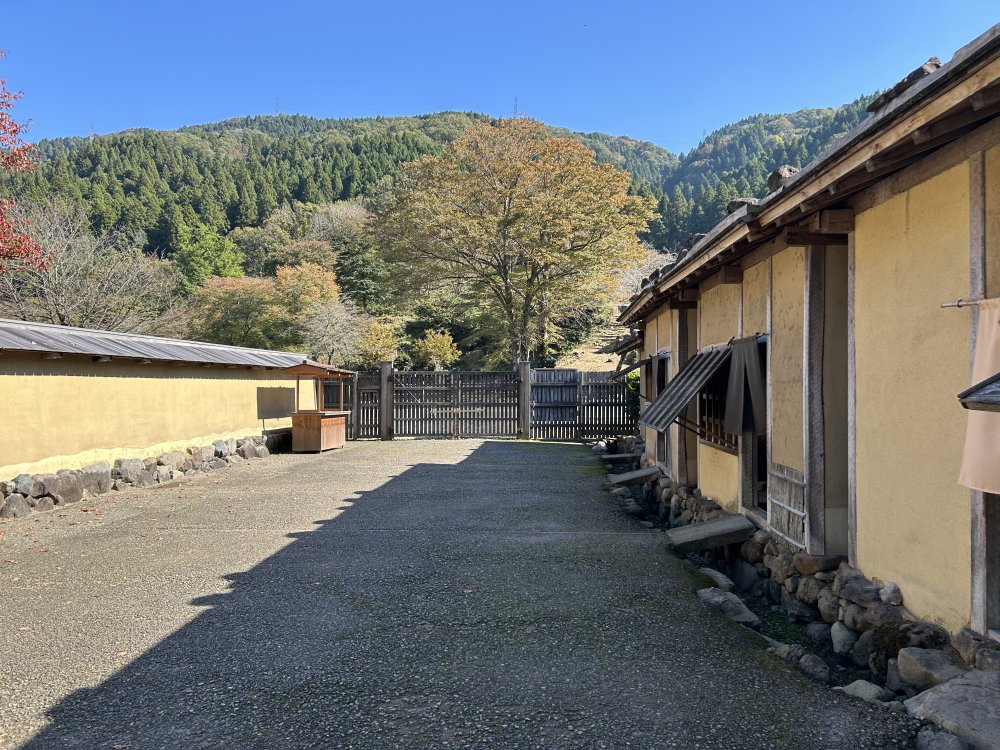
A wide east–west road with the merchant shops on the right. The merchants likely set up stalls in front of their shops.
Ichijodani is a valley approximately 3 km from north to south and 500 meters from east to west, spreading along both sides of the Ichijo River, which originates from Mount Ichijo (741 m) and flows into the larger Asuke River. It was a castle town that flourished for five generations of the Asakura clan over a span of 100 years, protected by Ichijodani Castle, which stood on a mountain ridge to the east at an elevation of 473 meters. The town stretched roughly 1.7 km along the Ichijo River and was guarded by northern and southern gates; at its height, it was home to more than ten thousand samurai and townspeople. Because the museum is located outside the northern gate, farther upstream from the former castle town, it is quite a distance from the main attractions of the site—the reconstructed townscape and the four gardens designated as Special Places of Scenic Beauty—so traveling between them by car is convenient. We drove to the parking lot beside the entrance to the reconstructed townscape and met up with the local guide we had booked in advance. The woman who guided us was extremely well-informed. She told us that although she was not originally from the area, she had decided to take the plunge and become a volunteer guide for the city of Fukui, and that she had become particularly fascinated by Ichijodani. Several scheduled group tours led by volunteer guides are offered each day in Ichijodani, but the one I booked was a special 90-minute tour that, in addition to the regular group-tour route, also covered the garden ruins that I especially wanted to see.
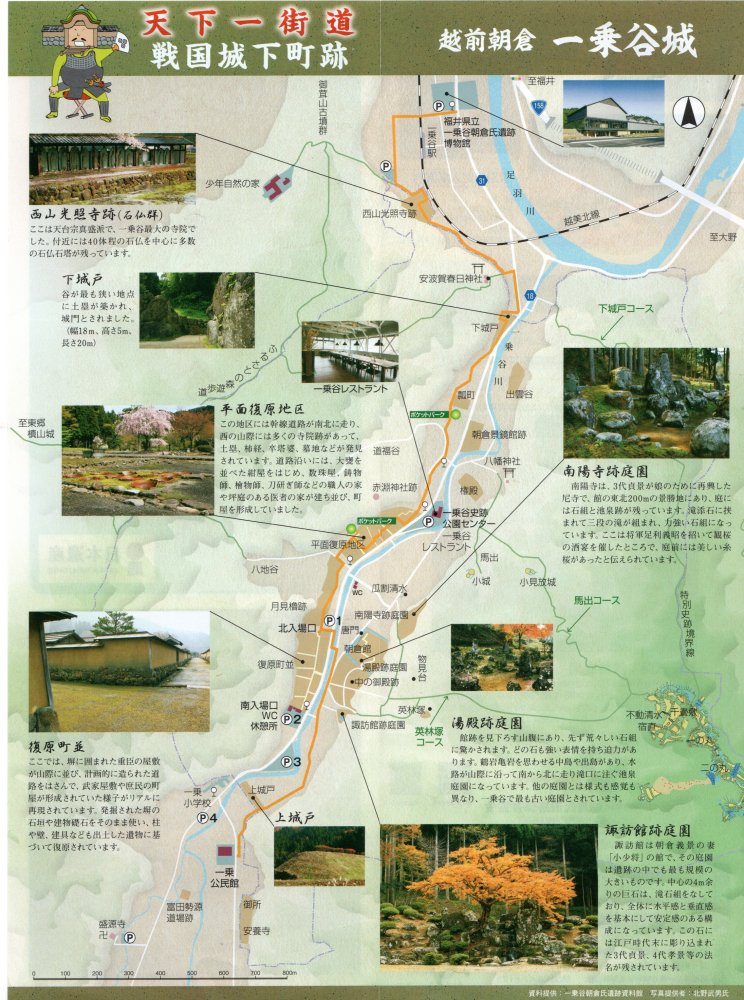
This is the only map I found that clearly shows how the various parts of the site are positioned in relation to one another. Other maps are harder to understand—some place north to the side, and in some cases even at the bottom. Unfortunately, I was not able to find an English version of the map. The river curving at the upper left is the Asuwa River. The river branching off from it and running downward (although the actual flow of the river is from south to north before eventually joining the Asuwa River) is the Ichijodani River. As you can see from the photo on the side, the parking area marked “P” at the very top is the museum. From there, we drove to the parking lot marked “P2,” where we met our guide. The reconstructed townscape lies on the west side of the Ichijo River, between P2 and P1, and we visited that area first. We then crossed the Ichijo River to the opposite bank to see the Asakura Residence and the four gardens.
On the east bank of the river once lived lower- and middle-ranking samurai and townspeople, while the Asakura residence and the homes of the Asakura family and senior retainers were situated on the gently rising ground on the west bank. Our guide proposed the following route: begin with the reconstructed townscape on the east side—a stretch of about 300 meters faithfully restored—then cross the river to visit the site of the Asakura residence and the four excavated garden ruins. She began by explaining the distinction between 復元 and 復原, two terms that are both pronounced fukugen in Japanese but have different meanings. “復元,” she said, “refers to recreating something when nothing remains. 復原, as in Ichijodani, is restoration based on actual archaeological evidence—foundation stones, structural remains, building materials, postholes, and so on.” Hearing this again underscored the extraordinary fact that, despite being completely burned during the Warring States period, the castle town survived beneath the earth almost untouched—earning Ichijodani the name “the Pompeii of Japan.”
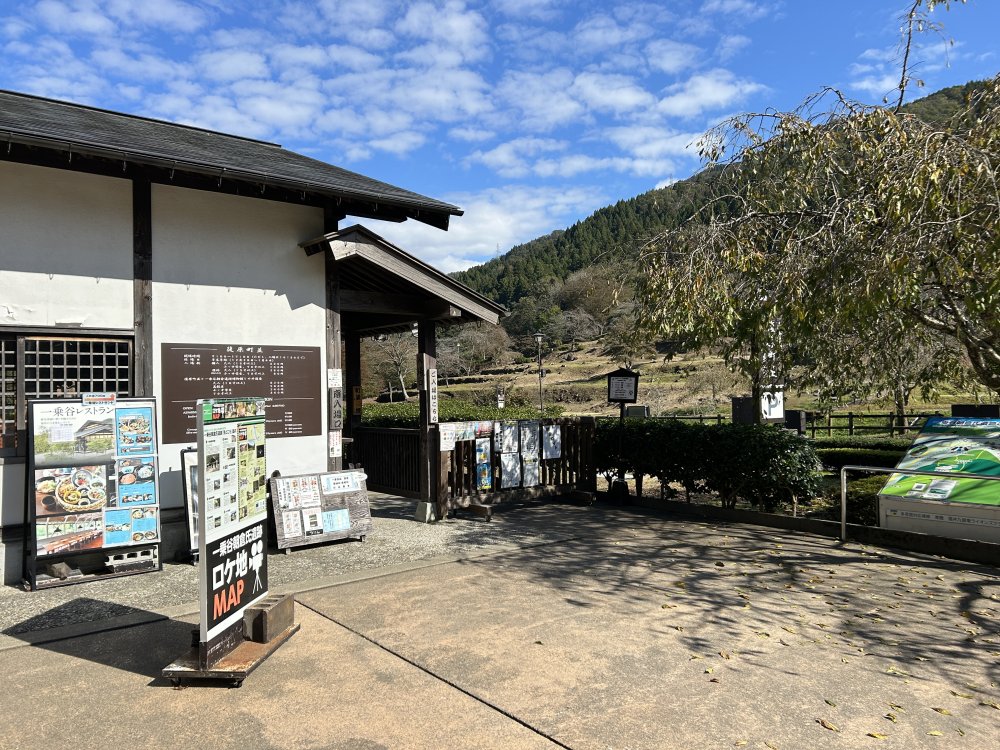
The southern entrance gate to the Restored Town Area located in Car Park 2. Other than the admission office, there is a gift shop as well as a rest area serving soba and drinks. If you wish to have a proper meal, you need to go north about 0.5 kms where there is a restaurant serving a full range of meals.
Just inside the entrance to the Restored Town Area, I asked a question that my prior reading could not answer but that I had been eager to resolve. “In 1930, Ichijodani was already designated as a Historic Site. Why, then, was it only in 1971 that it became a Special Historic Site, and why have excavation and conservation work continued for more than fifty years since?” The guide explained: “This entire area used to be rice fields. When a land improvement project began here as part of an agricultural modernization program, valuable artifacts started turning up one after another. That discovery prompted full-scale excavation and preservation efforts.” (Afterward, I looked into it further: work began in the mid-1970s, but thanks to the efforts of those who wished to preserve the valuable ruins, 278 hectares—covering Ichijodani and its surrounding area—were designated a Special Historic Site in December 1971. Fukui City subsequently purchased most of the former castle town lands that were at risk of destruction, enabling the long-term excavation and preservation projects that continue today.)
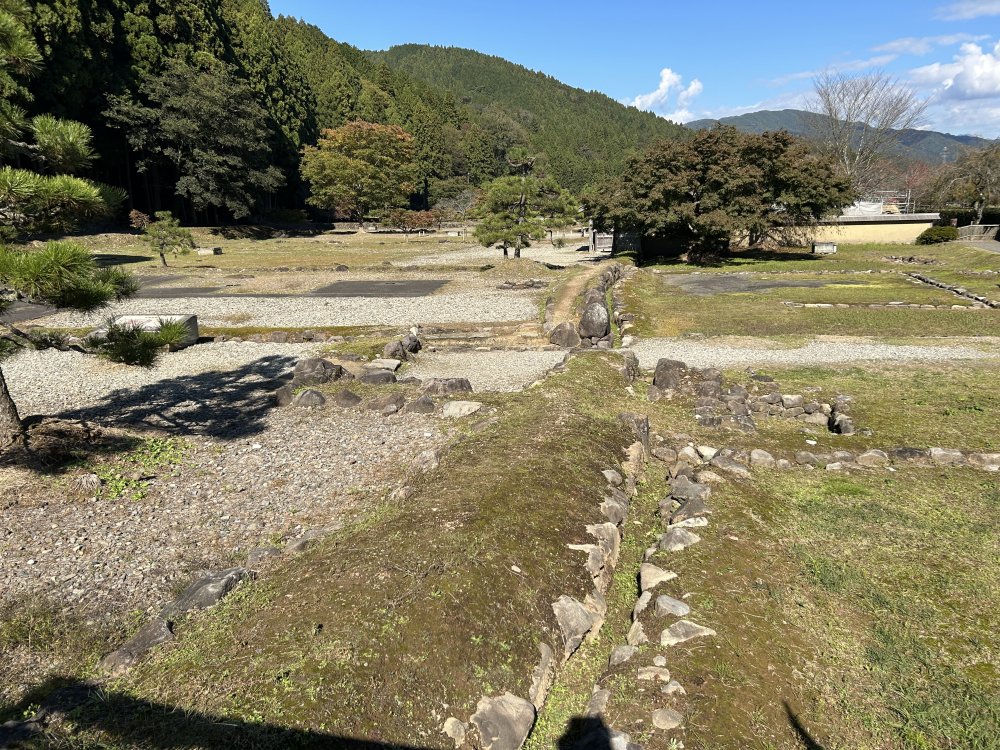
The guide informed us“This entire area used to be rice fields. When a land improvement project began here as part of an agricultural modernization program, valuable artifacts started turning up one after another. That discovery prompted full-scale excavation and preservation efforts.”The vast tract of land that comes into view once you pass the entrance gate to the Restored Town Area. This tract in front was a samurai residence.
Upon entering the Restored Town Area, we proceeded north along the well-maintained road running through the center. On the left side were the samurai residences, while on the right were the homes of lower-ranking samurai and the shops and houses of townspeople, all arranged in an orderly manner. What makes the Asakura site truly remarkable is that the townscape, burned by Oda’s army, was excavated exactly as it had been left. Even the stone-paved streets remain as they were at the time of destruction. In particular, the wells and toilets of each household have been uncovered. This reveals that, even in one of Japan’s most densely populated areas of the period, there were thoughtful measures for sanitation—possible only because the town had prospered to such an extent.
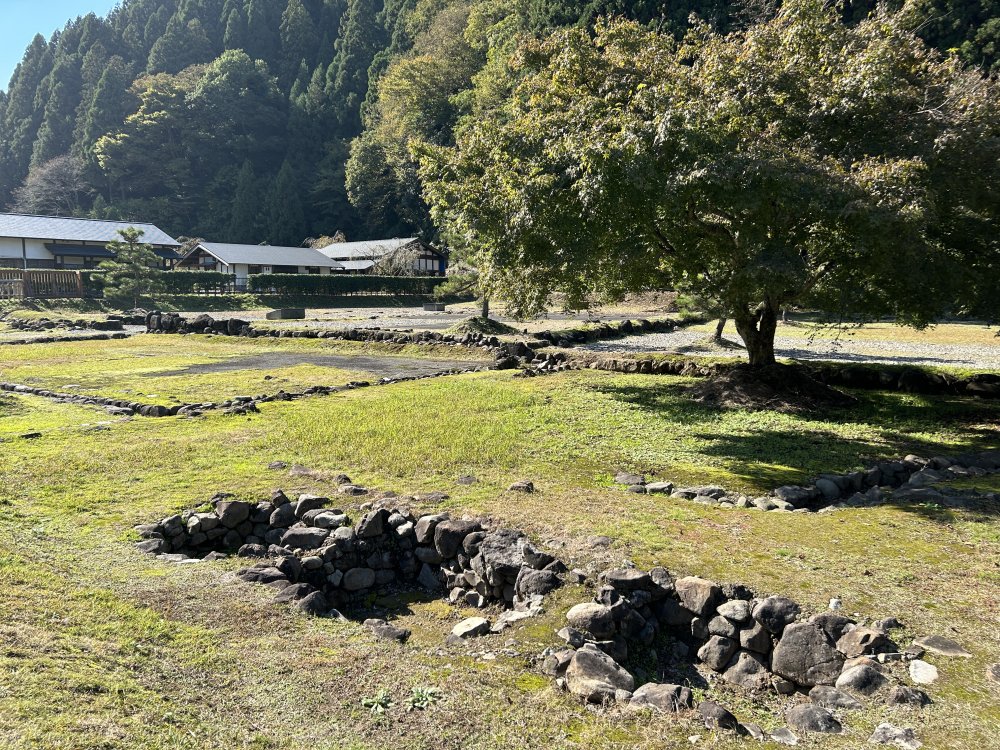
An excavated well and toilet. It is truly remarkable that each household had its own in those days instead of a shared facility.
There are also clever design features reflecting its role as a castle town during the Warring States period. The guide advised us to look ahead along the road: “You can see the road seems to end straight ahead, but it actually continues with a sharp, key-shaped bend. This is a deliberate design to make the street appear narrower. The town gates stand at the southern and northern ends of the castle town, and this feature is mainly intended to defend against invaders approaching from the south, that is, from the direction of Kyoto. When you reach the bend, turn around and you'll find another secret there.”
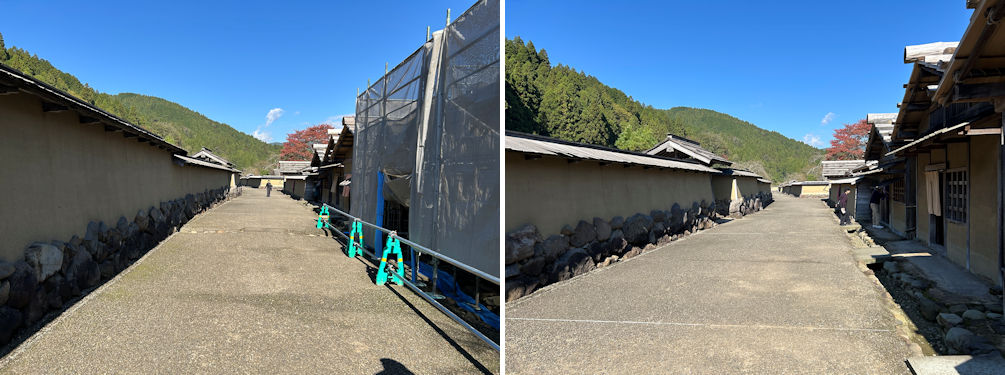
At first glance, the street seems to end abruptly (left), but as you approach, you can see it continues in a zigzag pattern (right). According to the guide, this design makes the township appear smaller. A common feature in castle towns, but often more intended to make the enemy's approach difficult.
Proceeding along the street, we came to the traces of a water channel that must once have carried household water from west to east. There are also several wide east–west roads. From this, it becomes clear that the town had been laid out in a grid pattern as viewed from the elevated Asakura residence. We were shown both the large samurai residence on the left side and the residences of mid- and lower-ranking samurai on the right. The guide advised us to pay attention to the stone walls and gate structures. Indeed, the stones used in the walls of the high-ranking samurai residences were larger, and their gates had four supporting pillars. In contrast, the lower-ranking samurai’s houses had small-stone walls and simple two-pillar gates—a striking illustration of the strict class hierarchy. The reconstructed shops and dwellings of the townspeople, located on the right side and along the east–west streets, were also fascinating. One of the shops had a dyed fabric curtain hanging at the entrance. Inside, many jars were lined up. “A large jar with traces of indigo dye was excavated just as you see here. The small partitioned room inside the shop shows that shops run by townspeople also served as their homes,” the guide explained.
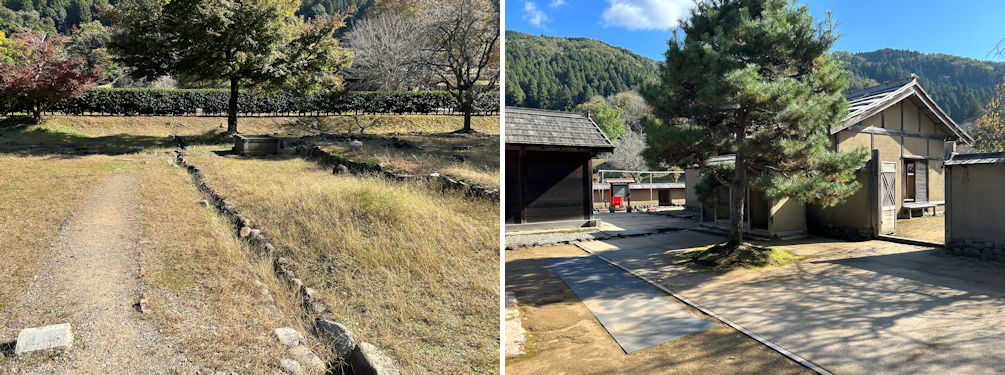
We came to the traces of a water channel that must once have carried household water from west to east (left). Inside a restored middle-class samurai residence (right). Middle-class samurai residences were placed on the eastern side along the merchants, in contrast to the higher ranking samurais whose residences were on the opposite (western side) closer to the western hills.
When we reached the point that had earlier looked like the end of the street, we found that the road indeed continued, bending sharply to the left. As the guide had suggested, I turned around to look back to where we had come from. “From this direction, it looks longer than it did when you first saw it, doesn’t it? The width of the road isn’t uniform. It’s a use of perspective—designed so that people approaching from the south, like we did from the southern entrance of the Restored Town Area, would perceive the street as shorter,” the guide explained.
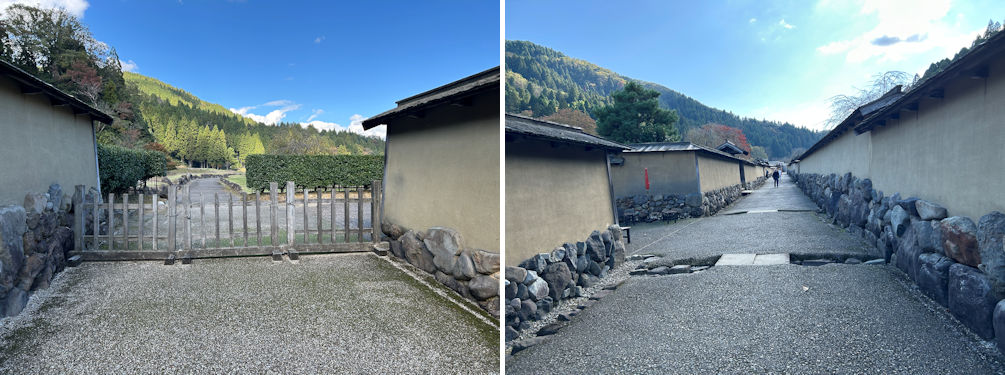
Turning left at what had appeared to be a dead end revealed that the township in fact continued much farther ahead (left). I also turned around to look back to where we had come from, and surely it looked much longer than from the other direction (right).
After finishing our tour of the Restored Town Area, we crossed over to the other side of the Ichijodani River—the east bank—toward the ruins of the Asakura Residence and the four gardens that was the main purpose of this visit (continued to Part 3).
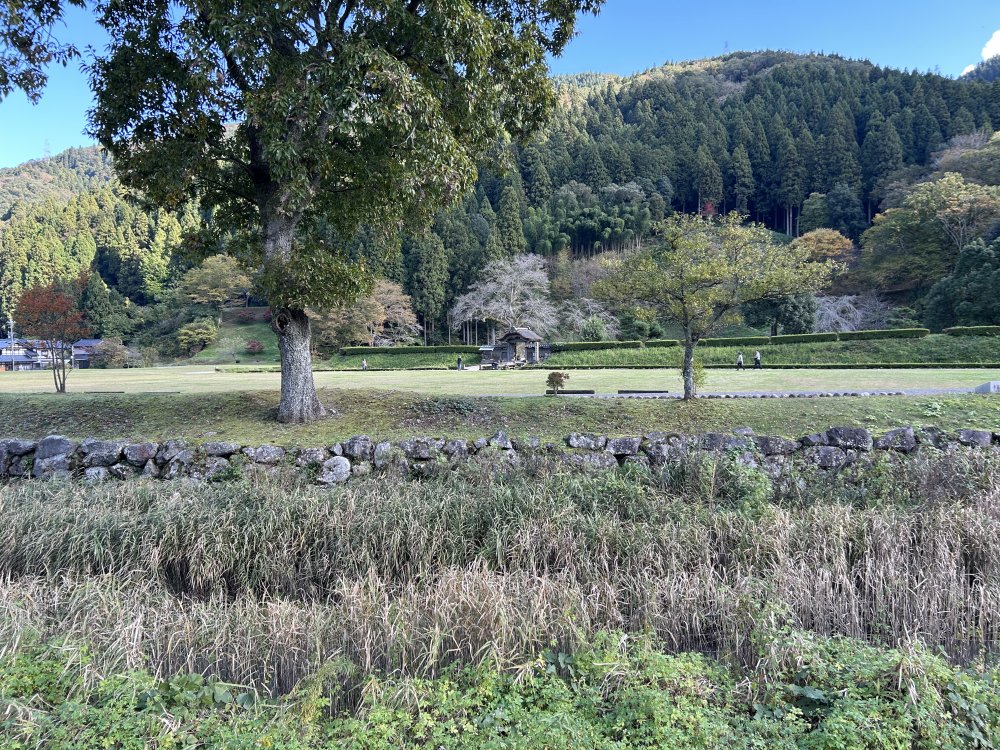
Entrance to the Asakura Residence viewed from the Restored Town Area. The river in the foreground is the Ichijodani River.