
Rediscovering Japan
Rediscovering Japan
Travel (Ichijodani/Echizen Ono/Katsuyama (Fukui) Part 1
by tomizuta
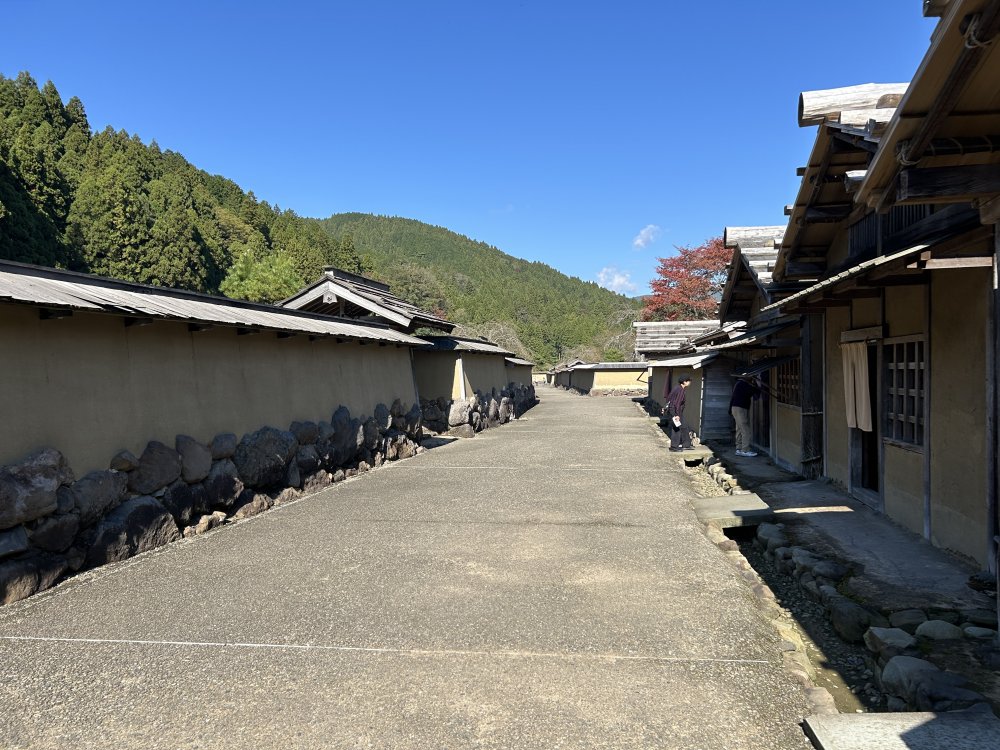
View of Restored Town Area of Ichijodani
In early November 2025, reports of bear sightings and attacks were coming in from across the country—from Akita and Iwate to many other prefectures—and there were even sightings in Fukui Prefecture. With a slight sense of unease, I nevertheless set out from Chino City in Nagano, traveling via Takayama to visit Fukui. I had visited Fukui once many years ago, when I travelled from Ishikawa to see Tojinbo and Eiheiji. But this was my first visit since becoming a nationally certified interpreter-guide and since launching this homepage to introduce Japan to overseas visitors. Over the past year, I have been studying Japanese gardens in earnest to deepen my knowledge of Japan. Under the Act on Protection of Cultural Properties, cultural properties are defined as follows:
| Category | Description |
| Tangible Cultural Properties | Buildings, paintings, sculptures, crafts, ancient documents, and other tangible cultural products of high historical or artistic value, as well as archaeological materials and historical materials of high academic value. |
| Intangible Cultural Properties | Performing arts, music, craft techniques, and other intangible cultural products of high historical or artistic value. |
| Folk Cultural Properties | Customs, manners, and practices related to clothing, food, housing, occupations, beliefs, and annual events, together with folk performing arts and folk techniques indispensable for understanding changes in people’s daily lives. |
| Monuments | Shell mounds, burial mounds, castle ruins, former residences, and other archaeological sites of high historical or academic value; as well as gardens, bridges, valleys, seashores, mountains, and other scenic places of high artistic or aesthetic value. |
Among Tangible Cultural Properties, those of particular importance are
designated as Important Cultural Properties. Of these, items of especially
high value from the standpoint of world culture—treasures outstanding even
among the nation’s cultural assets—are further designated as National Treasures.
Monuments follow a similar structure. Among them, sites of particular importance
are designated as Historic Sites or Places of Scenic Beauty. Those Historic
Sites or Places of Scenic Beauty deemed especially significant are further
designated as Special Historic Sites or Special Places of Scenic Beauty,
a ranking equivalent to National Treasures among Tangible Cultural Properties.
Japanese gardens can receive this double designation—Special Historic Site
and Special Place of Scenic Beauty—if they possess both high artistic or
aesthetic value as scenic landscapes and high historical or academic value.
Only the following nine locations across Japan currently hold this double
designation, including such renowned sites as the gardens of Kinkakuji,
Ginkakuji, and Koishikawa Korakuen (Actually Itsukushima in Hiroshima has
also received double designation, but Itsukushima is not a garden). The
Ichijodani Asakura Clan Ruins in Fukui Prefecture are also among them.
The main purpose of my trip to Fukui this time was to visit the gardens
at this exceptional site.
| Gardens with Double Designation | |
| Motsuji Temple grounds and gardens | Iwate |
| Koishikawa Korakuen | Tokyo |
| Hama-Rikyu Gardens | Tokyo |
| Ichijodani Asakura Family Site | Fukui |
| Jishoji (Ginkakuji) Temple gardens | Kyoto |
| Rokuonji (Kinkakuji) Temple gardens | Kyoto |
| Daigoji Temple Sanpo-in gardens | Kyoto |
| The Imperial Villa Garden Site of the Ancient Nara Capital | Nara |
| Nara Palace Site and To-in gardens | Nara |
It was already afternoon when we entered Fukui Prefecture after passing through Takayama. We prefer staying at traditional inns rather than modern city hotels. Although Fukui City and Awara Onsen offer a greater number of accommodation options, they lie farther west, beyond Ichijodani, and I wished to avoid staying in that direction. Having ruled out those areas, the best option closest to Ichijodani was the more mountainous city of Echizen Ono, where we had reserved our lodging. Since we still had time before check-in, we headed first to the Fukui Prefectural Dinosaur Museum in Katsuyama. The Fukui Station Dinosaur Area Portal Site explains: “For a long time it was said that there were no dinosaur fossils in Japan. Then an Early Cretaceous crocodile fossil was discovered on a cliff of the Kitadani Formation, Tetori Group, in Kitadani-cho, Katsuyama-shi in Fukui. In 1989, this discovery initiated the large-scale excavation of dinosaur fossils, which continues to this day.” Today, Fukui Prefecture is known as a true “dinosaur kingdom,” with dinosaur statues found throughout the region. The museum itself opened in July 2000 as a natural history museum, and this year marks its twenty-fifth anniversary.
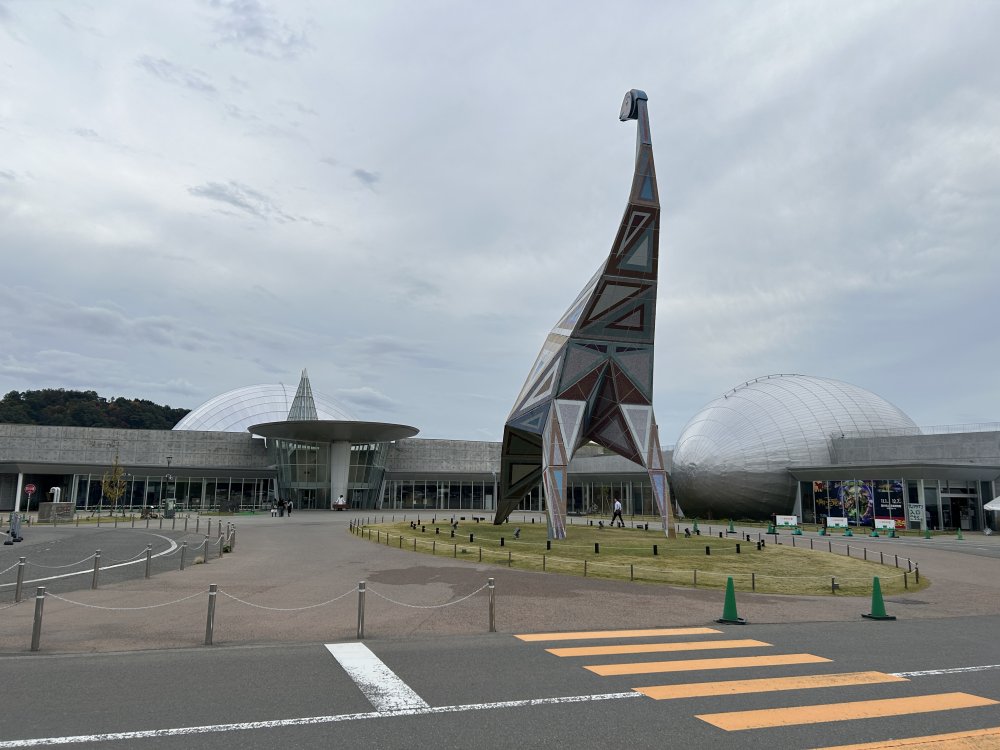
The Fukui Prefectural Dinosaur Museum is one of the leading dinosaur museums in the world. Today you can see dinosaur statues and figures all around the prefecture.
After parking in the museum’s main parking lot, the large, imposing structure came into view. Although advance reservations are generally required for admission, the road signs leading to the museum displayed “same-day tickets available,” and since it was just after a three-day weekend, we were able to enter immediately. Visitors enter on the third floor. From there, an escalator takes you down to the first basement level, after which you follow the route upward again—viewing the third-floor exhibits before moving through the first and second floors and finally returning to the third floor. The museum shop is also located on the third floor. As the museum’s website provides detailed explanations in English, I will omit a description of the exhibits here. Suffice it to say that the displays—covering everything from dinosaur classification to their evolution—are extensive enough that several hours are not nearly enough to take everything in. With the museum closing at 5:00 p.m., we returned to Echizen Ono and checked in at the inn we had reserved.
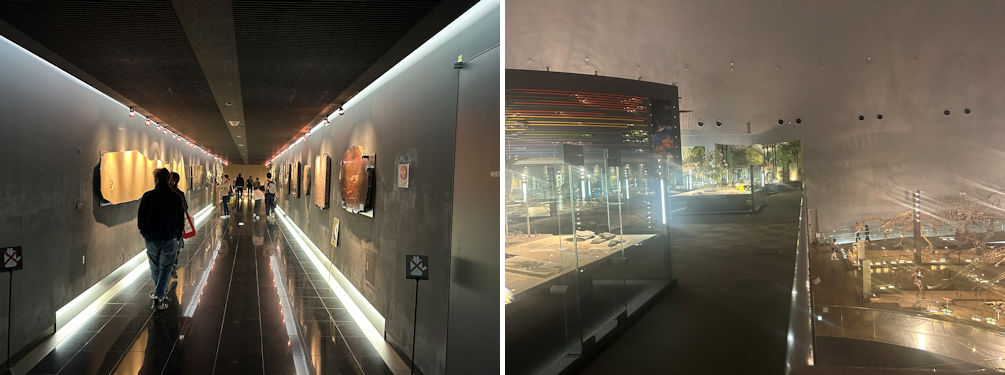
You take the escalator to the basement (left) and then go up to the third floor (right).
When we stepped through the entrance of the inn, a female staff member came out to greet us. A note at the door asked guests to wipe the casters of their suitcases with the paper towels provided before entering, so we followed the instruction. When she said she would show us to our room, I asked whether we did not need to check in first. She replied that the guest register had been placed in the room and that we could fill it out there. The inn appeared to be quite an old establishment with many years of history behind it. In fact, the inn itself states, “As our building is an old two-story wooden Japanese house, footsteps and voices may carry easily. We therefore accept guests of elementary-school age and older only.” Even so, I was impressed by how meticulously well maintained the entire place was.
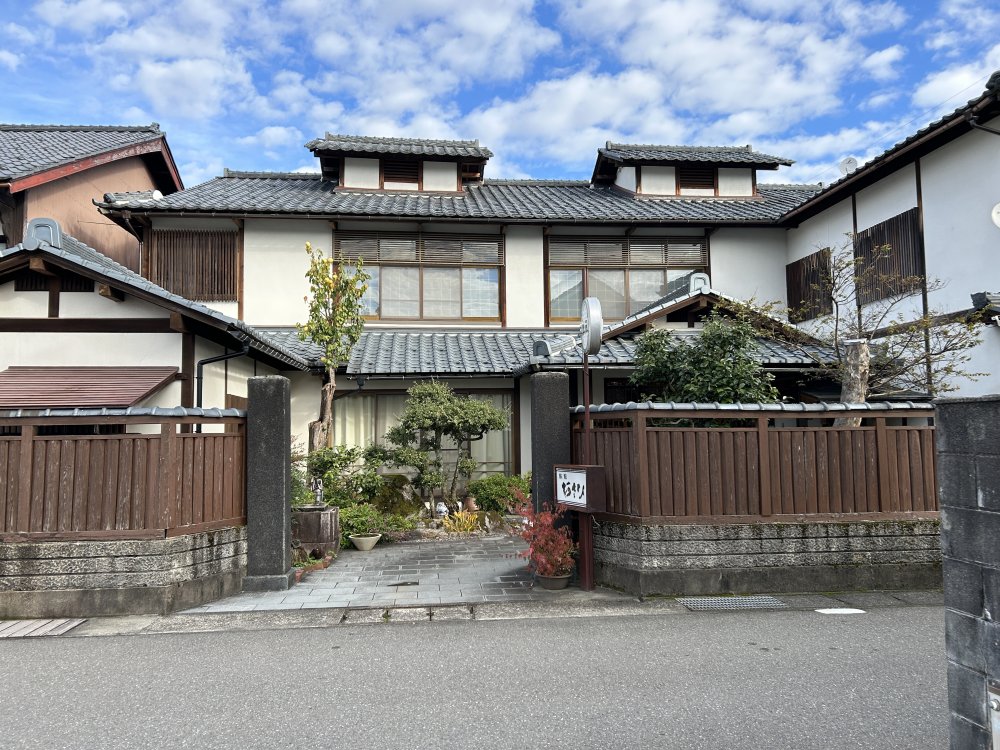
The inn appeared to be quite an old establishment with many years of history behind it.
Dinner was served in the dining room on the first floor. The meal was a splendid kaiseki-style course that made generous use of local ingredients: simmered vegetables already set on the table, grilled sea bream and sweetfish, crab meat and roe served in the shell, sashimi, and a hot pot of pork and vegetables. The only thing that concerned me was that, to my palate, the dishes overall tasted rather salty. Breakfast was served in the same room, and this time we were able to enjoy the view of the Japanese garden behind the inn—something we had not noticed the previous night after it had grown dark.
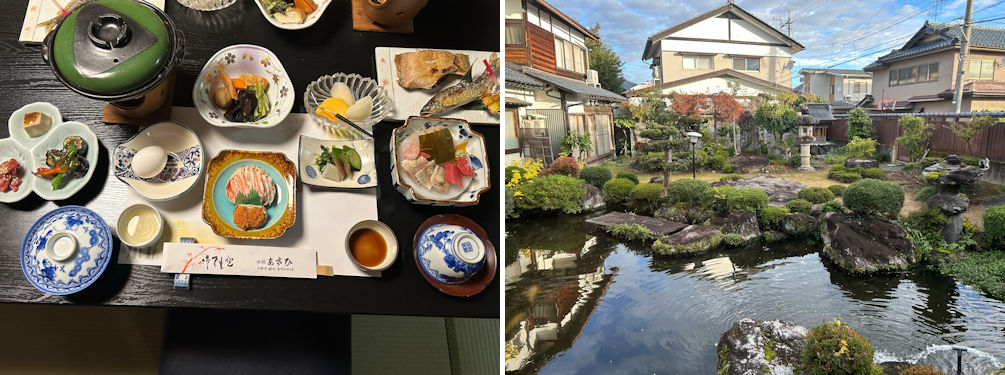
Dinner was a splendid kaiseki-style course that made generous use of local ingredients (left). Breakfast was served in the same room, and this time we were able to enjoy the view of the Japanese garden behind the inn—something we had not noticed the previous night after it had grown dark. (right).
On the morning of our second day, we had breakfast at the inn and then
headed early to Ichijodani. The Ichijodani Asakura Family Site lies about
a thirty-minute drive west from Echizen Ono, located west of the midpoint
between central Fukui City and Echizen Ono. At the edge of the site stands
the Ichijodani Asakura Family Site Museum, which was expanded and reopened
in October 2022. The museum’s English website is exceptionally informative and introduces the Ichijodani Site as "the
only ruins of a castle town in Japan which have been left undisturbed since
the Warring States period. During the Warring States period, many cultured
people and scholars visited Ichijodani and the knowledge, culture, and
cutting-edge technology they brought with them helped the local culture
blossom. Among Fukui Prefecture's long history, from a cultural standpoint,
this era was one where the culture was especially dazzling. This castle
town was the base of power for Asakura Family during the Warring States
period, and was very prosperous, but in 1573, it was burned down by Nobunaga
Oda's army. The Asakura Family collapsed and the castle town became buried
entirely under the earth. The Ichijodani Asakura Family Site Museum has
been working and excavating since 1967 to revive the Asakura Family's castle
town from its over 400-year slumber, and discover all there is to know
about the castle town and Asakura Family during the Warring States period.”
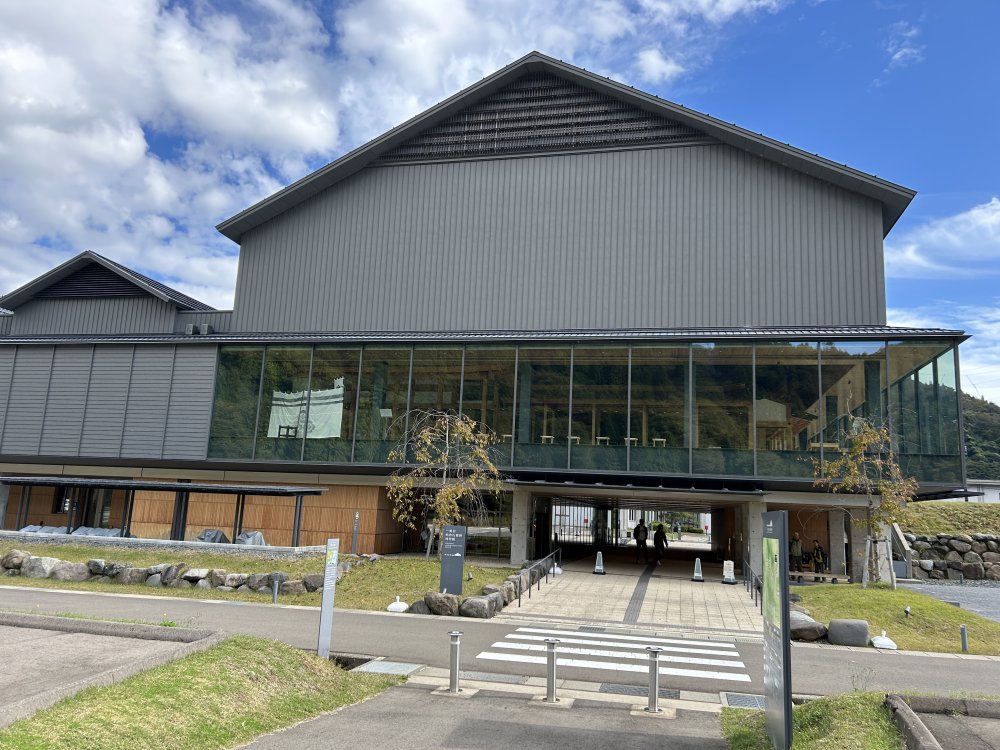
View of the museum from the car park. The Ichijodani Asakura Family Site Museum was expanded and reopened in October 2022.
The Warring States period, an age of competing warlords, came to an end when Toyotomi Hideyoshi, inheriting the ambitions of Oda Nobunaga, unified the country in the late sixteenth century, followed by the establishment of the Tokugawa shogunate in the early seventeenth century. Because many castle towns from that era were destroyed in the wars, the remains of the Asakura clan’s castle town at Ichijodani—“the only ruins of a castle town in Japan which have been left undisturbed since the Warring States period”—are extraordinarily rare, a historical discovery so significant that the site is often called “the Pompeii of Japan.” Wishing to study the site thoroughly, I had made an advance reservation for a guided tour with the association responsible for preserving the ruins. Before that tour, however, I planned to spend as much time as possible in the museum to build a solid foundation of knowledge.What you must not miss in the museum’s exhibits is the short video (about ten minutes) right after entering, in a space to the left, which introduces the history and culture of Ichijodani; the massive diorama of the castle town; and the full-scale reconstruction of Asakura Yakata (residence of the head of the Asakura Family), especially the garden that spans both inside and outside the residence, including the flower beds. When you later visit the actual site, you will find only the foundation stones, so it is helpful to have a clear picture of what the place once looked like by studying it here in advance. Another highlight is the stone-paved remains—believed to be a road—discovered during the construction of the present museum and preserved in situ inside the building. One theory holds that it was the approach to a temple.
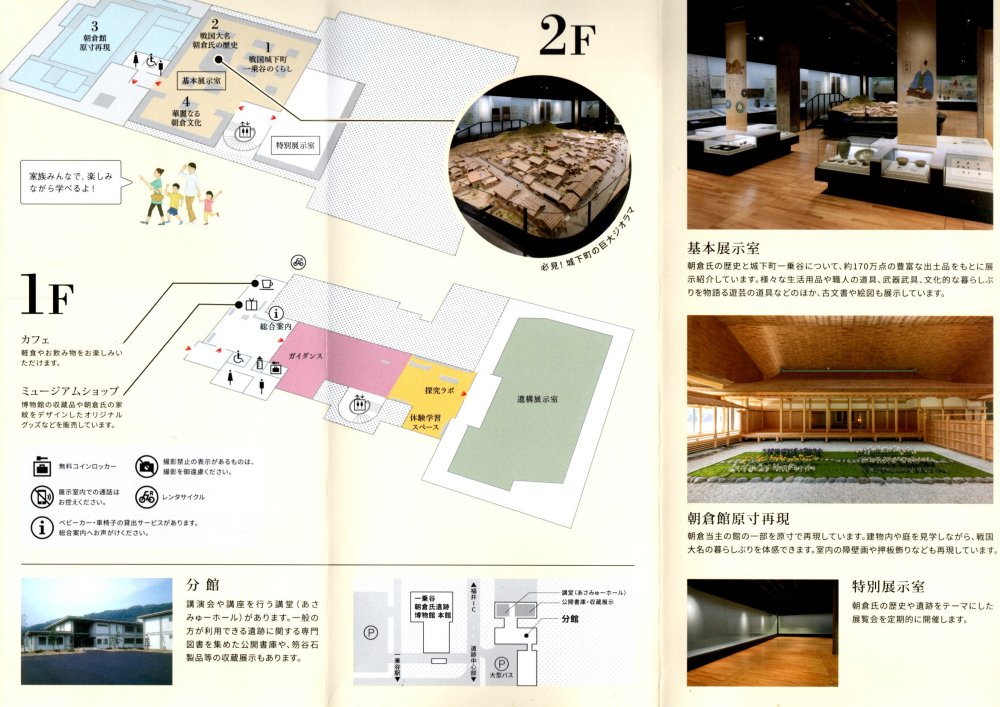
This is an excerpt from the museum pamphlet. On the second floor, the diorama shown in the circled photo just below the “2F”sign, as well as the full-scale reconstruction of the Asakura Residence in the middle section on the right, are not to be missed. Unfortunately, it appears that no English-language pamphlet is available.