
Rediscovering Japan
Rediscovering Japan
Travel (Enoshima (Fujisawa City, Kanagawa) Part 2)
by tomizuta
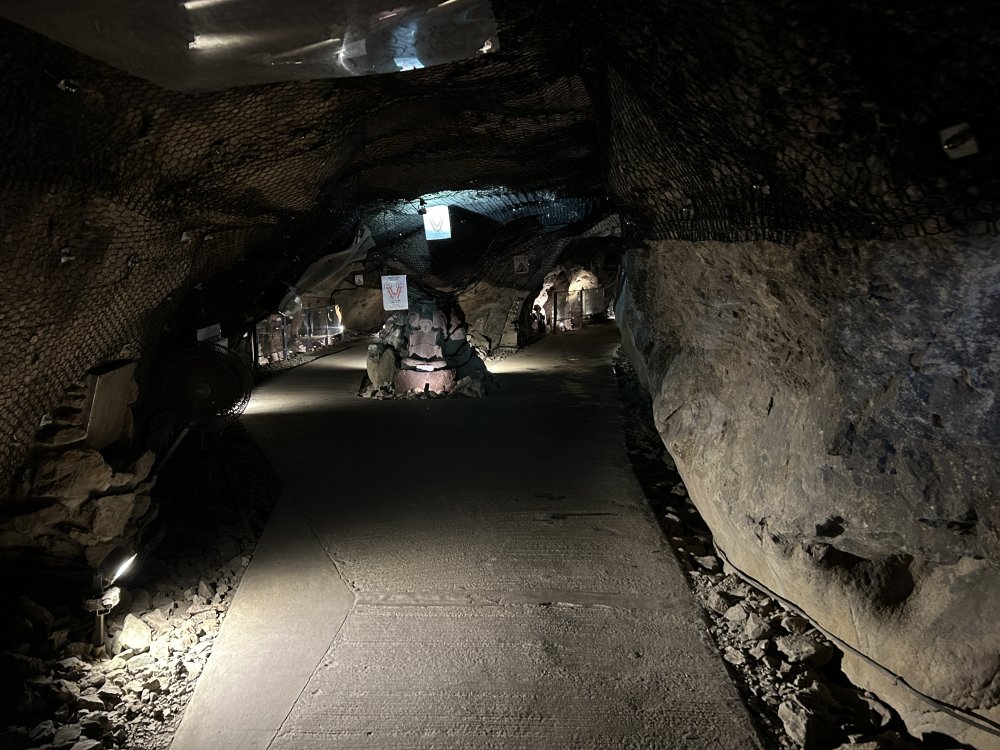
Inside the Iwaya Cave
From Samuel Cocking Garden, the path becomes noticeably more undulating. It first descends slightly. As is clear when looking at a map, Enoshima has a narrow “waist” near the center of the island, slightly to the west. At the bottom of the slope the path crosses a small bridge—this is the place known as Yama Futatsu (“Two Mountains”). A signboard explains: “This location is popularly called Yama Futatsu, as it forms the boundary dividing Enoshima Island. One theory holds that over many years the tides eroded the rock along the geological strata, forming a large sea cave that eventually collapsed, leaving what is now known as Yama Futatsu.” “Though you can’t see it because of the vegetation,” our guide pointed out, “the ground beneath this bridge has also collapsed.”
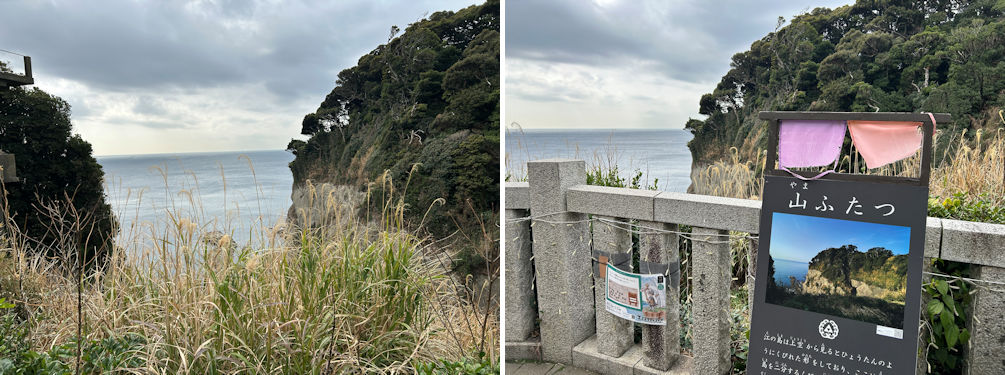
View of the narrow "waist" near the center of the island, slightly to the west (left). The signboard by the bridge explaining how the "waist" developed (right).
Beyond Yama Futatsu, the path begins to climb again. What surprised me was to find a row of restaurants lining the road along the way. This stretch is known as On-Iwaya-dori. “It’s still early, so it’s quiet now,” our guide said, “but by lunchtime there will be long lines here.” With only a handful of visitors about, I found that a little hard to believe at the time. He also told us, “There used to be many shops selling shell crafts here, but not a single one remains today.” Shell craft had become a well-established souvenir of Enoshima from the Edo period onward, and after the war the products were even exported abroad, enjoying a period of great prosperity. Eventually, however, the industry declined—not only in Enoshima but throughout Japan—pushed aside by inexpensive plastic goods and by changes in tourists’ lifestyles and tastes.
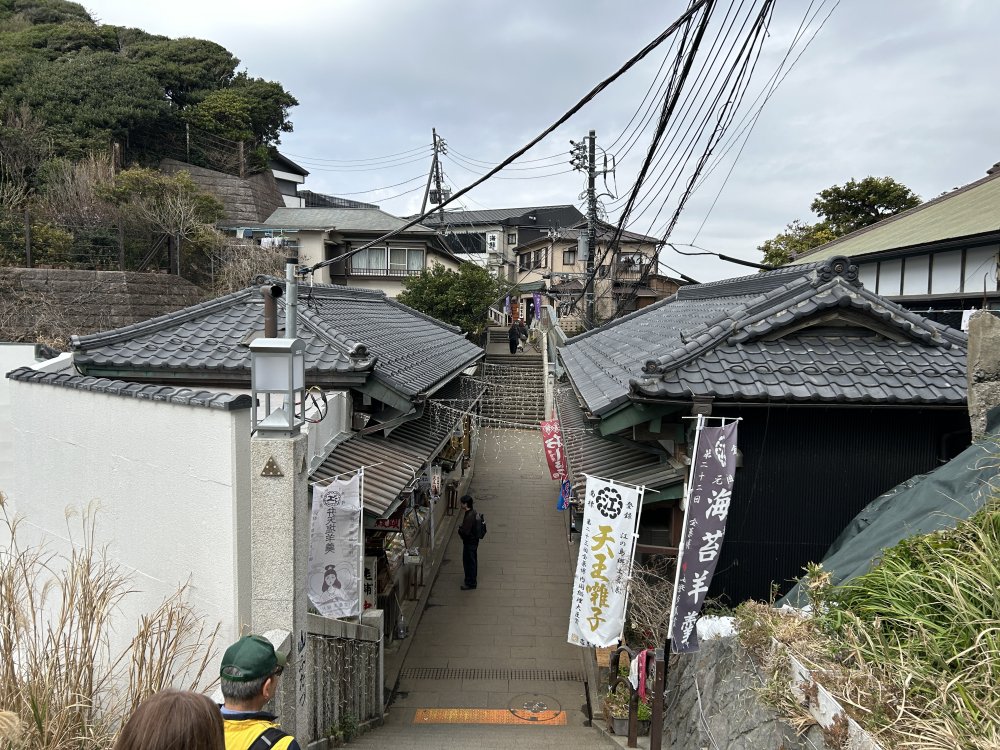
What surprised me was to find a row of restaurants and sweet shops lining the road along the way.
Proceeding further along On-Iwaya-dori, one arrives at Okutsunomiya Shrine, the third of the three shrines that compose Enoshima Shrine. The imposing shrine building seen today was rebuilt in 1842. On the ceiling of the worship area in front of the main sanctuary is the famous “Happo-nirami no Kame” (“Eight-Direction-Gazing Turtle”), painted by the Edo-period artist Sakai Hoitsu and restored in 1994. The turtle is said to glare down at the viewer no matter where one stands beneath it. The painting seen today is a replica; the original has been preserved separately.
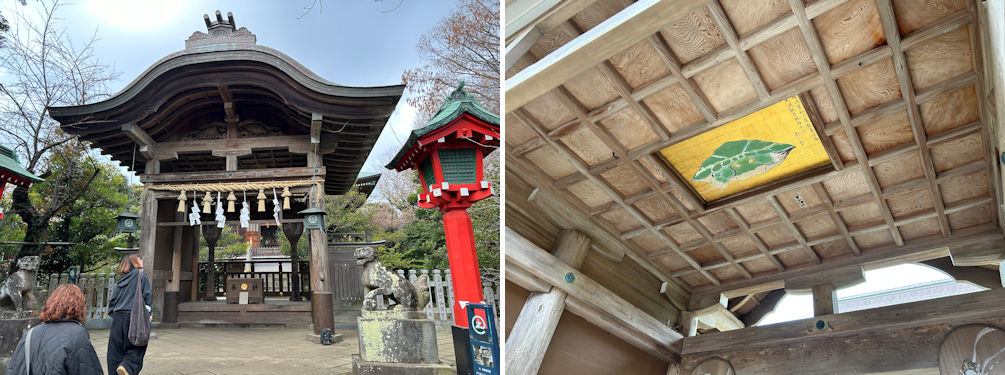
The main shrine building (honden) of Okutsunomiya Shrine (left). the famous “Happo-nirami no Kame” (“Eight-Direction-Gazing Turtle”), painted by the Edo-period artist Sakai Hoitsu and restored in 1994 (right).
Within the grounds of Okutsunomiya Shrine stands a bronze statue of Yamada Kengyo. The title Kengyo was the highest rank granted to blind men in a professional guild system that existed from the Muromachi period onward. “In the Edo period, the shogunate protected certain professions as exclusive occupations for the blind,” our guide explained. “These included musical arts such as the koto and shamisen, as well as therapeutic practices like acupuncture and massage.” An online exhibition of the National Diet Library titled “Koto: Harping about the Harp” describes the organization known as Todo, whose members enjoyed such patronage: “It began with guilds formed by blind monks known as biwa hoshi. Under the Muromachi and Edo shogunates they were officially protected. As a musical community they developed a distinctive repertoire centered on the shamisen, koto, and kokyu, but their activities were not limited to music—they also practiced acupuncture, moxibustion, massage, and even moneylending.” It was here that I first learned that Enoshima Shrine’s deity Benzaiten, revered as a patron of the arts, was worshipped not only by performers such as Kabuki actors but also by the blind. The man commemorated by the statue, Yamada Kengyo, was the founder of the Yamada-ryu, one of the two major traditions of koto music. He is credited with bringing the art of sokyoku (koto music), which had been centered in Kyoto and Osaka, to Edo and developing it into a distinctive Edo style.
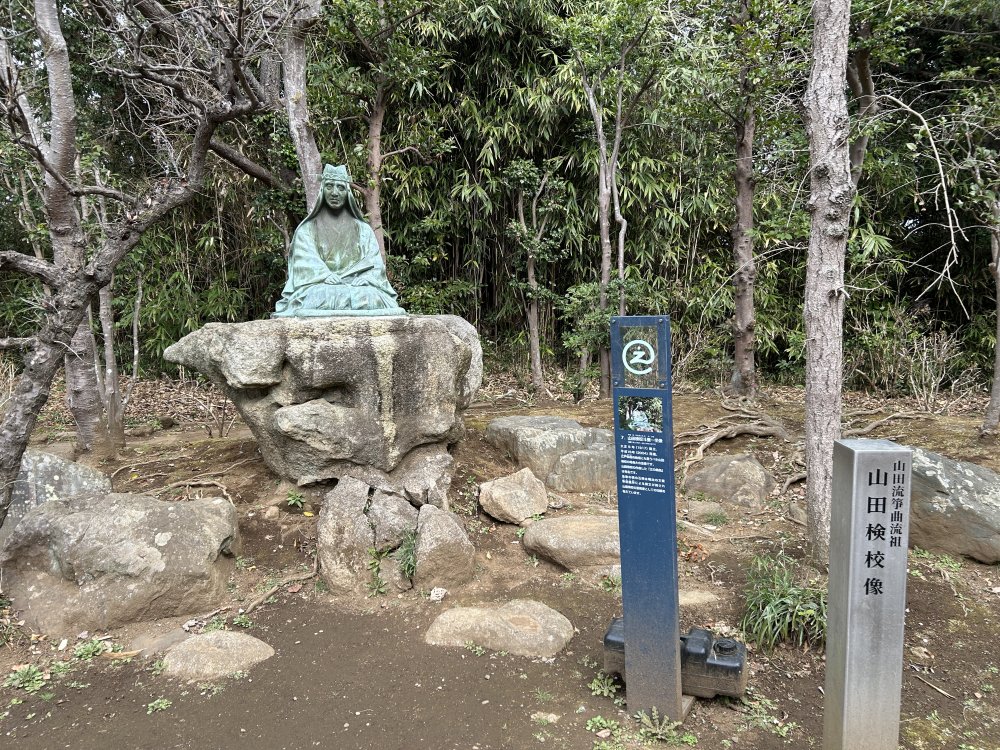
The statue of Yamada Kengyo in the grounds of the Okutsunomiya Shrine.
Leaving Okutsunomiya Shrine and continuing on, one soon reaches another torii gate. From here the path turns into a steep flight of descending steps. One only fully appreciates it on the way back, when the climb up these same stairs proves quite demanding. Just beyond the torii, before starting down the steps, there is a restaurant. At first one cannot help wondering why a restaurant would be located in such a place. But when returning later—climbing back up the stairs out of breath—it becomes clear that it is actually a perfect spot for attracting weary travelers.
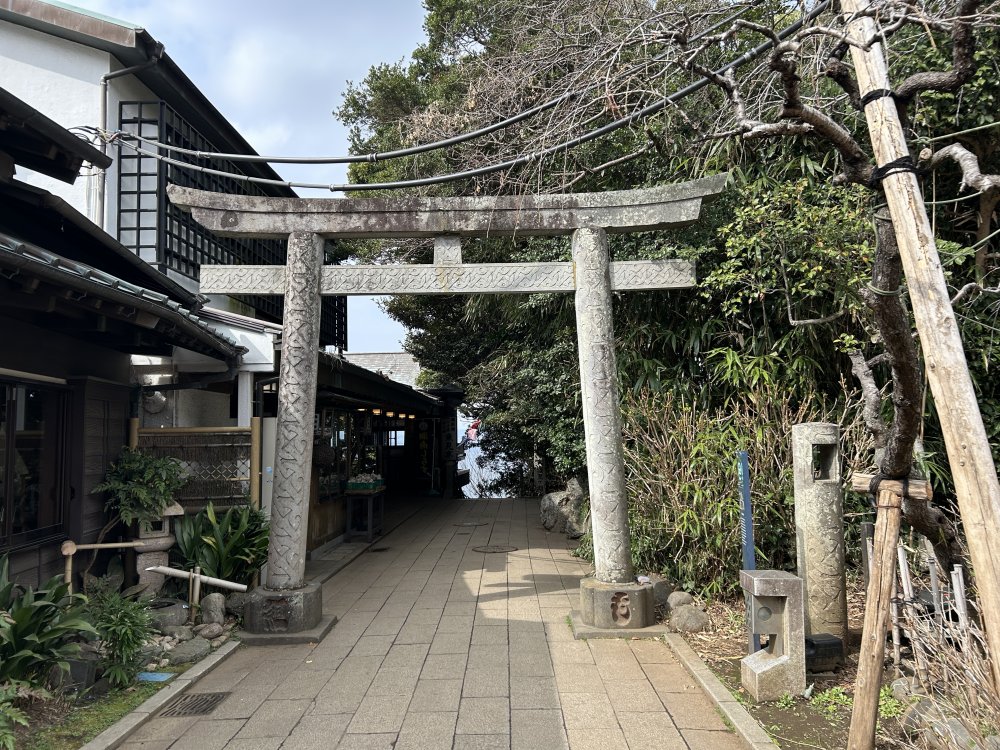
From here the path turns into a steep flight of descending steps. There is a restaurant just behind the torii gate.
At the bottom of the stairs we reached the island’s westernmost shore, a scenic spot known as Chigogafuchi. The word chigo refers to boys who lived at major temples, where they were educated and trained in proper conduct. “According to legend,” our guide explained, “a monk from Kencho-ji in Kamakura fell in love with a chigo and sent him letters again and again, but never received a reply. In the end, the boy threw himself into the sea from this very spot. That is how the place came to be called Chigogafuchi.”
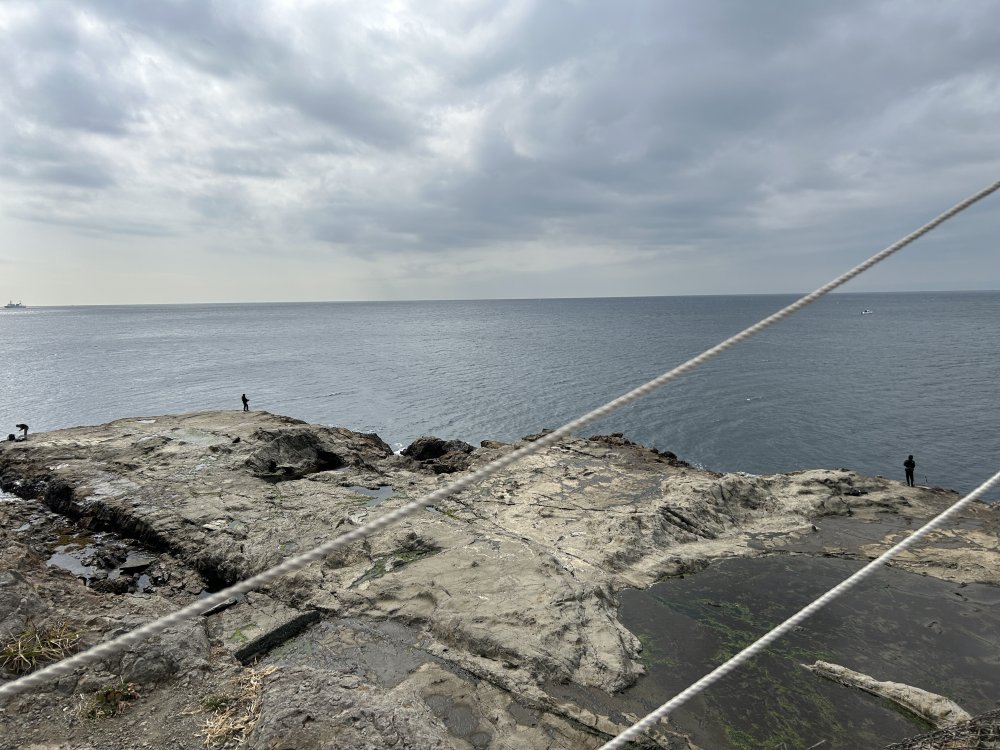
This is a scenic spot known as Chigogafuchi.
Following the paved path along the coast from Chigogafuchi, we eventually arrived at the Enoshima Iwaya Cave, which had been my main reason for visiting Enoshima. These caves were formed in the sea cliffs through erosion by waves. According to Fujisawa City Tourist Association’s description of Iwaya Cave pamphlet, “It is said that in ancient times Kukai and Nichiren also practiced ascetic training here, and the site has long been revered as the birthplace of the Enoshima faith. It is also said that in 1182 Minamoto no Yoritomo prayed here for victory in his campaign against Fujiwara no Hidehira (for more information on Hidehira and the Fujiwara Family, click here).” The first of these claims, however, is based on legend. The story concerning Yoritomo appears in Azuma Kagami, a historical record of the Kamakura shogunate compiled around 1300. This is the earliest reference to Enoshima preserved in historical sources, though it does not actually mention the Iwaya cave itself. What the text states more precisely is that high priest Monkaku of Takao invited Benzaiten to the island and conducted a consecration ceremony, which Yoritomo attended together with his commanders. At the very least, it seems clear that by the 12th century the island had already become a place of religious devotion and ascetic practice.
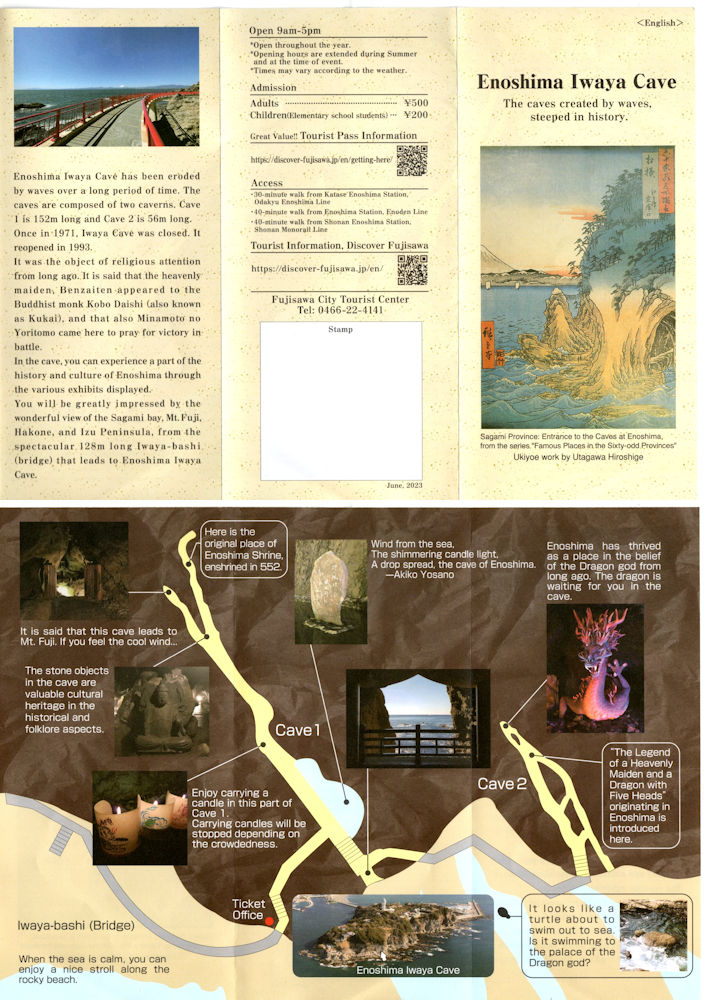
The English pamphlet of Iwaya Cave.
There are two caves here: the First Cave, which extends 152 meters, and the Second Cave, which is 56 meters long, both part of the Enoshima Iwaya Caves. In the First Cave, visitors are given a candle to carry as they explore the interior. Explanatory panels in both Japanese and English describe the cave, noting that it was formed over thousands of years as waves gradually eroded the rock along geological faults. At the very end of the cave, a panel explains—again in both languages—that “since ancient times, it has been said that this cave continues all the way to the Narusawa Ice Cave at the foot of Mount Fuji.”
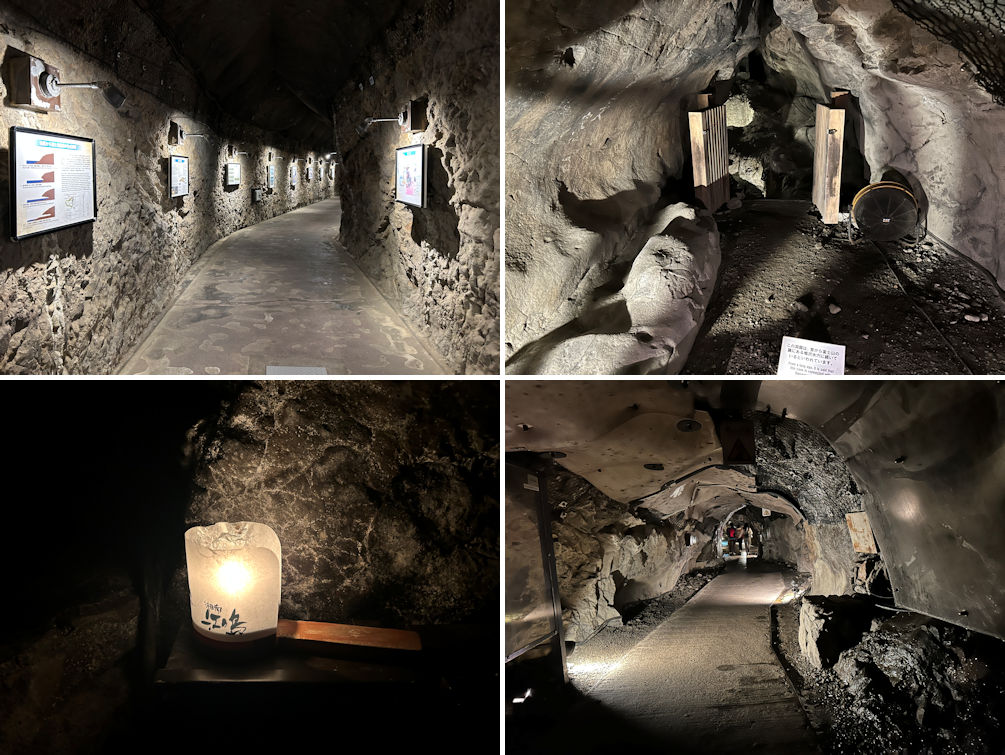
Explanatory panels of the cave in both Japanese and English are provided close to the entrance (upper left). The very end of the cave said to continue all the way to the foot of Mount Fuji (upper right). The candle light visitors are provided with (lower left). It gives you a dramatic feel, although the cave is relatively well lit, and a view of the cave close to the end (lower right).
Inside the Iwaya Cave, various objects along the way also deserve attention. These include a rock said to resemble the sleeping figure of Nichiren, a small shrine guarded by komainu statues, and a stone monument bearing a poem by Yosano Akiko. Akiko’s poem, written in 1911, depicts droplets of water scattering as they strike the flame of a candle flickering in the wind blowing in from the sea. It is not difficult to imagine that for many years people have entered this cave carrying candles as they came to pray, leaving behind carvings and other offerings as tokens of their devotion.
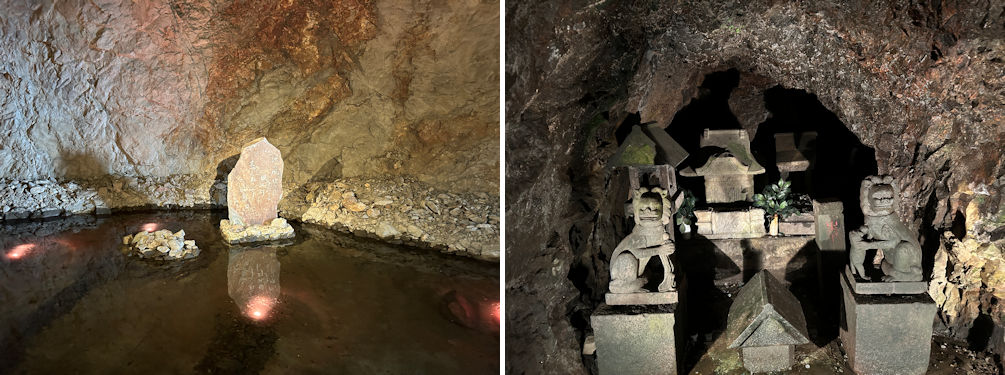
The stone monument bearing a poem by Yosano Akiko (left). A small shrine guarded by komainu statues (right).
Once you exit the First Cave of the Iwaya Cave, the entrance to the Second Cave is almost immediately beside it. The Second Cave is much shorter, and in places the ceiling is so low that visitors must bend over to proceed, making it difficult for those with back problems. At the far end of the cave, the interior is illuminated in purple light, where a statue of Ryujin, the dragon god of the sea, is enshrined. When visitors clap their hands in front of it, flashes of lightning appear.
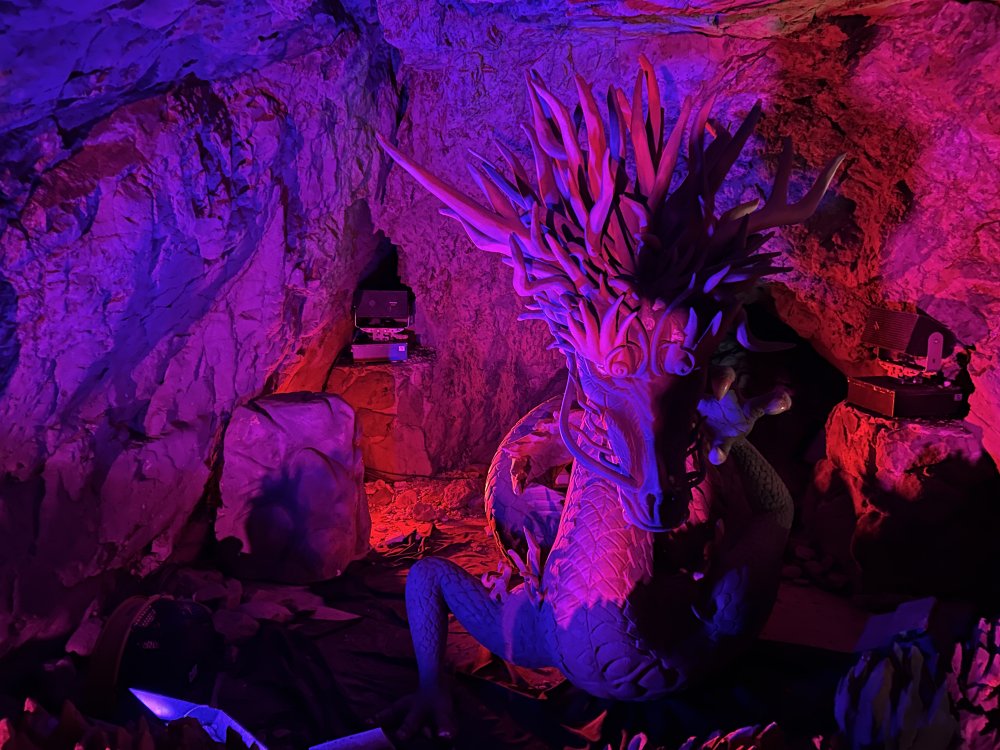
A Ryujin awaits you at the end of the cave.
The connection between Enoshima and dragons is inseparable. As mentioned earlier, the oldest historical document referring to Enoshima is the Azuma Kagami, compiled around 1300. On the other hand, the origins of Enoshima are described in the Enoshima Engi and later works based on it. The surviving manuscripts—including one preserved by Enoshima Shrine—date from the 14th century onward. Nevertheless, some scholars believe that the legend itself must already have existed by the late 12th century, when Enoshima was mentioned in the Azuma Kagami. The story goes as follows: Long ago, in a bottomless lake in Kamakura there lived a fearsome dragon with a single body and five heads. The dragon often raged violently, causing landslides and floods that brought great suffering to the people. One day in 552, the sea suddenly began to churn, and a beautiful heavenly maiden descended from the sky. At that very moment an island rose miraculously from the sea—this was Enoshima. The dragon fell in love with the maiden at first sight and asked her to marry him. She refused, however, citing the many evil deeds he had committed. Repentant, the dragon thereafter devoted himself to good deeds in service of the people. At last the maiden relented and agreed to marry him. When the dragon’s life finally came to an end, he vowed to protect the island where his bride lived and transformed himself into the mountain on the opposite shore. Benzaiten is associated with the image of this heavenly maiden, and Enoshima may truly be called the island of the legend of the celestial maiden and the dragon god—a realization that struck me vividly during this visit.
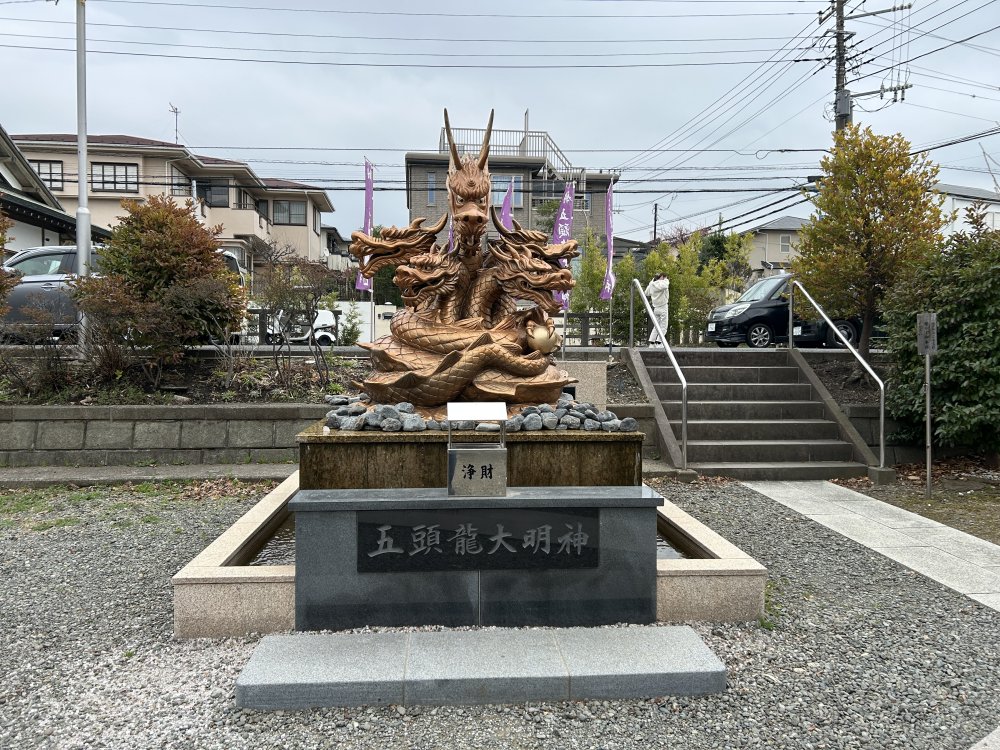
The five-headed dragon worshipped as a deity at Ryuko-myo Shrine
After finishing our visit to the Iwaya Cave, we retraced our steps. Climbing back up the steep stairs we had earlier descended proved quite a challenge. When we finally reached the landing, it became clear why the restaurant staff there were so eager to call out to passing visitors. After thanking our guide and saying goodbye, we left Enoshima. But there was still one more place we needed to stop by on the way back: Ryuko Myojin Shrine (Ryuko-Myojinja), where, according to legend, the five-headed dragon watches over the heavenly maiden from the opposite shore. The shrine stands in a quiet residential neighborhood within Kamakura. Although it was only a short overnight trip, the experience revealed the deep charm of Enoshima and left me eager to return.
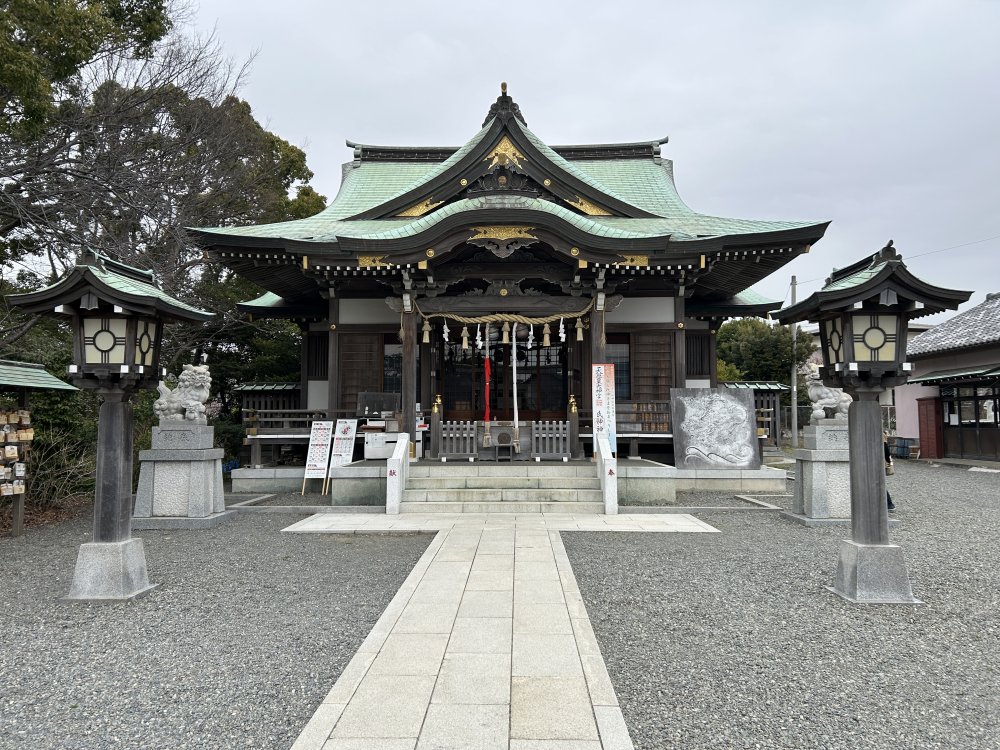
The main shrine building (honden) of Ryuko Myojin Shrine
back to Enoshima Part 1
back to top page