
Rediscovering Japan
Rediscovering Japan
Travel (Enoshima (Fujisawa City, Kanagawa) Part 1)
by tomizuta
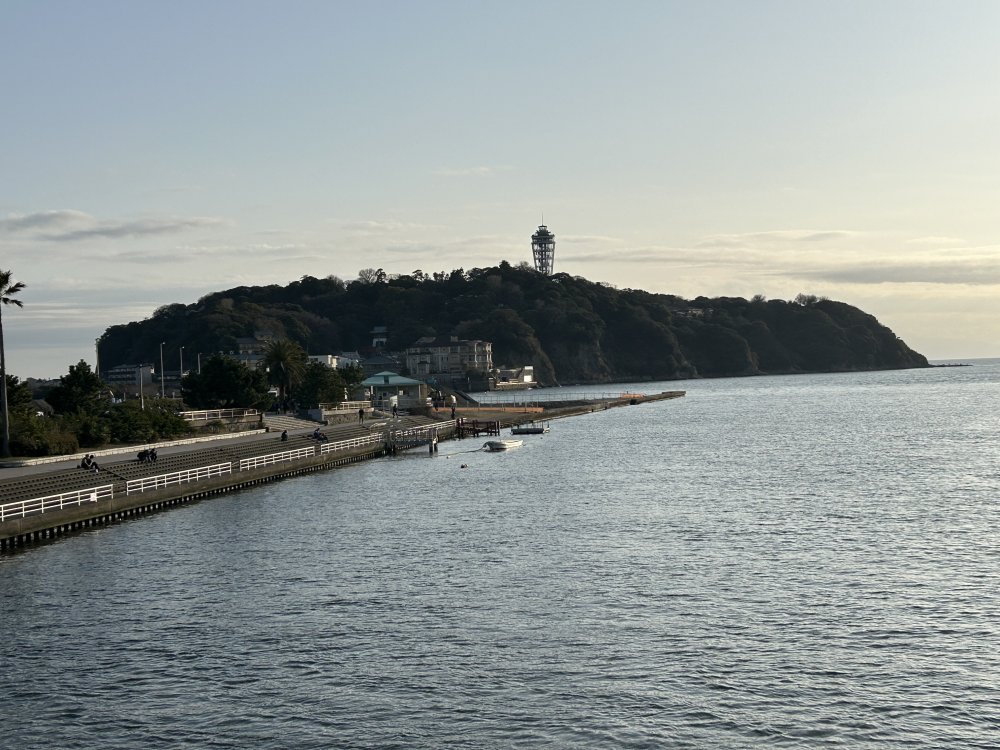
Enoshima as viewed from the inland shoreline.
When Japanese people hear the name Enoshima, almost everyone immediately knows what is meant: “Ah yes, Enoshima on the Shonan coast, near Kamakura.” It is that well known as a sightseeing destination. When guiding overseas visitors in Kamakura, I often conclude the itinerary by taking the charming little train popularly known as the Enoshima Electric Railway, or Enoden, from Kamakura Station to Hase. There I introduce guests to Hasedera Temple and the Great Buddha of Kamakura. Yet despite its fame and proximity, I realized on reflection that I had never actually taken the time to explore Enoshima itself in any depth. The national government–licensed guide interpreter qualification requires extensive preparation. When I recently pulled out the textbook I had used while studying for the examination and reread the section on Kanagawa Prefecture, I noticed something interesting. The entries on Hakone, Kamakura, and Yokohama were quite detailed, yet the description of Enoshima was surprisingly brief—little more than a note that the Enoden train running toward the scenic tied island of Enoshima is popular with visitors. Since 2025 I have begun making a series of short journeys to rediscover individual destinations in Tokyo and within easy day-trip distance of the capital. As part of that project, I visited Enoshima in Kanagawa Prefecture for a two-day, one-night stay in early March 2026.
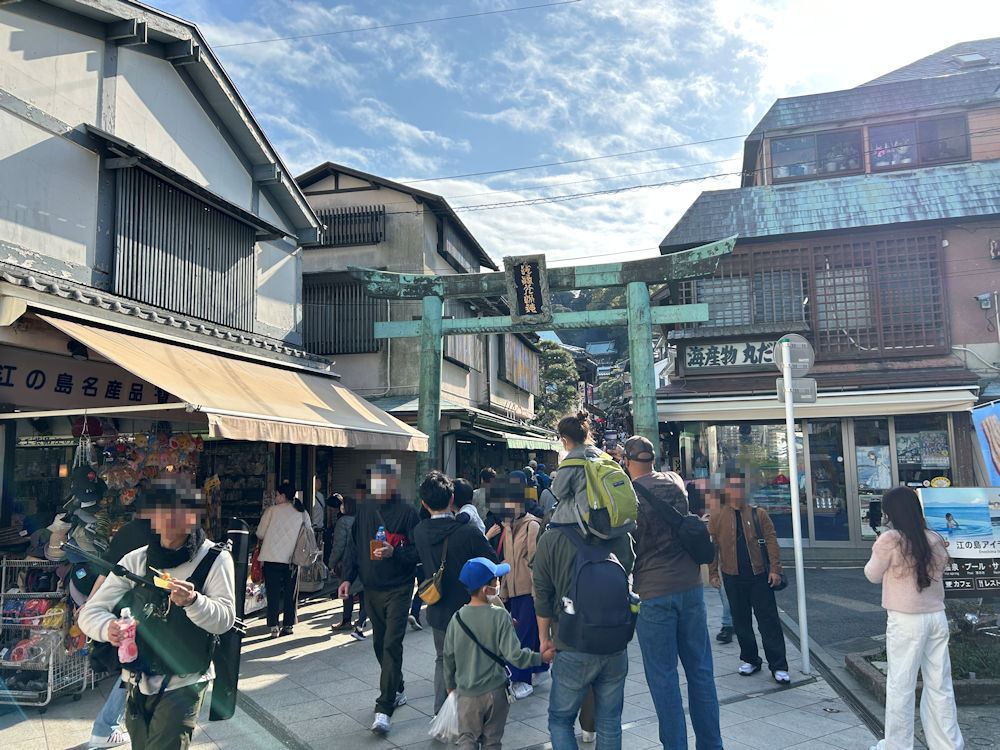
From the mainland, the first sight upon crossing to the island is the entrance torii gate and the Enoshima Benzaiten Nakamise Street shopping street that stretches beyond it.
Enoshima is a remarkably rugged island measuring roughly four kilometers in circumference. The only way to reach it is by crossing a bridge about 400 meters long. Once on the island, there is essentially just a single road wide enough for cars, continuing straight from the bridge. This road leads to the yacht harbor on the island’s northeastern shore, an area reclaimed and developed as the sailing venue for the 1964 Summer Olympics. Parking facilities are located just before reaching this harbor area. The typical sightseeing route on Enoshima begins at the torii gate directly ahead after crossing the bridge and proceeds uphill along Enoshima Benzaiten Nakamise Street, a lively approach lined with shops leading toward the island’s shrines. Around the torii gate where this street begins, visitors were packed shoulder to shoulder. One of the first things that struck me about Enoshima was the large number of seafood restaurants clustered near the entrance to Nakamise Street, many displaying shellfish and other fresh catches from the nearby sea. Scenes like this were once common at seaside resort towns throughout Japan, but today they have become surprisingly rare, making the atmosphere here feel almost nostalgic.
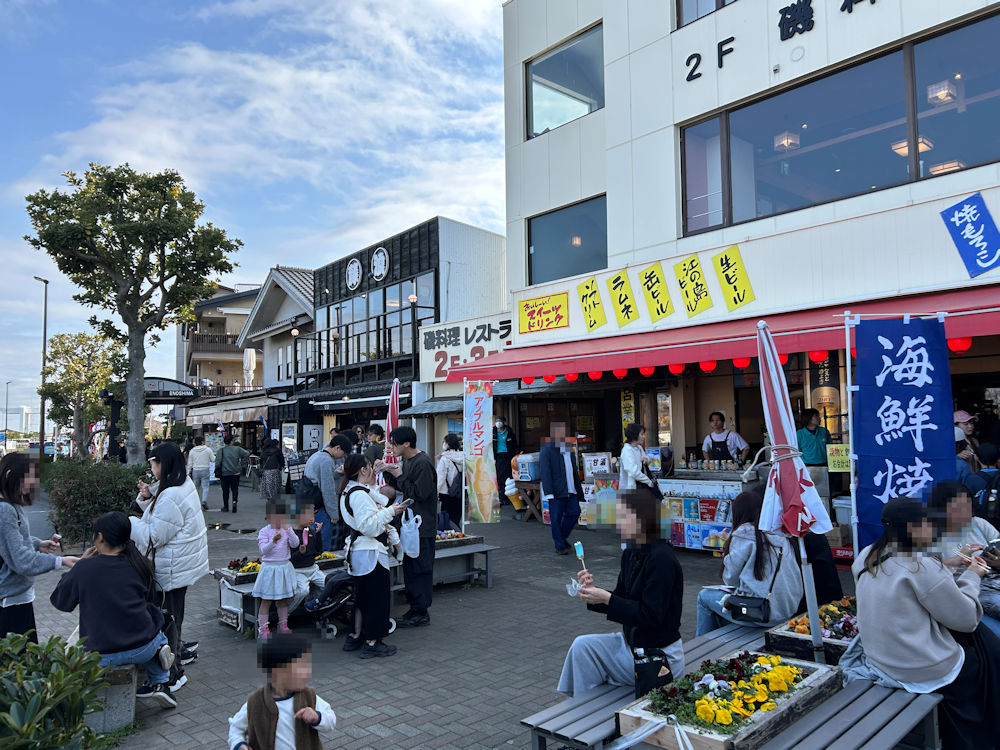
One of the first things that struck me about Enoshima was the large number of seafood restaurants clustered near the entrance to Nakamise Street, many displaying shellfish and other fresh catches from the nearby sea.
Since we had arranged for a local guide to show us around the island the following morning, we decided to cross back the bridge on foot that afternoon and explore the mainland side. Retracing the road by which we had arrived, we walked for about twenty minutes before a large temple came into view directly ahead. This was Ryukoji Temple, a temple belonging to the Nichiren Buddhism sect. Although the name Ryuko-ji is written with the characters meaning “Dragon’s Mouth,” it actually derives from the place name Tatsunokuchi, which is written with the same characters and read in the same way. This place name is closely connected with the history of Enoshima, though the explanation for that relationship is best left for later. Nichiren Buddhism was founded in the latter half of the thirteenth century by Nichiren, one of the influential figures of the so-called Kamakura schools of Buddhism. Emphasizing the teachings of the Lotus Sutra, Nichiren gained followers through the belief that salvation could be attained simply by chanting the phrase Namu Myoho Renge Kyo (meaning "I believe in the teachings in the Lotus Sutra."). At the same time, he submitted remonstrations to the Kamakura Shogunate, sharply criticizing both the authorities and other Buddhist sects. This brought him considerable hostility. According to tradition, Nichiren was brought to this very place to be executed. At the moment the execution was about to be carried out, however, a brilliant light—said to resemble the full moon—flew across the sky from the direction of Enoshima. The execution was halted, and his punishment was instead commuted to exile on Sado Island. Based on this episode, which is regarded as one of the four major persecutions suffered by Nichiren, Ryukoji Temple was founded in 1337 by one of his disciples. This explanation is given on the temple’s information board.
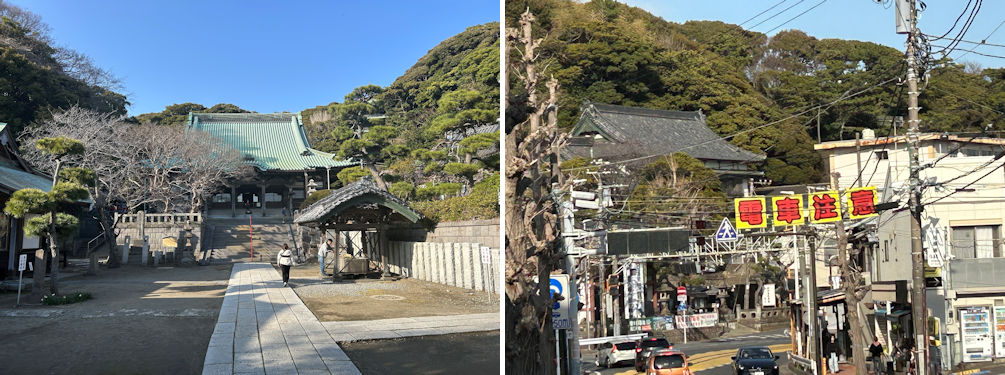
Ryukoji Temple (left). Just before reaching Ryukoji Temple from Enoshima, the tracks of the Enoshima Electric Railway (Enoden) cross the road. The yellow sign warns motorists to watch for approaching trains(right).
Ryukoji Temple stands along the national highway leading from Yokohama toward Enoshima, but a little to the west runs Subana-dori, a street that passes Enoden Enoshima Station and continues straight south toward the island. This street follows the old course taken by pilgrims traveling to Enoshima during the Edo period. Today it is lined with a mixture of long-established souvenir shops and restaurants serving coastal seafood dishes, alongside a number of modern cafés and eateries.
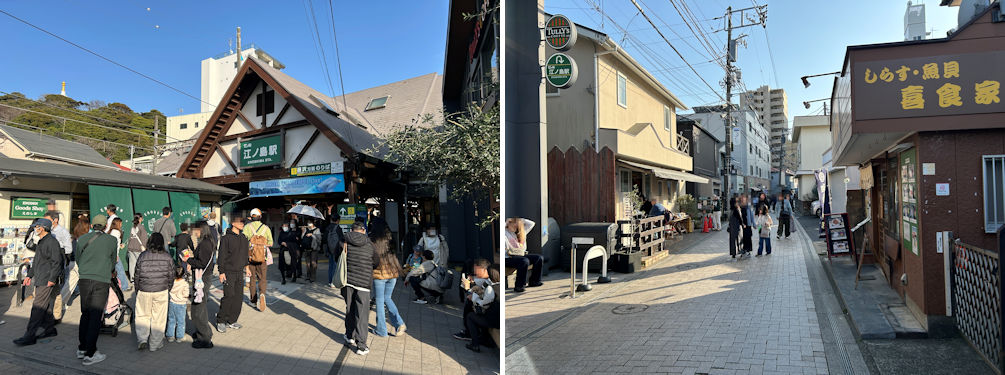
The exit of the quaint Enoshima Station on the Enoshima Electric Railway also faces Subana-dori (left). it is lined with a mixture of long-established souvenir shops and restaurants serving coastal seafood dishes, alongside a number of modern cafés and eateries (right).
After passing through Subana Street and nearing the point where we would return to the island, we turned right (west), crossed the river, and suddenly found ourselves facing a striking building whose ornate rooflines and bright colors make it look like an undersea palace from a Japanese fairy tale. This was Katase-Enoshima Station on the Odakyu Line. The day was unseasonably warm, with temperatures exceeding 20°C. To quench our thirst, we stopped at a café on the second floor of a riverside building. Whether arriving via Enoshima Station on the Enoshima Electric Railway or via Katase-Enoshima Station on the Odakyu Line, visitors should allow at least fifteen minutes on foot to reach Enoshima.
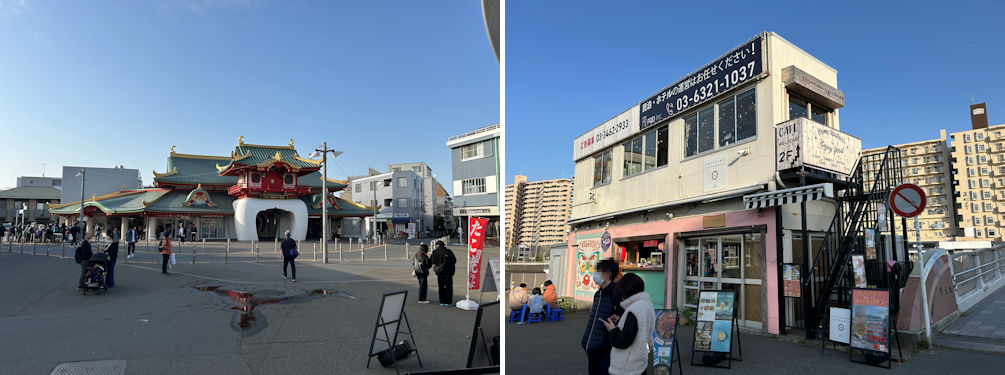
We suddenly found ourselves facing a striking building whose ornate rooflines and bright colors make it look like an undersea palace from a Japanese fairy tale. This was Katase-Enoshima Station on the Odakyu Line (left). To quench our thirst, we stopped at a café on the second floor of a riverside building (right).
Crossing Enoshima Benten Bridge, we returned to the island and checked in at Ebisuya Ryokan, a long-established inn said to date back to 1615. The ryokan stands just off Enoshima Benzaiten Nakamise Street, a short distance up the street before turning into a side lane. Breakfast the next morning was served in the large banquet hall. Nearly all the tables were occupied, suggesting that the inn was fully booked, yet the atmosphere remained remarkably quiet and calm. The building also contains a small in-house museum. Although it is open only from 7:00 to 10:00 in the morning, it displays several intriguing items, including a letter by Toyotomi Hideyoshi and Ukiyo-e depicting Enoshima. Anyone staying here should make a point of visiting it.
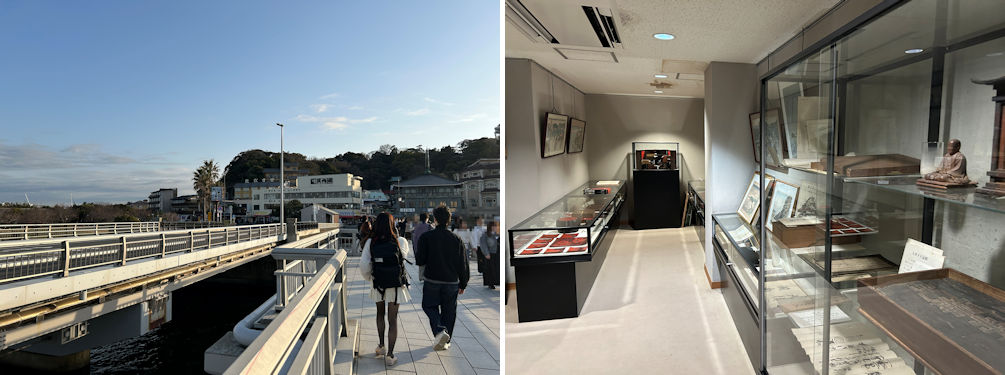
The sign of Ebisuya Ryokan (just in between the tall tree and the pole) can be seen as you approach the island (left). The inn has a small in-house museum worth a visit (right)
On the second day, we were guided around the island from early in the morning by a local guide. He was an affable elderly gentleman with an impressive depth of knowledge. The many things he pointed out to us along the way proved invaluable in helping us better understand Enoshima, and in the following account I will weave in some of the insights he shared. The tour began at the Torii Gate of Enoshima Shrine, which stands directly ahead after crossing Enoshima Benten Bridge, the symbolic gateway to the island. This bronze torii gate was originally erected in 1747 and later rebuilt in 1821 through donations from numerous benefactors from Edo; their names are still engraved on its pillars. During the Edo period, commoners were not permitted to travel simply for pleasure. Journeys were allowed mainly for visits to hot-spring resorts for convalescence or for pilgrimages to temples and shrines. As our guide explained:“People from Edo would first visit Oyama Afuri Shrine, and then continue on to pray at Enoshima and Kamakura before returning home. Compared with major pilgrimages such as the journey to Ise Grand Shrine, this route was much closer to Edo and became a very popular destination. As a result, Enoshima flourished as well.”
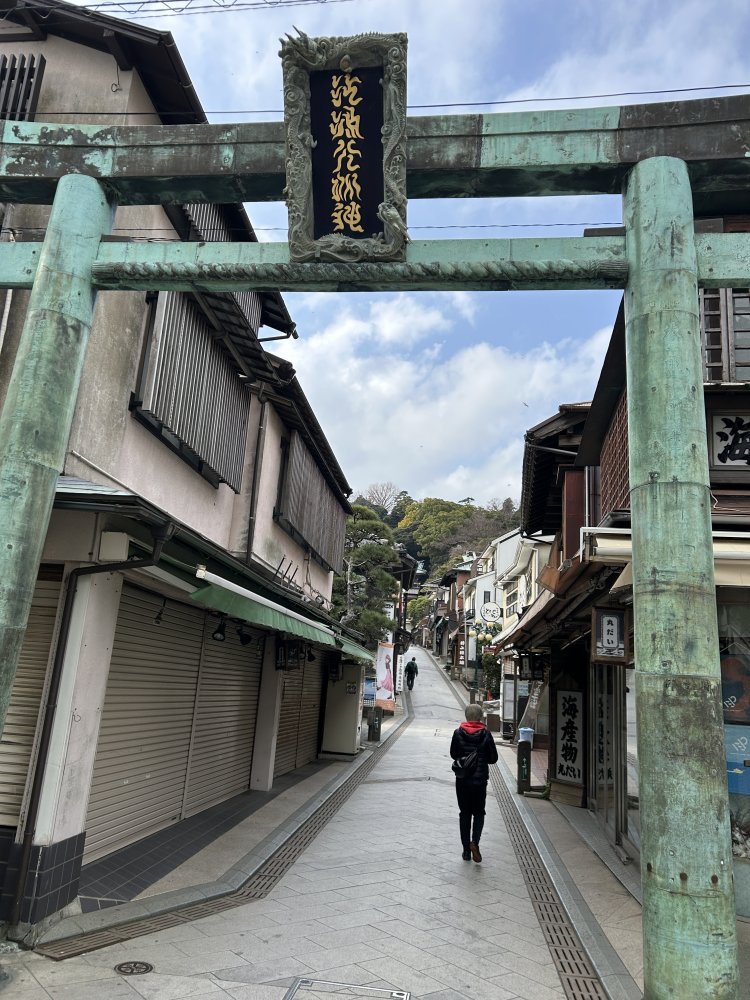
The great bronze torii marking the entrance to Enoshima. The plaque reading “Enoshima Daimyojin” is a replica of a calligraphic tablet said to have been bestowed by Emperor Go-Uda in 1275 to commemorate the repulse of the first Mongol invasion in 1274. The present torii was rebuilt in 1821, and the names of numerous donors—many of them wealthy townspeople from Edo—are engraved on its pillars. Perhaps because it was early on a weekday morning, there were far fewer visitors than on the previous Sunday afternoon.
Around Enoshima one repeatedly encounters the names Benten and Benzaiten—in places such as Enoshima Benten Bridge and Enoshima Benzaiten Nakamise Street. To understand the island’s religious history, it is helpful to pause briefly and explain who Benzaiten is. Enoshima has long been regarded as an island of history and faith. Today the principal place of worship is Enoshima Shrine, but before the Haibutsu Kishaku of the early Meiji period—when the new government elevated Shinto and ordered the separation of Shinto and Buddhism, triggering a nationwide movement against Buddhist institutions—the site was in fact a Buddhist temple dedicated to Benzaiten. Benzaiten originates from Saraswati, a Hindu goddess from India who was incorporated into Buddhism and later introduced to Japan. In Japan, Benzaiten images appear in two main forms: one with two arms and another with eight. The eight-armed form derives from the Golden Light Sutra and seems to have been embraced during the Nara period from the perspective of chingo kokka—the protection of the state—depicting her as a martial deity holding weapons in her eight arms. The oldest known eight-armed Benzaiten in Japan is an eighth-century statue preserved at Todai-ji. By contrast, images of Benzaiten with two arms playing the biwa (lute) appeared from the Kamakura period onward. Over time she spread among the common people not only as a deity of war but also as a goddess of water and music, and eventually as a bringer of good fortune. This explains why Benzaiten shrines are often found near water throughout Japan. She is also the only female deity among the Japanese Shitifukujin (Seven Lucky Gods are usually depicted riding together on a sailing vessel flying a banner bearing the character “treasure” (宝). At Enoshima Shrine, two important images are enshrined: the nationally designated Important Cultural Property known as Happi Benzaiten (the Eight-Armed Benzaiten) and Myo-on Benzaiten, a two-armed figure depicted playing the biwa.
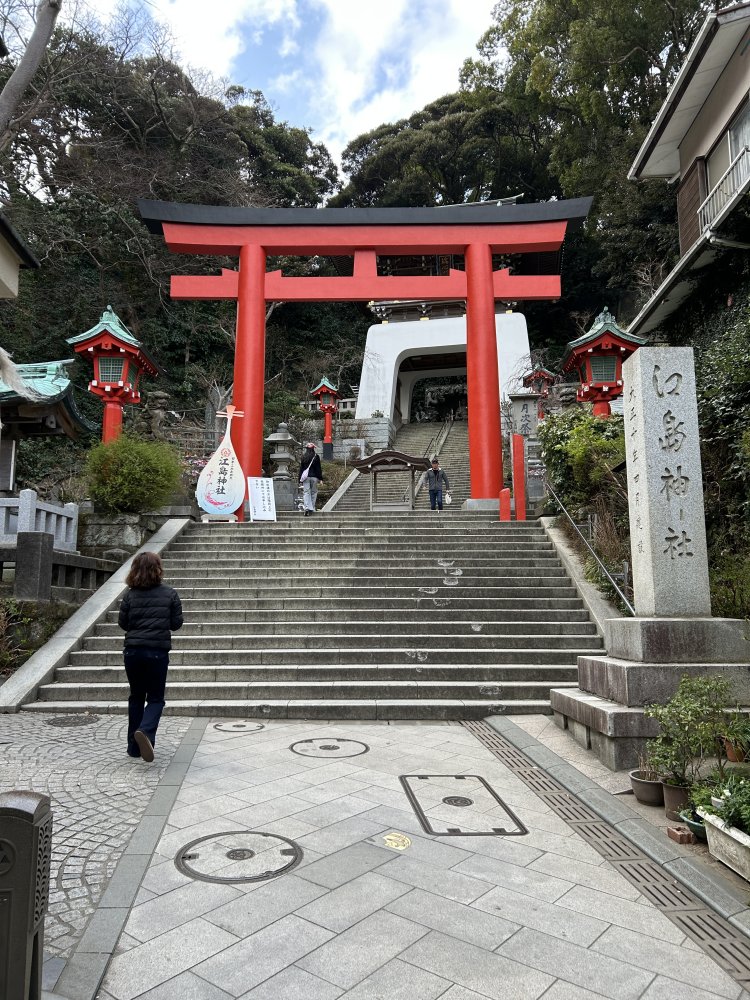
Beyond Enoshima Benzaiten Nakamise Street lies the entrance to Enoshima Shrine—or rather, the street itself serves as the shrine’s sando (approach). Note the giant replica of a biwa, the lute associated with Benzaiten, leaning against the left-hand pillar of the torii.
Perhaps because it was early on a Monday morning, Enoshima Benzaiten Nakamise Street was strikingly quieter than it had been the previous day. The greatly reduced crowds made it ideal for exploring at a leisurely pace. If possible, it is probably best to avoid visiting on weekends. At the top of Enoshima Benzaiten Nakamise Street stands a torii gate marking the entrance to Enoshima Shrine. The shrine complex consists of three separate sanctuaries, and the first one we reached was Hetsunomiya Shrine. Fittingly for a shrine dedicated to Benzaiten, a large replica biwa (lute)—the instrument closely associated with the goddess—leans against the left pillar of the torii. Beside the main shrine building there is a Benten-do dedicated to the Benzaiten, where visitors can pay an admission fee to view sacred ornaments including the Eight-Armed Benzaiten and Myo-on Benzaiten, the two-armed figure playing the biwa. Unfortunately, owing to time constraints, we were unable to visit the hall on this occasion—something I now regret.
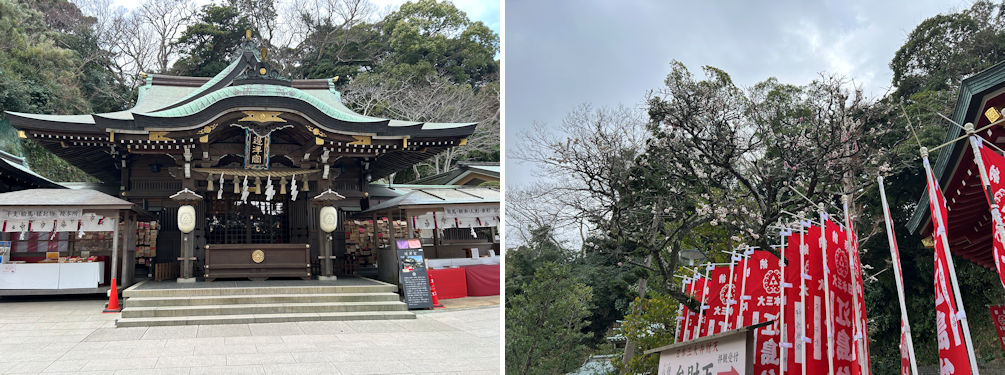
The main shrine of Hetsunomiya (left). The Benten-do beside the main shrine (right)
Proceeding beyond Hetsunomiya Shrine, a small park appears on the left. Passing it and climbing further up the hill, the second shrine—Nakatsunomiya Shrine—comes into view. According to the website of Enoshima Shrine, this shrine was founded in the 9th century by the eminent monk Jikaku Daishi (Ennin). The present shrine building faithfully reproduces a structure erected in the late 17th century by the Tokugawa shogun Tokugawa Tsunayoshi, and was reconstructed in 1996. Along both sides of the approach stand a pair of stone lanterns dedicated by the Edo-period Kabuki theaters Ichimura-za and Nakamura-za. Handprints of Kabuki actors also remain, suggesting that the shrine enjoyed the devotion of people whose livelihood was in the performing arts.
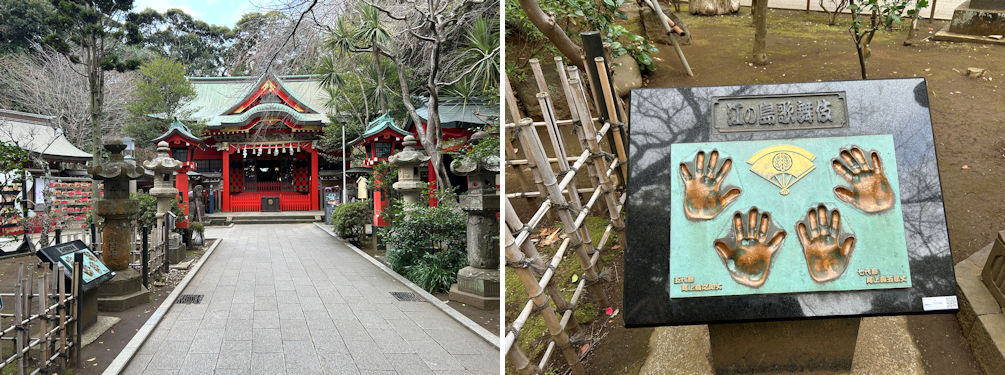
The honden (main shrine building) of the Hetsunomiya Shrine (left). Handprints of Kabuki actors, the 5th Kikunosuke Onoe and the 7th Kikugoro Onoe (right)
The next place we visited was Samuel Cocking Garden, located on a hilltop near the center of the island. Admission is free. The garden occupies the former estate of Samuel Cocking, a British trader who came to Japan soon after the Meiji Restoration and ran a successful trading business in Yokohama. Cocking married a Japanese woman, and as his business prospered he purchased, in his wife’s name, land that had once belonged to a temple vegetable garden closed during the anti-Buddhist movement following the Restoration. There he built a villa and laid out a botanical garden. The garden was planted with subtropical plants introduced from overseas, some of which still survive today. It also had a greenhouse equipped with boiler facilities, and the remains of this structure are now open to the public. Though on a far smaller scale, I could not help being reminded of Royal Botanic Gardens, Kew—perhaps I am not the only one who has had that impression.
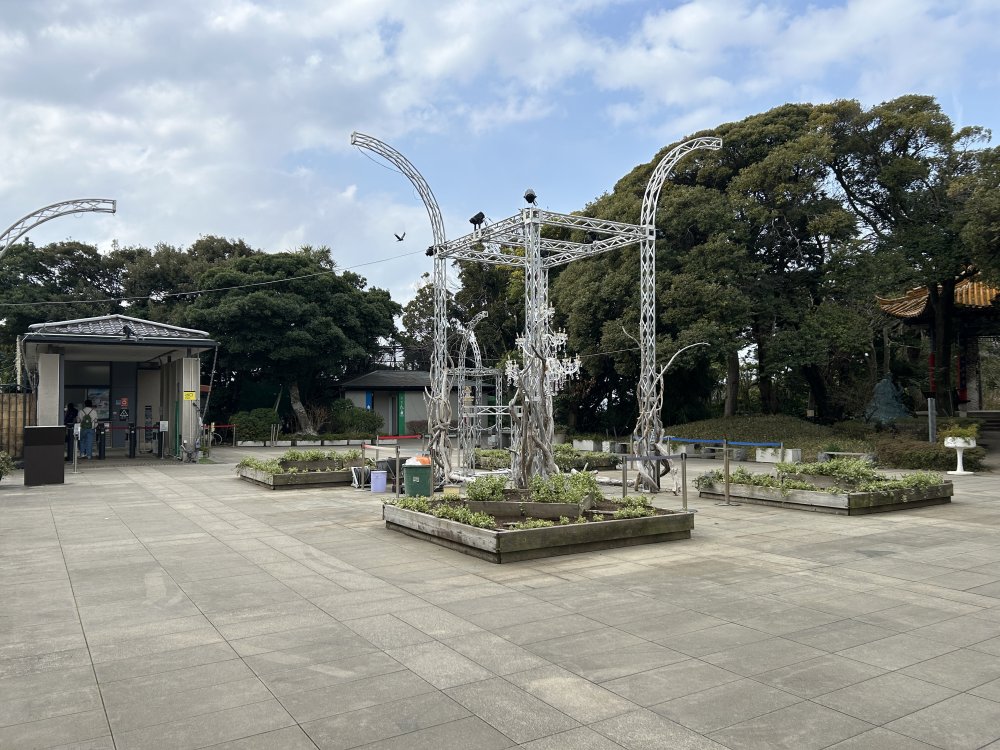
The area of Samuel Cocking Garden you first see after the admission gate
In the “Samuel Cocking Greenhouse Ruins Exhibition and Experience Hall,” built above the remains of the original greenhouse at Samuel Cocking Garden, materials relating to Samuel Cocking are displayed, including a chronological timeline of his life. Our guide pointed out that Cocking also appears to have purchased treasured objects that had been dedicated to temples as offerings and were in danger of being discarded during the anti-Buddhist movement that followed the Meiji Restoration. “At the very least,” he said, “it is fortunate that these items were saved from destruction.” One exhibit that particularly caught my eye was an old photograph of an elderly man. To my surprise, it was a portrait of Rokuroemon Sugiura VI, the founder of what is today Konica Minolta. At Cocking’s suggestion, Sugiura began handling materials for lithographic printing and photography—then cutting-edge technologies—and this eventually became the origin of the company. They say Sugiura was so struck by the clarity of the first photograph ever taken of him that it inspired him to enter the business. That very photograph was later donated and is now displayed here. Cocking also seems to have made other notable contributions, such as importing carbolic acid as a disinfectant during cholera outbreaks and attracting foreign residents from the international settlements in places like Yokohama to visit Enoshima.
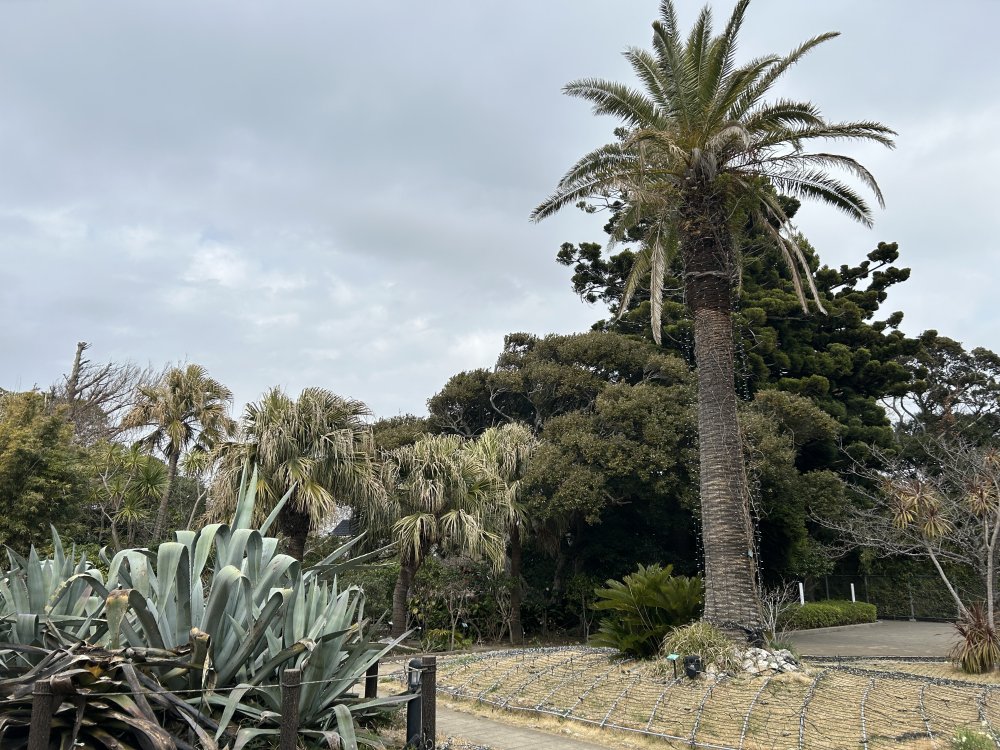
Cockings planted the garden with subtropical plants he brought from overseas, some of which still survive today.
Within Samuel Cocking Garden stands a 60-meter observation lighthouse popularly known as the Enoshima Sea Candle. The views from its observation deck are said to be spectacular at dusk, and it is also a major attraction when illuminated at night. On this occasion, however, we simply passed by and continued on toward our final destination—the Enoshima Iwaya Cave.
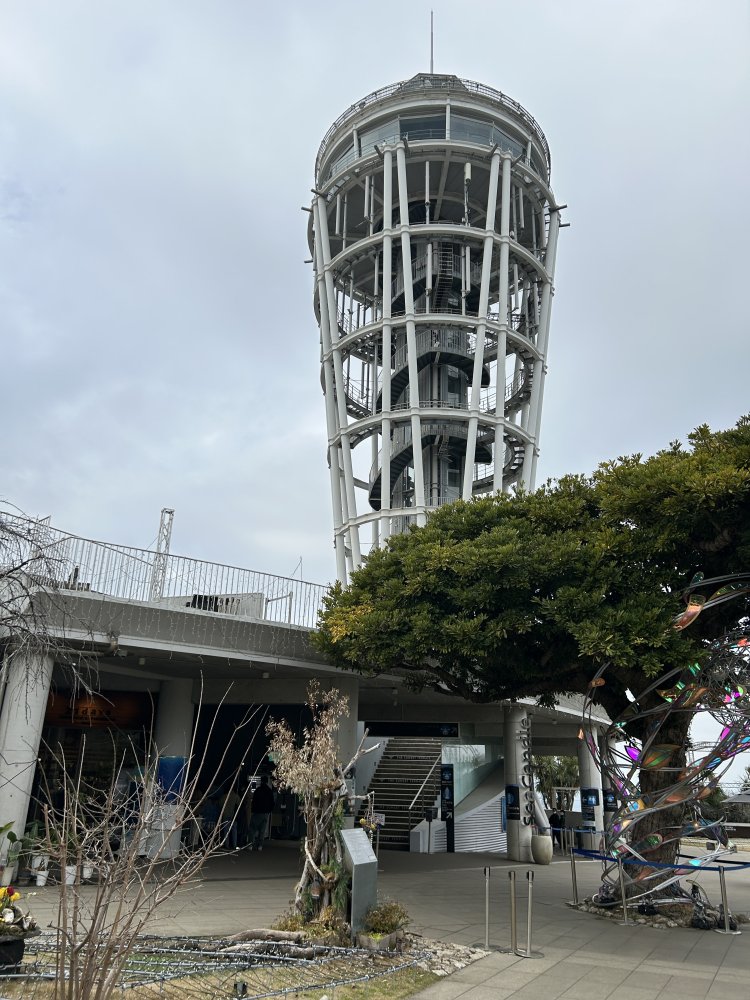
Within Samuel Cocking Garden stands a 60-meter observation lighthouse popularly known as the Enoshima Sea Candle.
continue to Enoshima Part 2
back to top page