
Rediscovering Japan
Rediscovering Japan
Travel (Matsumoto)
by tomizuta
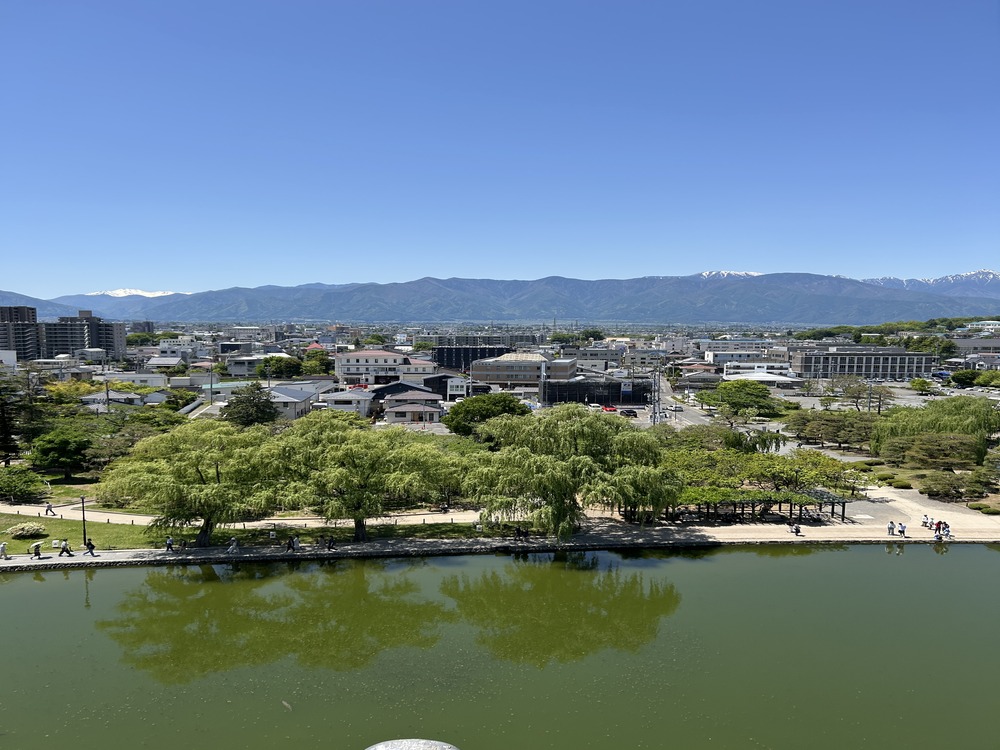
A wonderful westward view from the top floor of Matsumoto Castle, one of only twelve surviving original castle keeps remaining in Japan. The mountains visible in the background are the Northern Alps, and the white-capped peak in the left background is Mount Norikura.
In May 2026, we visited Matsumoto in Nagano Prefecture. Nagano is an inland prefecture surrounded by high mountains, and it is commonly divided into four regions: Hokushin in the north, Toshin in the east, Chushin in the center, and Nanshin in the south. Matsumoto belongs to the Chushin region. The city lies at an elevation of about 600 meters and has a population of roughly 230,000. It is best known for Matsumoto Castle, one of Japan's most important surviving castles and one of the country's National Treasure castles.
Map of Nagano Prefecture showing its four commonly used regional divisions: Hokushin, Toshin, Chushin, and Nanshin. Matsumoto is located in the Chushin region.
The area now known as Nagano Prefecture was historically Shinano Province. Matsumoto Castle developed on the site of an earlier fortress, and the castle town grew as the political center of the Matsumoto Domain. The castle reached its present form after Ishikawa Kazumasa, a former retainer of Tokugawa Ieyasu, became lord of Matsumoto in the late sixteenth century. Although many castle buildings in Japan were lost in the modern period, the main keep of Matsumoto Castle survived, making it one of the rare original castle keeps still standing in Japan.
Layout map of Matsumoto Castle, showing the main keep, the Honmaru and Ninomaru palace ruins, the Kuromon, and the Taiko-mon, from the official Matsumoto Castle website.
We parked on the north side of the castle and first entered the former Ninomaru area. A demonstration of traditional matchlock gun techniques was being held there. It was a reminder that Matsumoto Castle was not merely a beautiful historical building, but a military facility designed in the age of firearms.
A demonstration of traditional matchlock gun techniques was being held in the former Ninomaru area of Matsumoto Castle.
At the ticket counter, I found the electronic ticketing system rather difficult to use and eventually bought an ordinary paper ticket. From there we entered the Honmaru through the Kuromon, or Black Gate. The gate was reconstructed in 1960, but it still gives a strong sense of entering the central enclosure of the castle.
The Kuromon, or Black Gate, reconstructed in 1960, serves as the entrance to the Honmaru, the main enclosure of Matsumoto Castle.
After passing through the Kuromon, a straight path leads toward the castle buildings. The main keep stands in the center. On one side is the Inui Kotenshu, a smaller keep connected to the main structure, while on the other side are the Tatsumi Tsukeyagura and Tsukimi Yagura, later additions from the Edo period. The site of the former Honmaru Palace was on the right-hand side of the path in the middle of the picture, although only the site remains today.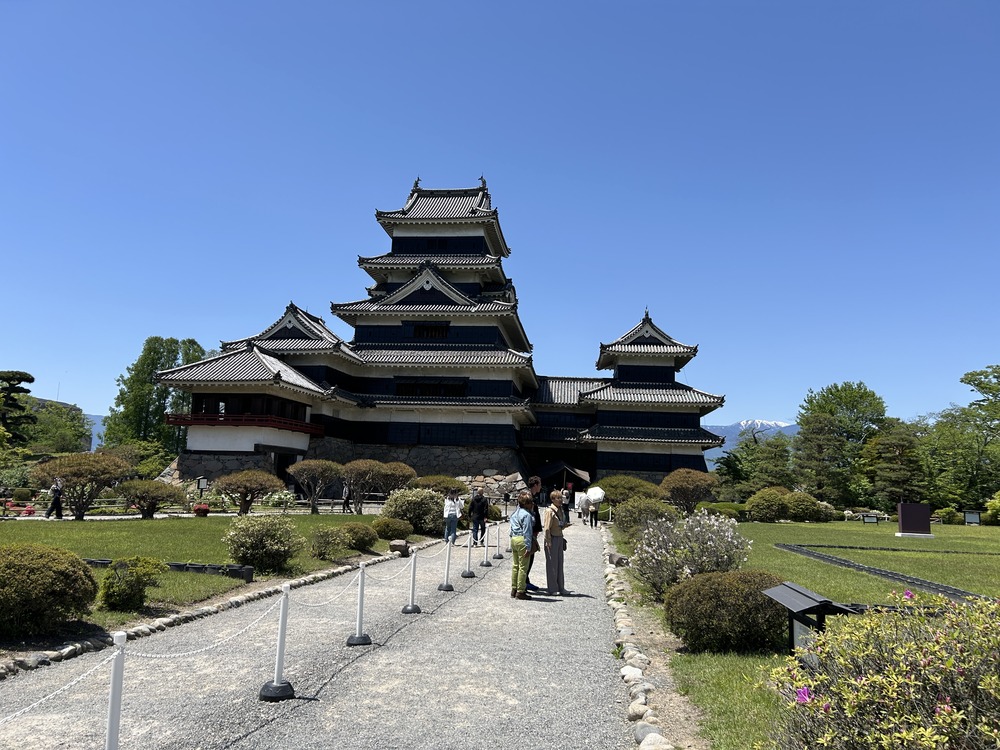
After passing through the Kuromon, a straight path leads toward the castle buildings. The main keep stands in the center, with the Inui Kotenshu to the right and the Tatsumi Tsukeyagura and Tsukimi Yagura to the left.
We entered the main keep, but unfortunately the Inui Kotenshu was closed to visitors. The Japanese explanation contained an interesting point that was not included in the English version. Although the small keep stands to the north of the main keep, it was called inui, meaning northwest, rather than north. This was because the Japanese word for north could suggest rebellion or defeat. The omission was understandable, since the point is rather difficult to translate concisely.
Unfortunately, the Inui Kotenshu was closed to visitors. The Japanese explanation says that, although the small keep stands to the north of the main keep, it was called inui, meaning northwest, rather than north, because the word for north could suggest rebellion or defeat. This point is omitted from the English explanation, probably because it would have been difficult to translate concisely.
The main keep is believed to have been completed around 1596 and is the oldest surviving five-tier, six-story castle keep in Japan. Inside, it functions almost like a museum, with displays on the structure of the building, weapons, and the life of the castle. Since visitors kept coming in one after another, it was difficult to stop in the narrow passageways to study the exhibits or take photographs slowly. Even so, the building itself was fascinating, and the view from the top floor was magnificent.
(Upper left) The explanations included building materials, such as the note that inside the stone base of the Main Keep were 16 tsuga (hemlock fir) pillars, each standing 5 meters high. (Upper right) The fifth floor, one floor below the top sixth floor, with the stairs leading up to the sixth floor on the right. (Lower left) Since visitors kept coming in one after another, it was difficult to stop in the narrow passageways to study the exhibits or take photographs slowly. (Lower right) The view from the top floor was magnificent.
The Tatsumi Tsukeyagura and Tsukimi Yagura were added in the early Edo period, after Japan had entered a more peaceful age. The Tsukimi Yagura, literally a moon-viewing turret, has a very different atmosphere from the older defensive parts of the castle. These later additions make Matsumoto Castle especially interesting, because they show both the military and the more peaceful ceremonial sides of castle architecture.
The view from the Tsukimi Yagura, or moon-viewing turret. Unlike the older defensive parts of the castle, the Tatsumi Tsukeyagura and Tsukimi Yagura were added in the early Edo period, after Japan had entered a more peaceful age.
After leaving the keep, we walked around the moat. I learned that the width of the moat was apparently designed so that a matchlock gun fired from the opposite bank would not quite reach the castle keep. This kind of practical defensive detail made the castle feel more real as a military structure.
After leaving the keep, we walked around the moat. The width of the moat was apparently designed so that a matchlock gun fired from the opposite bank would not quite reach the castle keep.
We had lunch on the south side of the castle and then came across the Taikomon, or Drum Gate. The gate was originally built around 1595, demolished in 1871 after the Meiji Restoration, and restored in 1999 after preservation work. Passing through it, visitors enter a masugata, a square-shaped defensive enclosure. This arrangement forced attackers to slow down and change direction, making the entrance easier to defend.
After passing through the Taikomon, visitors find themselves in a masugata, a square-shaped defensive enclosure with gates on two sides. Such a layout was designed to slow attackers and make the castle entrance easier to defend.
North of Matsumoto Castle stands the Former Kaichi School. In 1872, shortly after the abolition of the domains in 1871, the new Meiji government issued an education ordinance to establish a modern school system. Matsumoto, however, had already experienced severe anti-Buddhist policies under Toda Mitsunori, the last lord of the Matsumoto Domain, and many temples had been destroyed. One of them was Zenkuyin Temple, whose site was later used for the original Kaichi School. Zenkuyin Temple was later revived. Its website, which includes a rough English translation, states that Mitsunori ordered the destruction of Buddhist temples and images in the Matsumoto area.
Extracted from the English brochure of the Former Kaichi School. It provides a brief history of the school, together with a photograph of the building at its original location just south of Matsumoto Castle.
The Former Kaichi School building was completed in 1876. It served as an actual school for many years before being moved and restored in 1964, and it opened as an educational museum in 1965. In 2019, the building was designated a National Treasure. Although the exterior appears Western at first glance, the walls, including the lower part that resembles brickwork, are finished in plaster, and the building also includes Japanese features such as the traditional curved gable above the entrance, a feature related to the style seen in Karamon gates.
The Former Kaichi School building, completed in 1876 and designated a National Treasure in 2019. Although the exterior appears Western at first glance, it combines Western-looking details with Japanese elements, including the traditional curved gable above the entrance.
On the first floor, visitors can see corridors, classrooms, a staff room, and exhibits explaining the history of the school and the architecture of the building. The English explanations were helpful, and the displays made it easier to understand how a provincial city like Matsumoto adopted modern education in the early Meiji period.
The first floor of the Former Kaichi School includes corridors and exhibition rooms (left), as well as displays on the history of the school and the architecture of the building (right).
The second floor contains more exhibits on textbooks and other materials related to elementary school education. There is also a spacious lecture hall. I had expected the visit to be fairly short, but the building contained far more to see than I had imagined. Anyone interested in the history of education, architecture, or the early Meiji period could easily spend several hours there.
On the second floor, exhibits include textbooks and other materials related to elementary school education (left), and the spacious lecture hall shows another important part of the school building (right).
Near the Former Kaichi School stands another Western-style building, painted in a pale blue that makes it look quite different from the school building. From the outside, it gives a strong impression of Western architecture, with its wooden siding, shuttered windows, and small entrance porch. Inside, however, the rooms are quite modest. The simple furnishings and fireplace suggest that Western forms were being adapted to local needs, rather than copied as grand architecture. This contrast made the building interesting in a quiet way.
The pale blue Western-style exterior of the building (left) contrasts with its modest interior (right), where simple furnishings and a fireplace suggest how Western forms were adapted locally rather than copied as grand architecture.
Between the Former Kaichi School and Matsumoto Castle, we noticed a shrine that looked as if it must have a long history, so we decided to stop there. It was Matsumoto Shrine. As explained on the information board at the shrine, it has a close historical connection with Matsumoto Castle. The present shrine was created in 1953 by combining two shrines, Gosha and Wakamiya Hachimangu.
In Japanese castles, it was common to have a tutelary shrine, or chinju-sha, to pray for the protection of the castle and its buildings. Gosha originated from shrines connected with the ancestors of the Toda family. After the Toda family returned to Matsumoto as domain lords in the eighteenth century, shrines that had been located in Akashi and Mikawa and were dedicated to Toda ancestors were gradually moved to this site. Since five ancestors came to be enshrined here, the shrine became known as Gosha, literally "five shrines."
Wakamiya Hachimangu, on the other hand, originated as a tutelary shrine in the northeastern part of the Matsumoto Castle grounds. It enshrined warriors connected with the founding of the castle in the Sengoku period, and was moved to this location in the early twentieth century. It was impressive to see the two shrines standing side by side in a deep grove of trees, so close to the castle yet with a very different atmosphere.

Wakamiya Hachimangu (left) and Gosha (right), the two shrines that were combined in 1953 to form Matsumoto Shrine. Standing side by side in a grove of trees, they preserve different historical connections with Matsumoto Castle.
Our return visit to Matsumoto turned out to be a very rewarding trip.