
Rediscovering Japan
Rediscovering Japan
Travel (Kagawa Part 3 (Kotohira-gu))
by tomizuta

To reach the main shrine of Konpira Shrine, located halfway up 521-meter-high Mt. Zozu (meaning elephant head), visitors must climb 785 stone steps. It is not an easy ascent unless you are in reasonably good shape.
On the final day of our trip, we visited Kotohira-gu Shrine in the rain. The shrine principally enshrines Omononushi-no-kami. Before the anti-Buddhist movement of the early Meiji period separated Buddhism and Shinto, however, it had functioned as a temple centered around Konpira Daigongen, a deity worshipped through a fusion of Buddhism and Shinto. Konpira Daigongen originated from the Hindu crocodile deity Kumbhira, which was incorporated into Buddhism in China and eventually came to be worshipped in Japan as a protector of maritime transportation. For that reason, the shrine long attracted sailors, merchants, and others connected with seafaring. Perhaps because it was still early in the morning, the approach to the shrine was strikingly quiet compared with the lively atmosphere of the previous day. The stone stairway continues for 365 steps up to the Omon (“Grand Gate”) and 785 steps in all to the main shrine building.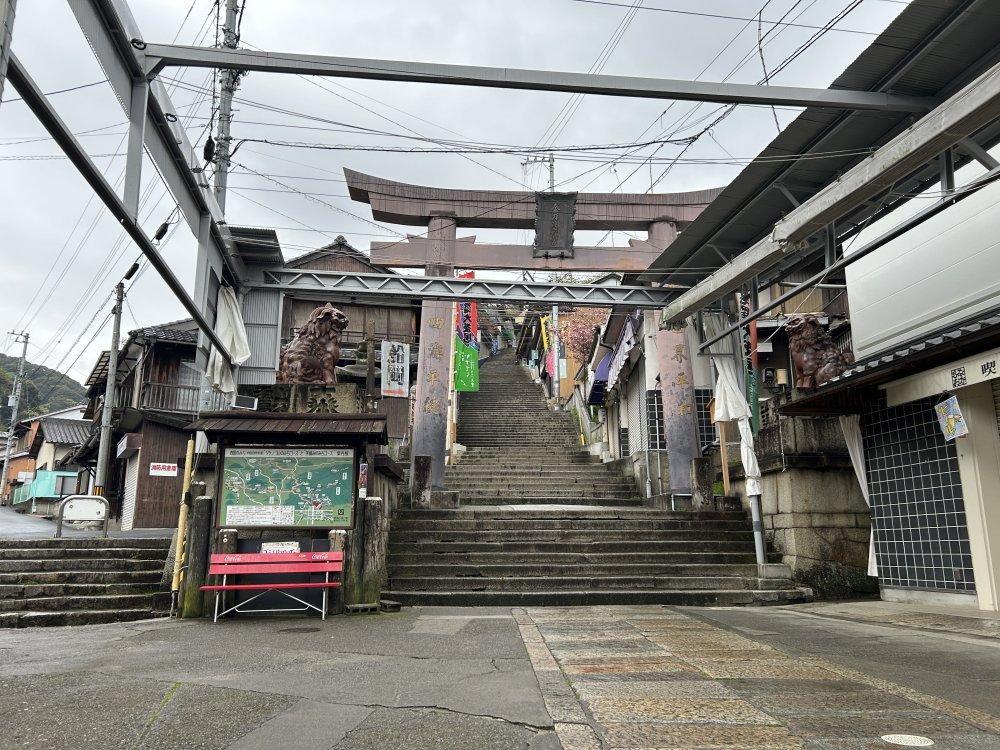
Perhaps because it was still early in the morning, the approach to the shrine was strikingly quiet compared with the lively atmosphere of the previous day.
There are also some noteworthy spots just before reaching the Omon (“Grand Gate”) of Kotohira-gu Shrine. The first thing that catches the eye is the Memorial to Minesweeping Casualties. Toward the end of the Second World War, more than 10,000 naval mines were laid by U.S. forces along the Japanese coast. This memorial was established to honor those who lost their lives in the postwar minesweeping operations and to pass on the memory of their achievements to future generations. The project was initiated by the mayors of numerous port cities throughout Japan.
This memorial was established to honor those who lost their lives in the postwar minesweeping operations (left). The signboard explaining the background of the memorial monument (right)
Climbing a few more steps toward Kotohira-gu Shrine, we came upon a bronze statue and a Japanese-style building. The statue is of Kotooka Hirotsune, who had originally served as the head priest of Konpira Daigongen when it was still a Buddhist temple complex. Following the government’s policy separating Buddhism and Shinto in the Meiji period, he transformed Konpira Daigongen into Kotohira-gu Shrine and oversaw the rebuilding of the main sanctuary as part of its conversion into a Shinto shrine. According to the explanatory plaque, Hirotsune also organized the Kotohirayama Hakurankai exhibitions, held in Kotohira in 1873 and 1879 to introduce Western science and technology. In his later years, as chief priest of Kotohira-gu Shrine, long associated with maritime faith, he founded Marine Rescue Japan , an organization that continues to this day supporting volunteer civilian rescuers responding to maritime accidents and providing emergency medical services for seafarers. Related historical materials are exhibited in the adjacent building. Together, the statue and exhibition vividly illustrate the shrine’s longstanding connection with maritime transportation as well as the historical transition from Buddhism to Shinto.
The statue of Kotooka Hirotsune (left), and the Japanese-style building exhibiting related historical materials (right).
We finally reached the Omon (“Grand Gate”) of Kotohira-gu Shrine. To my surprise, nearby stands the Kiyozuka, said to be the grave of Sei Shonagon, the celebrated female author of the Heian period. It was also the first time I had heard that Sei Shonagon is believed to have spent her later years in Sanuki. The site once again impressed upon me the long and layered history associated with Kotohira-gu Shrine.
To my surprise, nearby Omon stands the Kiyozuka, said to be the grave of Sei Shonagon, the celebrated female author of the Heian period.
The Omon (“Grand Gate”) of Kotohira-gu Shrine is said to have been donated by Matsudaira Yorishige, the first lord of the Takamatsu Domain. Warrior figures stand on either side of the gate, but the structure was probably originally a Nio-mon gate during the temple period, and the statues themselves appeared to be of comparatively recent date.
The Omon (“Grand Gate”) of Kotohira-gu Shrine said to have been donated by Matsudaira Yorishige, the first lord of the Takamatsu Domain (left). Warrior figures stand on either side of the gate (right)
Climbing further beyond the Omon (“Grand Gate”) of Kotohira-gu Shrine, we came upon a guide map of the shrine precincts directly ahead. This proved extremely helpful. Using it as our guide, we headed toward the Omote-shoin, an Important Cultural Property located to the right. On the way, we passed a charming statue of a dog. It commemorates the “Konpira dogs,” which are said to have made pilgrimages on behalf of owners who, for one reason or another, were unable to travel to the shrine themselves.
The guide map of the shrine precincts was extremely helpful (left). The Konpira dog (right)
The Omote-shoin of Kotohira-gu Shrine, designated an Important Cultural Property, was originally used to receive distinguished guests during the temple period. It is said to date from around 1660. Admission costs 800 yen, and I noticed some visitors turning back upon seeing the fee, but it is something well worth seeing. The sliding-door paintings by Maruyama Okyo, who flourished in the late 18th century, as well as the garden, deserve to be appreciated at leisure. Particularly famous are the paintings in the Tiger Room and the Crane Room.
The Omote-shoin (left). The sliding-door paintings of the Tiger Room by Maruyama Okyo is one of the many paintings well worth viewing (right).
Before reaching the next destination, the Asahi-sha of Kotohira-gu Shrine, we passed several other noteworthy structures, including the Mokuba-sha, which was also donated by Matsudaira Yorishige, the donor of the Omon (“Grand Gate”), and the Hono Ikazuchi Shrine, dedicated to the deities of fire prevention and firefighting (hono meaning “fire” and ikazuchi meaning “thunder”).
The Mokuba-sha donated by Matsudaira Yorishigeh (left). The Hono Ikazuchi Shrine, dedicated to the deities of fire prevention and firefighting (right).
The Asahi-sha of Kotohira-gu Shrine stands 628 steps up along the 785-step climb to the main shrine. Once reaching this point, the main sanctuary is not far away. Visitors are expected to pay their respects at the Asahi-sha after visiting the main shrine, and those ascending from below are directed to proceed one way to the right in front of the building toward the main sanctuary. Passing through the Sakaki-mon gate, said to have been donated by Chosokabe Motochika, who invaded Sanuki at the end of the Sengoku period (c.1580), we climbed the final straight stretch of 157 stone steps, passing several smaller shrines including the Masuga Shrine along the way.
(Left) The Sakaki-mon gate in the far back, said to have been donated by Chosokabe Motochika. (Right) Passing through the Sakaki-mon gate, the final flight of stone steps leading to the main shrine comes into view on the left. At the foot of the staircase stands a wooden signboard bearing the encouraging message in blue letters: “Just a little farther. 133 more steps to the main shrine! Climb and happiness will come to you!” On a stone pillar to the left is carved the inscription Ohyaku-do Ishi. In Japan there is a custom known as ohyaku-do mairi, in which worshippers are said to have their prayers answered if they make one hundred round trips between a designated point and the main hall of a shrine or temple. The ohyaku-do stone marks the starting point for those repetitions. Seeing it, I could not help wondering how many people over the centuries had climbed these 133 steps a hundred times in succession.)
The site of the main shrine of Kotohira-gu Shrine, standing 251 meters above sea level, was originally occupied by the main hall of a temple known as Matsuo-ji Konko-in. Following the government order separating Buddhism and Shinto, the original structure was remodeled and transformed into the present main shrine building, which was completed in 1878. According to the official website of Kotohira-gu Shrine, the date of the building’s original construction is unknown, although repeated enlargements and renovations are said to have been carried out from at least the 11th century onward. Despite the rain, many worshippers, including foreign visitors, had made the climb all the way up to the main shrine.
At last, I reached the main shrine of Kotohira-gu Shrine. I could not help but feel a quiet but unmistakable sense of accomplishment
To the left of the main shrine of Kotohira-gu Shrine stands the Gobetsu-gu auxiliary shrine. An explanatory plaque beside it states that the building was constructed in 1876, preceding the completion of the present main shrine. As is often the case at major shrines in Japan, Kotohira-gu Shrine periodically conducts sengu, the ceremonial rebuilding or renewal of shrine buildings. This grand rite is held once every 33 years, the most recent having taken place in 2004. Beside the sign for the Gobetsu-gu is another for the Miho-tsu-hime Shrine, which appears to enshrine the wife of Omononushi-no-kami, the principal deity of the main shrine. The main shrine and the Gobetsu-gu were designated Important Cultural Properties in 2024 as valuable examples illustrating the architectural transition associated with the separation of Buddhism and Shinto.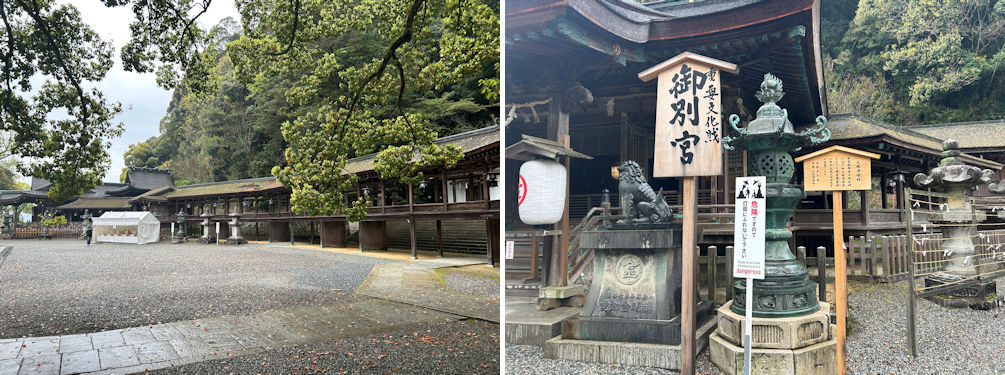
(Right) The right side of the Gobetsu-gu, with the two signs. (Left) The left side of the Gobetsu-gu.
After paying our respects at the main shrine and the Gobetsu-gu of Kotohira-gu Shrine, we descended the stone steps and returned once more to the Asahi-sha. This magnificent structure, completed in 1845 after forty years of construction, is the largest wooden religious building in Shikoku. It was designated an Important Cultural Property in 1982, even before the main shrine. As can be seen from the photograph, the building was originally constructed as a Buddhist temple hall enshrining Yakushi Nyorai, the Buddha of healing. After the transition to a Shinto shrine following the separation of Buddhism and Shinto, it came to enshrine Amenominakanushinokami together with all the gods of heaven and earth (yaorozu no kami), according to the official website of Kotohira-gu Shrine. Having completed our visit, we made our way back down the long approach. It had been a deeply rewarding visit, offering much to learn about the long history of the site and the complex transition brought about by the separation of Buddhism and Shinto.
The magnificent structure of Asahi-sha, completed in 1845 after forty years of construction, is the largest wooden religious building in Shikoku. It was designated an Important Cultural Property in 1982, even before the main shrine.
continue to Part 4 (Manno/Takamatsu)