
Rediscovering Japan
Rediscovering Japan
Travel (Takamatsu (Kagawa)) Part 1
by tomizuta

Ritsurin Garden makes masterful use of Mt. Shiun as borrowed scenery.
In early April 2026, I traveled to Kagawa Prefecture on a two-night, three-day trip. The main purposes were to attend a Kabuki performance at the Konpira Grand Theatre (Kanamaruza) and to visit Ritsurin Garden, which I had long wished to see as part of my ongoing exploration of Japanese gardens over the past couple of years. Ritsurin Garden is one of only nine gardens in Japan designated as both a Special Place of Scenic Beauty and a Special Historic Site. In addition, apart from having once used Takamatsu Airport in the past, I had had virtually no prior connection with Kagawa Prefecture. I therefore planned an itinerary that also included a visit to Marugame Castle, regarded as one of Japan’s most notable castles, and to Manno Pond, the largest irrigation reservoir in Japan associated with Kukai.
Note: Kukai (774–835): A Buddhist monk of the early Heian period, when Japan’s capital moved to Kyoto. After studying in Tang China, he introduced esoteric Buddhism to Japan and became the founder of the Shingon school. The temple complex of Kongobu-ji on Mount Koya, which he established, is part of the UNESCO World Heritage site “Sacred Sites and Pilgrimage Routes in the Kii Mountain Range.” In recognition of his wide-ranging cultural and educational contributions, he was posthumously given the honorific name Kobo Daishi. After his death, stories of his deeds took on a legendary character, giving rise to popular devotion to Kobo Daishi. The Shikoku pilgrimage—visiting 88 sacred sites associated with him—spread rapidly from the late 17th century as a journey undertaken to follow in his footsteps, offer prayers, or reflect on oneself.

Map of the main areas of Kagawa Prefecture covered on this trip. The places visited are highlighted in yellow; Ritsurin Garden is indicated by the yellow mark below Takamatsu.
I flew from Haneda Airport and arrived at Takamatsu Airport shortly after noon, then set off in a reserved rental car. At about 1,900 square kilometers, Kagawa Prefecture is the smallest prefecture in Japan. Incidentally, this region has been known as Sanuki since around the 8th century. It became Kagawa Prefecture in 1888, making it the last of Japan’s 47 prefectures to be established in its present form. The main sights are scattered across the prefecture, so a rental car is an effective way to get around efficiently. As I planned to attend a Kabuki performance at the Konpira Grand Theatre (Kanamaruza), I booked a hotel in Kotohira for the second night, and one in Marugame for the first. From the airport, it was about a 15-kilometer, 30-minute drive to my first destination, Ritsurin Garden.

Map of Ritsurin Garden on their brochure. I started from the North Gate on the top right, went across the North Garden to the East Gate on the center bottom, and basically followed the South Garden recommended course.
The website of Takamatsu City describes Ritsurin Garden as follows: “Ritsurin Garden originated in the mid-Kanei era (around 1631), when the Ikoma family developed the area around the South Pond based on a garden belonging to the Sato family, local lords of the region. After the Matsudaira family took control in 1642, they spent more than 100 years over five generations expanding and refining the garden, completing it in 1745. The garden was used as a suburban residence by the Matsudaira family for 228 years across 11 generations. It was transferred to the prefectural government and opened to the public on March 16, 1875. The garden is divided into the South Garden and the North Garden: the South Garden, dating from the early to mid-Edo period, is a superb example of a stroll-style daimyo garden with carefully designed landforms and stone arrangements, while the North Garden was created during the Genroku era (1688–1704) and used as a duck hunting ground, later undergoing modern renovations from the late Meiji to early Taisho period.”

The parking lot by the East Gate was full, and we had no choice but to park near the North Gate in the North Garden.
Even excluding the surrounding borrowed scenery, the flat area of Ritsurin Garden alone covers 160,000 square meters—more than twice the size of Koishikawa Korakuen, which is about 70,000 square meters. The garden’s website recommends a model course starting from the East Gate and circling the South Garden, so we initially headed for the East Gate to follow that route. However, the parking lot there was full, and we had no choice but to park near the North Gate in the North Garden. After paying the 500-yen admission fee at the North Gate entrance, we made our way briskly through the North Garden and reached the East Gate area. The East Gate’s formal name is Kitte-gomon, which served as the official entrance for invited guests bearing a “kitte,” or invitation letter.

We made our way briskly through the North Garden and reached the East Gate, which is the starting point of the South Garden Recommended Course. The East Gate’s formal name is Kitte-gomon, which served as the official entrance for invited guests bearing a “kitte,” or invitation letter.
Next, we headed to the Shoko Shoreikan. This charming wooden structure, symmetrically designed in the style of Byodo-in, was built in 1899 on the site of the former Hinoki Goten, a villa of the feudal lord, as the Kagawa Prefectural Museum. It was renamed Shoko Shoreikan in 1938. The building is laid out in a corridor style, allowing visitors to walk around it in a continuous loop. It includes a spacious reception hall, which is now used for various events and MICE functions.

The Shoko Shoreikan, literally meaning a facility for the promotion of commerce and industry, was originally intended to showcase Kagawa Prefecture’s traditional crafts and other local products to a wider audience.
Leaving the Shoko Shoreikan and heading south, we soon arrived at the South Garden of Ritsurin Garden. Despite its name—often translated as “Chestnut Forest Park”—there are no chestnut trees to be seen; instead, the true stars are some 1,700 pine trees that have been meticulously tended over the centuries. The garden was apparently called “Ritsurin” (chestnut forest) in the 17th century, but the origin of the name remains unclear. We decided to follow the South Garden walking route indicated in the brochure and marked by signposts throughout the garden. The first spot we visited was the Tsurukame Matsu. According to the explanation board, “a crane (tsuru)-shaped black pine is arranged atop a rock formation composed of 110 stones representing a tortoise (kame), creating what is considered the most beautiful pine in the garden.” Incidentally, all the signboards in Ritsurin Garden are written in both Japanese and English, making them very accessible for international visitors. The English descriptions, however, are generally shorter and less detailed than the Japanese text.

In Japanese gardens, stone arrangements inspired by Taoist immortality beliefs—such as Mount Horai, Crane Island, and Tortoise Island—have long been featured, symbolizing wishes for longevity and eternal youth. Pine trees, being evergreen, have likewise been regarded as auspicious. Here, the crane, tortoise, and pine appear together in a single composition.
Following the route, we next proceeded west along the northern side of the Hokko (North Pond) in Ritsurin Garden. The garden contains six ponds, and although Hokko is not the northernmost of them, the name is thought to derive from the fact that it is the northernmost pond within the South Garden. The tall pines on the north side are known as Byobu-matsu (Screen Pines), while the lower pines on the south side are called Hako-matsu (Box Pines). Although it was clear that the pine trees had been meticulously maintained, I must admit I could not tell which was which.

The tall Folding Screen Pines and the low Box-shaped Pines. Although it was clear that the pine trees had been meticulously maintained, I must admit I could not tell which was which.
Continuing along the route on the western side of the Hokko (North Pond) in Ritsurin Garden, we came to two noted features: the “Mikaeri-jishi” (Backwards Turned Lion) and the “Botan-ishi” (Peony Stone). During the peaceful Edo period, feudal lords are said to have competed in collecting unusual rocks. This one, too, was likely presented by a local subject, perhaps in expectation of some form of favor in return. While I could vaguely recognize the Backwards Turned Lion, the Peony Stone remained elusive to me.

I think you can make out the Backwards Turned Lion..
It was a Monday, and unfortunately the atmospheric teahouse Higurashi-tei (literally, “a place where one could spend the whole day”)—open only on weekends and public holidays—was closed. As I will mention later, there is also a Kyu Higurashi-tei within the garden. The Kyu-Higurashi-tei (meaning the former or original Higurashi-tei) dates back to the Edo period, whereas the present Higurashi-tei was built in 1898. At the time of its construction, the original Higurashi-tei had been relocated outside the garden; however, when it was moved back into the grounds in 1945, it came to be known as the “former” Higurashi-tei. Passing by the teahouse, we continued on to a man-made hill called Kaisengan in Ritsurin Garden. According to the sign at its base: “The bold stone arrangement of the hill Kaisengan, overlooking the West Pond, was once even larger, and old drawings suggest it evoked a gathering place of immortals. From here, one can enjoy views of scenic features such as the Sekiheki Wall (Red Cliff) and the Ranka Sekioku Cave.” Climbing to the top, I found that the view was indeed impressive, and the atmosphere noticeably different.

The steps leading up to the man-made hill of Kaisengan (left). The view from the top was indeed impressive, and the atmosphere noticeably different. (right)
Proceeding further, I stood before the Sekiheki (Red Cliff) in Ritsurin Garden and felt a sense of refreshment at the bold, naturalistic composition. The explanatory sign reads: “The stone wall that supports the richly natural scenery of the West Pond is called Sekiheki (Red Cliff). It is named after the famous scenic site on the left bank of the Yangtze River in China, known for the poet Su Shi, who composed the ‘Ode on the Red Cliff.’”

Proceeding further, I stood before the Sekiheki (Red Cliff) in Ritsurin Garden and felt a sense of refreshment at the bold, naturalistic composition.
Following the route south along the eastern shore of the West Pond in Ritsurin Garden, we passed by the Kyu-Higurashi-tei. This teahouse, built some 400 years ago, has been relocated both within and outside the garden over time, before being moved to its present location in 1945. According to the information board, this was not its original site; it once stood on nearly the opposite side of the garden, in the southeastern area. It is open to the public only on weekends and public holidays. Its appearance is full of rustic charm. Although it was still a little early in the season for flowers, the presence of a wisteria trellis was also striking.

The Kyu (original) Higurashi-tei tea house was built 400 years ago (left). The presence of a wisteria trellis was also striking. (right)
Continuing along the West Pond in Ritsurin Garden, a waterfall on the opposite shore caught my eye. It is an artificial waterfall, said to have been named the Okedoi Waterfall because water was once carried by hand to a tub (oke) halfway up the hill and then channeled down through a wooden conduit (toi). Today, it appears that water is pumped up from the pond and circulated. The scenery changes constantly, and I felt that considerable ingenuity had gone into ensuring that visitors never lose interest.

This an artificial waterfall, said to have been named the Okedoi Waterfall because water was once carried by hand to a tub (oke) halfway up the hill and then channeled down through a wooden conduit (toi).
It had been about one hour since entering from the North Gate when I reached this point, and I was beginning to feel a bit tired. Just then, I came upon the teahouse Kikugetsu-tei in Ritsurin Garden. According to the explanation board, “Located at the focal point of the South Garden, this sukiya-style shoin building, designed to be viewed from all four sides, serves as the central facility of the stroll garden.” A serving of matcha with sweets, including the admission fee to the teahouse, costs 800 yen. After enjoying the matcha, what one should not miss is the view of the garden from the large tatami room at the southern end of the teahouse. Sitting on the engawa (a wooden veranda running along the edge of the building,) the view feels almost as if one were looking out from a boat. Although there was no detailed explanation of the building itself, it appears to have a history of at least 300 years. It is said to be a structure incorporating numerous architectural devices that anyone involved in Japanese architecture would wish to see at least once.
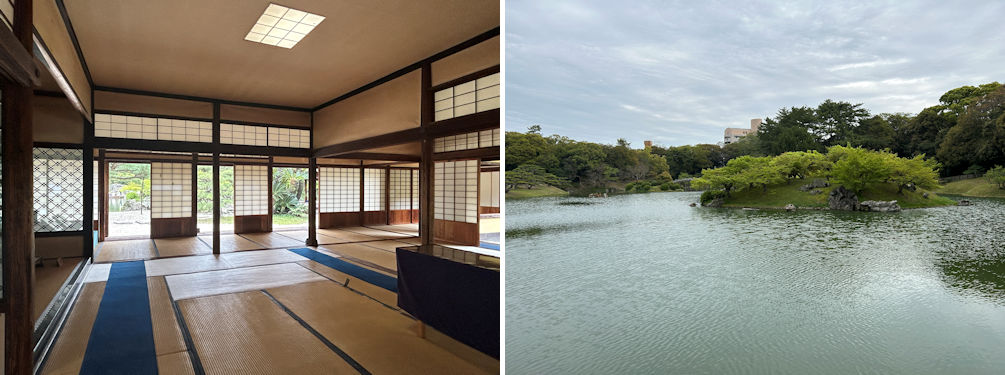
The large tatami room (left) and the view you enjoy at the very end (right).
After a short rest and taking in the view from the main tatami room, we resumed the walking route. Passing Kikugetsu-tei, we reached the southwesternmost part of the South Garden in Ritsurin Garden, where the West Pond comes to an end. Across the water stands a stone-built hill known as Shofuda. The garden’s brochure describes it as “a hill constructed using stone arrangement techniques from the Muromachi period, the oldest in the garden and said to mark the place where Ritsurin Garden began.” According to the official website of the Kagawa Prefecture Tourism Association, the origins of Ritsurin Garden date back to the late 16th century, during the Genki–Tensho era, when the local Sato clan created a garden in the southwestern area (around Shofuda). Later, in the Kanei period (1630s), Ikoma Takatoshi, then lord of Sanuki Province, developed the area around the South Pond, forming the prototype of the present garden. (Unfortunately, this portion is omitted in the association’s English materials.) The English-language pamphlet for Ritsurin Garden states that the hill was created “using a technique developed around the year 1400,” but this appears to be inaccurate; the late 16th century is more likely correct. The stone arrangements also seem comparable to those found at the garden remains of the Ichijodani Asakura Clan Ruins from the same period.

This hill constructed using stone arrangement techniques from the Muromachi period, appears to be the oldest part in the garden probably dating back to the late 16th century.
Boat rides are available on the South Pond in Ritsurin Garden, and thinking we might just catch the last departure, we picked up the pace. Heading east along the pond, we arrived at the Hien-gan Rock Arrangement, located at the southeasternmost edge of the garden. This is the largest stone arrangement in the garden and is said to incorporate techniques used in castle construction. The view from here is quite impressive.

Boat rides are available on the South Pond in Ritsurin Garden (left). Hien-gan Rock Arrangement, located at the southeasternmost edge of the garden is the largest stone arrangement in the garden (right).
The view from around here is outstanding. Overlooking the South Pond of Ritsurin Garden, including the wooden bridge known as Engetsu-kyo, this scene is described in the garden’s pamphlet as “the place in the garden in which the most effort has been taken to create a rich sense of artistry.”
Overlooking the South Pond of Ritsurin Garden, including the wooden bridge known as Engetsu-kyo.
Ticket sales for the boat ride had already ended, so we had no choice but to leave it for another visit. Before heading back to the North Gate, we looked up at the mountains to the west—the approximately 200-meter-high Mount Shiun, which forms part of the garden’s borrowed scenery. I was struck by how seamlessly it blends with Ritsurin Garden. Having visited a number of gardens, I felt that Ritsurin Garden truly stands at the pinnacle of daimyo gardens. With a sense of satisfaction from a rewarding visit, we set off for our overnight destination in Marugame, hoping to return again someday.

I looked up at the mountains to the west—the approximately 200-meter-high Mount Shiun, which forms part of the garden’s borrowed scenery. I was struck by how seamlessly it blends with Ritsurin Garden.
continue to Part 2 (Marugame/Tadotsu/Kotohira)